Concentrated Liquidity: What a Price Range Actually Does
A narrow range earns more per dollar and stops earning sooner. The trade is not complicated, but almost nobody prices both halves of it.
The short answer
Concentrated liquidity lets a provider choose the price range their capital works in. Inside the range it earns a far larger share of fees than the same money spread across all prices; outside it, the position is entirely one asset and earns nothing. Narrowing multiplies both the fee rate and the chance of being switched off.
In the original automated market maker design, a provider's capital was spread across every price from zero to infinity. Almost all of it sat at prices that would never occur, doing nothing. Concentrated liquidity fixed that by letting you say where your money should work, and it turned providing liquidity from a passive deposit into a position with a view.
What a range means mechanically
You pick a lower and an upper price. Between them, your capital behaves like a normal pool position and collects a share of the fees on every trade that crosses your range, proportional to how much of the liquidity at that price is yours.
Because your money is not spread thin across prices nobody trades at, your share at the prices that do occur is much larger. That is the entire source of the extra yield. It is not a bonus – it is the same fees, divided among fewer dollars.
The part that is easy to underprice
When the price leaves your range, the position converts entirely into whichever asset is now the cheap one, and it stops earning. Not less – nothing. It sits there, fully in one asset, until the price comes back or you do something.
Capital efficiency, and why the number flatters
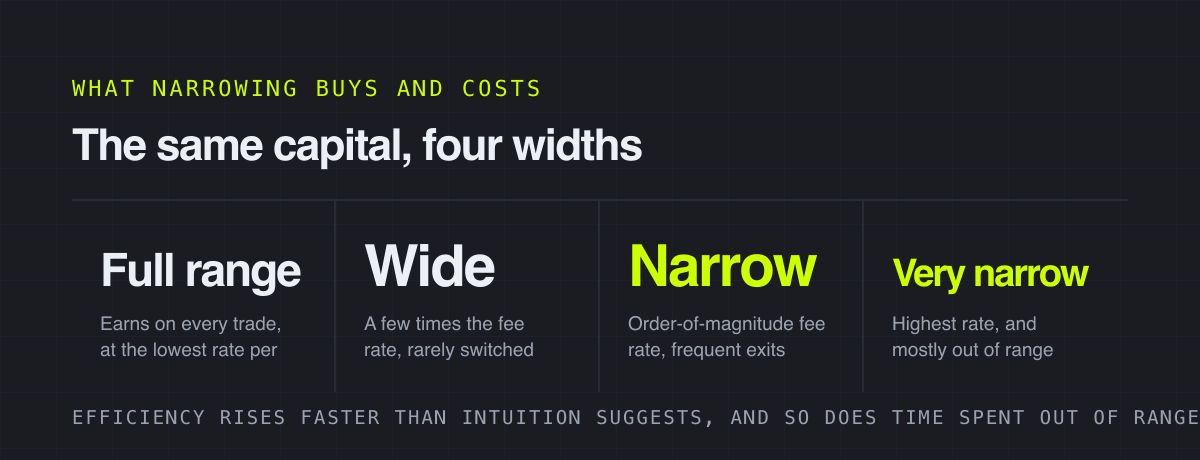
The efficiency multiple from narrowing grows quickly – halving a range does considerably more than double the fee rate. Marketing quotes that multiple and stops there, which is where the misunderstanding starts. The multiple describes the rate while you are earning, and says nothing about what fraction of the week that is.
A position earning ten times the rate for a fifth of the time is not earning ten times. Working out which side you are on requires two numbers: how wide the range is, and how volatile the pair is. The first you choose; the second you do not.
| Range width | Fee rate while in range | Time in range | Attention needed |
|---|---|---|---|
| Full | Lowest | Always | None |
| Wide | Higher | Most of the time | Occasional |
| Narrow | Much higher | Sometimes | Constant |
| Very narrow | Highest | Briefly | More than it pays |
Impermanent loss does not go away
Concentrating does not remove divergence loss, it sharpens it. Inside a narrow range the conversion between the two assets happens over a smaller price move, so the same percentage change in price rearranges more of your position. The fees are meant to pay for that, and sometimes they do.
The only way to know is to compare the position's value against simply holding the two assets. That comparison is what the impermanent loss calculator on this site does, and it is worth running before opening a position rather than after closing one.
Who should use a narrow range
- Pairs that genuinely mean-revert, where leaving the range is temporary rather than terminal.
- Providers who will actually rebalance, rather than intending to.
- Positions large enough that the gas cost of adjusting is not a meaningful share of the fees.
- Anyone using a manager –
 Arrakis Finance and Gamma exist to move the range for you, at a fee.
For everyone else, a wider range with a lower headline rate usually beats a narrow one that spent most of the month switched off. The comparison people fail to run is not between two ranges. It is between their range and having held the two tokens and done nothing.
Tools mentioned
FAQ
What is concentrated liquidity?
A design where a liquidity provider chooses the price range their capital operates in, rather than spreading it across all possible prices. Inside that range the capital earns a much larger share of fees; outside it, the position earns nothing.
Is a narrower range always better?
No. Narrowing raises the fee rate while you are in range and reduces how long you stay there. A very narrow position can earn a spectacular rate for six hours and nothing for the rest of the week.
What happens when the price leaves my range?
The position converts fully into one of the two assets – whichever is now the cheaper one – and stops collecting fees entirely until the price returns or you move the range.
Does concentrated liquidity reduce impermanent loss?
The opposite. Concentrating means the same price move rearranges more of your position, so divergence loss is sharper within the range. The higher fee rate is the compensation, and whether it is adequate depends on the pair.
More from the blog
Tracking Whale Wallets Without Mistaking Size for Skill
A large balance is evidence of a large balance. Whether it means anything about the next trade is a separate question, and usually the answer is no.
Wallet Tracking You Will Actually Read
Everyone sets up alerts. Almost nobody survives the second week, because the setup was designed to catch everything.
Risk-Reward on a Token With No Floor
The ratio assumes you know where you get out. On a DEX with no stop loss, half the formula is missing – and it is the half that matters.