Tokenized Bonds Beyond Treasuries: Credit, Coupons and Who May Hold Them
A tokenized treasury is a short government loan with no credit question. Everything else in the bond market has one, and it changes the product.
The short answer
Tokenized bonds cover everything from short government paper to corporate and municipal debt. Treasuries are the easy case: no credit risk and a daily price. Everything else adds a borrower who can default, coupons that have to reach holders somehow, and transfer restrictions written into the contract.
Tokenized treasuries are the part of RWA that plainly works: a short loan to a government, a price that updates daily, and a yield with no opinion attached. The rest of the bond market is much larger and much less tidy, and the differences are worth being specific about before treating the two as one category.
The borrower can fail
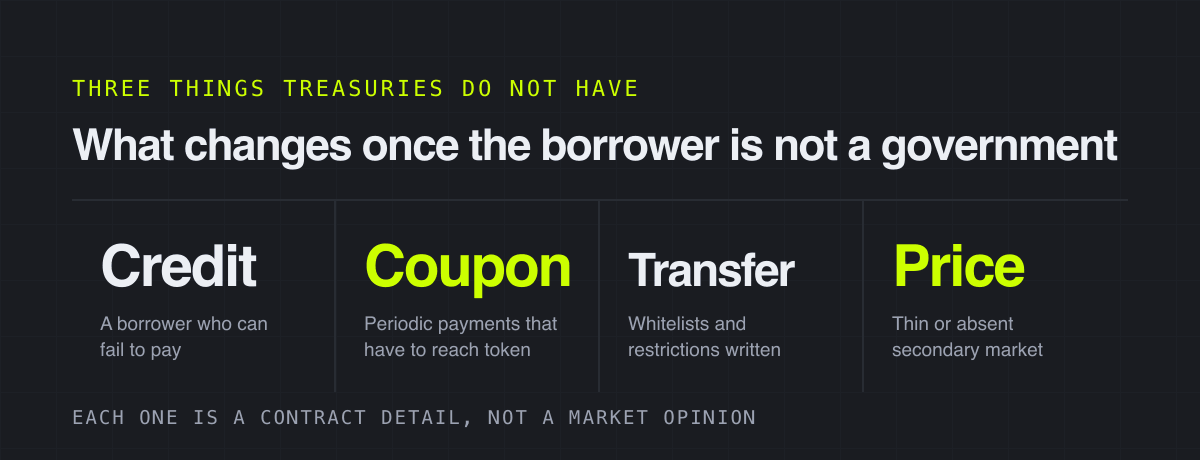
That is the whole difference in one sentence. A treasury's yield compensates you for time. A corporate bond's yield compensates you for time and for the chance the company does not repay. The second part is priced by a credit market, badly sometimes, and tokenizing the instrument does not improve that pricing.
Which means the yield gap between a tokenized treasury product and a tokenized corporate one is not an opportunity. It is a description of the risk you are being asked to take.
Coupons have to get to you somehow
Most bonds pay periodically. A token has to represent that, and issuers solve it in different ways: minting additional tokens, adjusting a balance, letting the price accrue, or paying a separate stablecoin distribution. Each has different tax and accounting consequences and different failure modes, and the documentation is the only place the answer lives.
The token may decide who can hold it
Debt securities come with rules about who may own them, and tokenized versions enforce those rules in the contract. That usually means a whitelist: transfers only between approved addresses, with an identity check to get on the list.
This is not a flaw – it is what makes the instrument legal – but it has a consequence people discover late. A token that can only move between approved wallets cannot be sold into a public pool, which means its liquidity is whatever the issuer's redemption window provides. Open the contract on  Blockscout Explorer and look for the transfer restrictions before you assume otherwise.
| Tokenized treasuries | Corporate and other bonds | |
|---|---|---|
| Credit risk | Effectively none | The main risk |
| Pricing | Daily, from a deep market | Often modelled or infrequent |
| Coupon handling | Usually accrual in price | Varies by issuer, materially |
| Transfer | Sometimes restricted | Usually whitelisted |
| Exit | Redemption, often daily | Redemption window, or nothing |
What to check
- Identify the borrower and whether the debt is rated. No rating is not disqualifying, but it means you are doing the credit work.
- Find the coupon mechanism in writing – new tokens, rebasing balance, accrued price or separate payment.
- Read the transfer restrictions in the contract rather than in the marketing.
- Establish the exit: a redemption window with notice, or a secondary market with depth. Ideally both.
- Check the category's size on
 DefiLlama RWA. A product nobody else holds has not been stress-tested either.
Where this leaves you
Tokenized fixed income is one of the few parts of this market where the onchain version is a real improvement – faster settlement, smaller minimums, a position you can see. That is true of treasuries and true of credit.
What is not true is that the token changes the instrument. A corporate bond onchain is a corporate bond, with the same borrower, the same coupon and the same thing that happens if the company stops paying. The blockchain part is the plumbing, and the plumbing was never the risky bit.
Tools mentioned
FAQ
What are tokenized bonds?
Debt instruments issued or represented as tokens on a blockchain – government, corporate or municipal. The token records who holds the claim; the underlying borrowing arrangement is unchanged.
How are tokenized bonds different from tokenized treasuries?
Treasuries carry effectively no credit risk and have a deep daily-priced market behind them. Corporate and municipal bonds add a borrower who can default, coupon mechanics that vary by issuer, and usually a thinner or absent secondary market.
How do coupon payments work on a tokenized bond?
It depends on the issuer. Common approaches are minting additional tokens, adjusting holders' balances, letting the interest accrue in the token's price, or paying a separate stablecoin distribution. The documentation is the only reliable source.
Can anyone buy tokenized bonds?
Often not. Many carry transfer restrictions enforced in the contract, so the token can only move between whitelisted addresses after an identity check. That restriction is also why such tokens usually cannot be sold into a public liquidity pool.
More from the blog
Tokenized Private Credit: The Yield Is Someone Else's Loan
The highest yields in RWA come from the part with no public market, no daily price and no easy exit. That is not a coincidence.
Tokenized Commodities: What Is Behind the Barrel
Gold sits in a vault. Oil does not sit anywhere convenient, which is why almost every oil token is a fund and not a barrel.
Tokenized ETFs: A Wrapper Around a Wrapper
An ETF is already a basket you do not hold directly. Tokenizing it adds a second layer, and the second layer is where the differences live.