Robinhood Chain Ecosystem: Every Project Category That Matters
Day-one partners, the launchpad wave, and the AI-agent layer nobody expected.
The short answer
The Robinhood Chain ecosystem breaks into five layers. Infrastructure came first: Alchemy for RPC, Chainlink for oracles and CCIP, LayerZero for bridging, BitGo and Fireblocks for custody. Trading is led by Uniswap for spot, with Lighter and Arcus for perps and Rialto as a PropAMM venue. Lending is dominated by Morpho. On top of that sits a launchpad layer of 15+ venues led by PONS, and an AI-agent layer — Virtuals, VEX, Otto and others — that emerged faster here than on comparable chains. Chain TVL has run past $1.6 billion.
Robinhood Chain is an Arbitrum Orbit L2 attached to a brokerage with more than 23 million customers. That distribution explains why its ecosystem filled out in weeks rather than quarters. Here is the map, by layer.
Layer 1: infrastructure
The chain shipped with named partners rather than waiting for them. Alchemy is the recommended RPC provider and also supplies the Data API and gasless transaction infrastructure; QuickNode, Blockdaemon, dRPC and Validation Cloud also support the chain. Chainlink provides price feeds, Data Streams and CCIP messaging. LayerZero handles omnichain bridging. BitGo and Fireblocks cover institutional custody, Allium and Entropy Advisors cover analytics, and TRM Labs handles compliance.
Layer 2: trading
Uniswap is the primary public liquidity venue with v2, v3, v4 and UniswapX. Pleiades runs a proprietary AMM for prop trading; Rialto operates a PropAMM-driven spot exchange supporting 25+ stock-token markets. For leverage, Lighter runs a ZK perp DEX and Arcus — from dYdX Labs with Robinhood Crypto — covers perps across crypto and stock tokens.
Layer 3: lending and yield
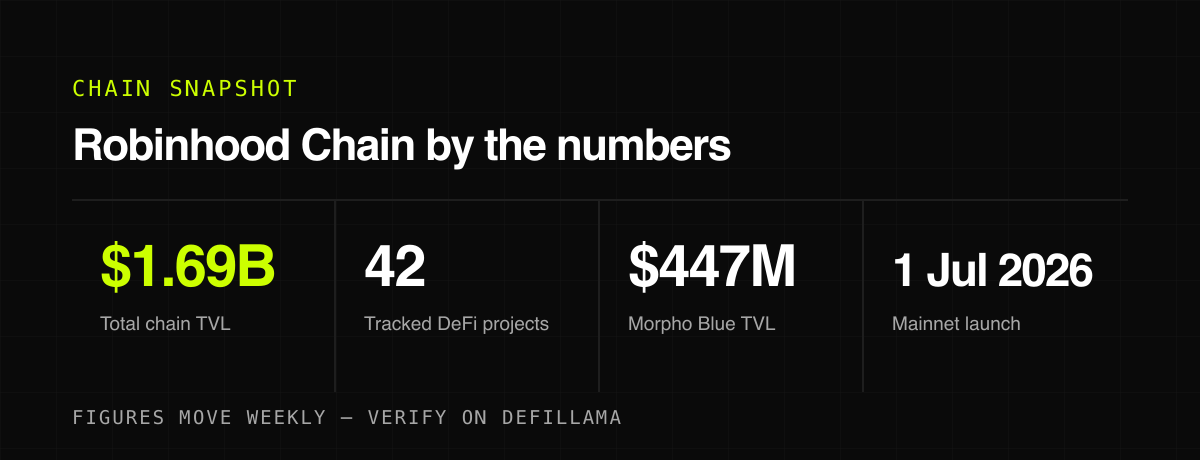
Morpho is the main lending market and the largest single TVL holder on the chain, crossing $300 million in deposits within three weeks. Morpho Blue alone has shown $447 million in TVL. It also powers Robinhood Earn's ~7% USDG product inside the Robinhood app, which is the clearest example of the chain's design thesis: on-chain infrastructure serving an app-layer product used by people who never touch a wallet.
Spark, Steakhouse Financial and Ripe Protocol fill out the yield layer, with Ripe bringing multi-collateral borrowing against stock tokens.
Layer 4: launchpads
This layer did not exist in the original plan and is now one of the busiest. PONS leads with 167,000+ tokens and roughly $4 billion cumulative. Around it: hood.fun, pools.trade from Uniswap Labs, Long and Bankr for stock-paired launches, Flap, BasedOneX, Klik, Launchhood, bow.fun, RobinFun, Quiver, Stoxes and Circus Trade. They compete on fee models, creator payouts and RWA integration rather than on technology.
Layer 5: AI agents
The surprise. Robinhood announced agentic trading — letting eligible US users connect AI agents to dedicated accounts — and the ecosystem ran with it. Virtuals became a leading launchpad for agent tokens, with 2,400+ agent launches. VEX, Otto AI, Sleuth, Moby and Hyperium built agent-facing tooling. Several protocols now expose MCP servers so agents can query chain data or trade tokenized stocks directly from a chat interface.
Where to track it
- Official ecosystem page — robinhood.com/chain lists partners by category and is the least noisy source.
- DefiLlama — chain TVL and protocol breakdown, updated continuously.
- growthepie — network activity, TPS, fees and stablecoin supply.
- Dune — community SQL dashboards for anything the above do not cover.
What the layer structure tells you about risk
The five layers are not equally safe, and the difference is not about code quality. It is about who bears the loss when something fails.
Infrastructure failures — an RPC outage, an indexer lagging — are inconvenient and rarely cost you money directly. Trading and lending failures are custodial in effect: your capital is inside the contract when it breaks. Launchpad and agent failures are usually not failures at all in a technical sense; the contract works exactly as written and the loss is economic.
That matters when you read an audit. A clean audit on a launchpad tells you the contract does what it says. It says nothing about whether what it says is good for you.
How to tell a real project from a wrapper
- Does it hold TVL? A protocol with meaningful capital locked has passed a test that a landing page has not.
- Is it in the official ecosystem directory? Inclusion is not endorsement, but it does mean someone checked the thing exists.
- Who built it? Several of the strongest projects here are deployments of established protocols — Uniswap, Morpho, Chainlink — rather than new teams.
- Does it work without the chain narrative? A project whose entire pitch is 'we are on Robinhood Chain' is selling the chain, not a product.
The concentration problem
Chain TVL past $1.6 billion sounds like a diversified ecosystem. It is not. Morpho and Uniswap hold the large majority between them, with Morpho Blue alone showing $447 million. Everything else is competing for a comparatively small remainder.
Concentration is normal for a young chain and it cuts both ways. It means the two largest protocols are battle-tested deployments rather than experiments. It also means a problem at either would be a chain-level event rather than a protocol-level one.
 Chainlink
 Alchemy
 Uniswap
 Lighter
 Arcus
Arcus Morpho
 PONS
PONSFAQ
How many projects are live on Robinhood Chain?
DefiLlama-style trackers show around 42 DeFi protocols with measurable TVL, but the wider ecosystem including launchpads, agents, NFT tools and infrastructure runs into the hundreds. The official ecosystem page is the best curated starting point.
What is Robinhood Chain's TVL?
It has run past $1.6 billion, concentrated heavily in Morpho for lending and Uniswap for AMM liquidity. It grew from roughly $90 million to $300 million in the first fortnight after launch.
Who are the day-one partners?
Uniswap for public liquidity and Pleiades for prop trading on the application side; Alchemy, Chainlink, LayerZero, BitGo, Fireblocks, Allium and Paxos on the infrastructure side.
Is Robinhood Chain permissionless?
Yes. Anyone can deploy contracts, run a node or build applications. Inclusion of a project in Robinhood's ecosystem directory does not constitute endorsement or a security review.
More from the blog
How to Find a Wallet Worth Copying on Robinhood Chain
Leaderboards rank by total profit, which is mostly size and luck. Five checks that separate a repeatable edge from one lucky position.
Is Copytrading Profitable? The Arithmetic Nobody Runs First
Copytrading pays you the leader's return minus four deductions. Here is what each one costs, and the win rate a wallet needs before following it makes money.
Copytrading vs Trading Yourself: Which Actually Suits You
One rents someone else's research at a fixed price. The other charges you in time instead of fees. The honest comparison on cost, control and what you learn.