Robinhood Chain NFTs: The First Season, and What It Taught
80,000 secondary sales, four collections that defined the run, and where to look for the next one.
The short answer
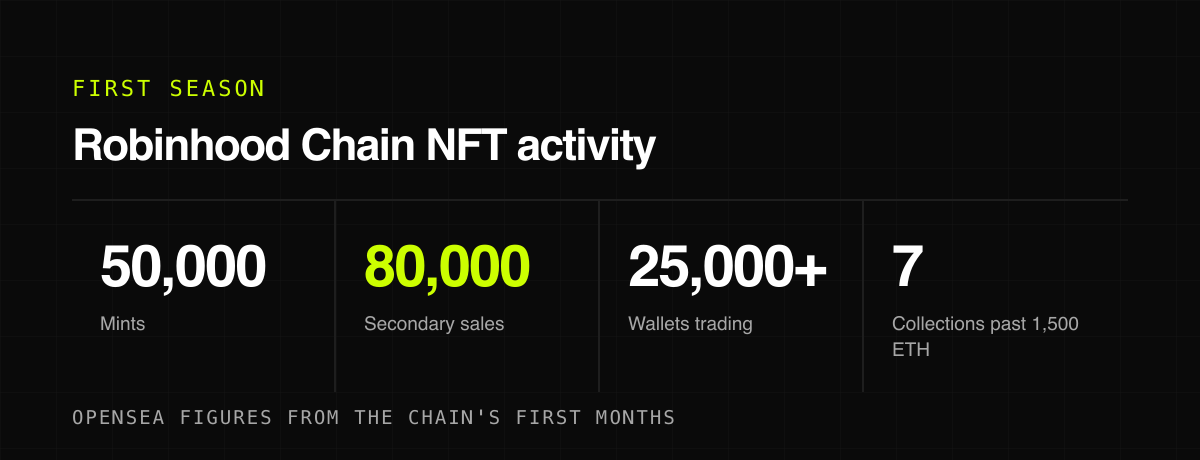
NFTs on Robinhood Chain trade primarily on OpenSea, which supports the chain with full tooling including floor prices, offers, rarity and collection analytics. The first season produced real volume — 50,000 mints and 80,000 secondary sales across 25,000+ wallets — with seven collections passing 1,500 ETH in cumulative volume. StonkBrokers, Pyopyopyopyo, Gremlin Cartel and Spritehood Wisps defined the run, and almost all of them launched as free or near-free mints before repricing 10–100x.
A chain built for tokenized equities produced a genuine NFT season within weeks. The numbers are not vanity metrics — 125,000 swaps, 50,000 mints and 80,000 secondary sales across more than 25,000 wallets, on a network that was three months old.
Where they trade
OpenSea is the primary marketplace and integrated the chain with its full toolkit: floor prices, offers, rarity and collection analytics, on web and mobile. Element also integrated. Alongside them, a set of chain-native marketplaces appeared — HoodMarket, HOODIES Marketplace and SeaHood — mostly built by teams behind early collections.
For floor and market-cap data across collections, CoinGecko maintains a Robinhood Chain NFT page.
The four that defined the season
- StonkBrokers — 4,444 pieces, free mint in July 2026. Floor ran past 11 ETH with cumulative volume above $4.7 million.
- Pyopyopyopyo — minted at 0.0014 ETH, floor reached 0.045 ETH. Roughly a 32x from mint.
- Gremlin Cartel — minted at 0.001 ETH, floor reached 0.018 ETH on close to 280 ETH of volume. Sold out quickly and is widely credited with restarting the chain's NFT activity.
- Spritehood Wisps — 44,444 supply, sold out in about 53 minutes, with the paid portion generating $1.28 million.
The pattern, stated plainly
Almost every collection that ran launched free or near-free. The economics were not about mint revenue — they were about distributing supply fast enough to create a secondary market before attention moved. Collections that priced their mint high mostly did not run.
Finding mints early
- Blockscout's token list — NFT contracts appear the moment they are deployed, before any marketplace indexes them.
- OpenSea's chain collections page sorted by recent activity.
- OPENMINTZ — a live mint tracker showing what is minting right now.
- RobinScreener maintains an NFT section alongside its token data.
Practical notes
Gas is ETH, so bridge before a mint window opens rather than during it — the most common way to miss a free mint is arriving with no gas. Verify the mint contract on Blockscout before signing; fake mint pages for real collections are the standard attack during any hyped drop.
And treat the reported floor with suspicion on low-volume collections. A floor price on two sales a day is a number, not a market.
How to evaluate a mint in the window you actually have
Mint decisions happen in minutes and most of the checks people recommend take longer than the window. These four fit.
- Verify the contract. Take the address from the project's own pinned post, not from a reply, and confirm it on the explorer. Fake mint pages for real collections are standard during any hyped drop.
- Check supply against expected demand. A 44,444-piece collection needs an order of magnitude more buyers than a 4,444 one to produce the same floor.
- Check the mint price against the collection's ambition. Nearly every collection that ran on this chain launched free or near-free.
- Check who is minting. A mint filling from freshly funded wallets in identical amounts is being bundled, not discovered.
Floor prices lie on low volume
A floor price is the cheapest listing, not a market price. On a collection doing two sales a day, one seller who needs liquidity sets the number everyone quotes, and one buyer sweeping three listings resets it upward without any change in demand.
Read floor alongside sales count and unique buyers. A rising floor on falling volume is a collection being marked up, not bid up. It is the most common way NFT charts mislead and it is visible in thirty seconds on any marketplace analytics tab.
Where this market goes from here
The first season's pattern — free mints, fast sell-outs, 10–100x repricings — is well understood by everyone now, which is precisely what stops it repeating. Free mint is no longer a signal of confidence; it is the default, and it attracts flippers rather than holders.
What has not been tested on this chain is whether NFTs find a use beyond speculation given what the chain is actually for. Collections tied to tokenized-asset mechanics, or to access rather than to art, are the interesting experiment. None have proven anything yet.
Tools mentioned
FAQ
Where do Robinhood Chain NFTs trade?
Primarily OpenSea, which supports the chain with floor prices, offers, rarity and collection analytics. Element also integrated, and chain-native marketplaces including HoodMarket, HOODIES and SeaHood operate alongside them.
Which Robinhood Chain NFT collections performed best?
StonkBrokers ran from a free mint to an 11+ ETH floor with over $4.7M volume. Pyopyopyopyo went from a 0.0014 ETH mint to a 0.045 ETH floor, and Spritehood Wisps sold 44,444 pieces in about 53 minutes.
How do I find NFT mints early on Robinhood Chain?
Watch Blockscout's token list for newly deployed NFT contracts, use a live mint tracker such as OPENMINTZ, and sort OpenSea's chain collections page by recent activity.
What do I need to mint?
ETH for gas, since that is the chain's gas token. Bridge before a mint window opens — running out of gas mid-window is the most common reason people miss free mints.
More from the blog
How to Find a Wallet Worth Copying on Robinhood Chain
Leaderboards rank by total profit, which is mostly size and luck. Five checks that separate a repeatable edge from one lucky position.
Is Copytrading Profitable? The Arithmetic Nobody Runs First
Copytrading pays you the leader's return minus four deductions. Here is what each one costs, and the win rate a wallet needs before following it makes money.
Copytrading vs Trading Yourself: Which Actually Suits You
One rents someone else's research at a fixed price. The other charges you in time instead of fees. The honest comparison on cost, control and what you learn.