Do You Pay Tax on Memecoin Trades? What Creates an Event
Not advice, and not jurisdiction-specific. A description of which onchain actions tax authorities generally treat as events, and what records you will need if yours does.
The short answer
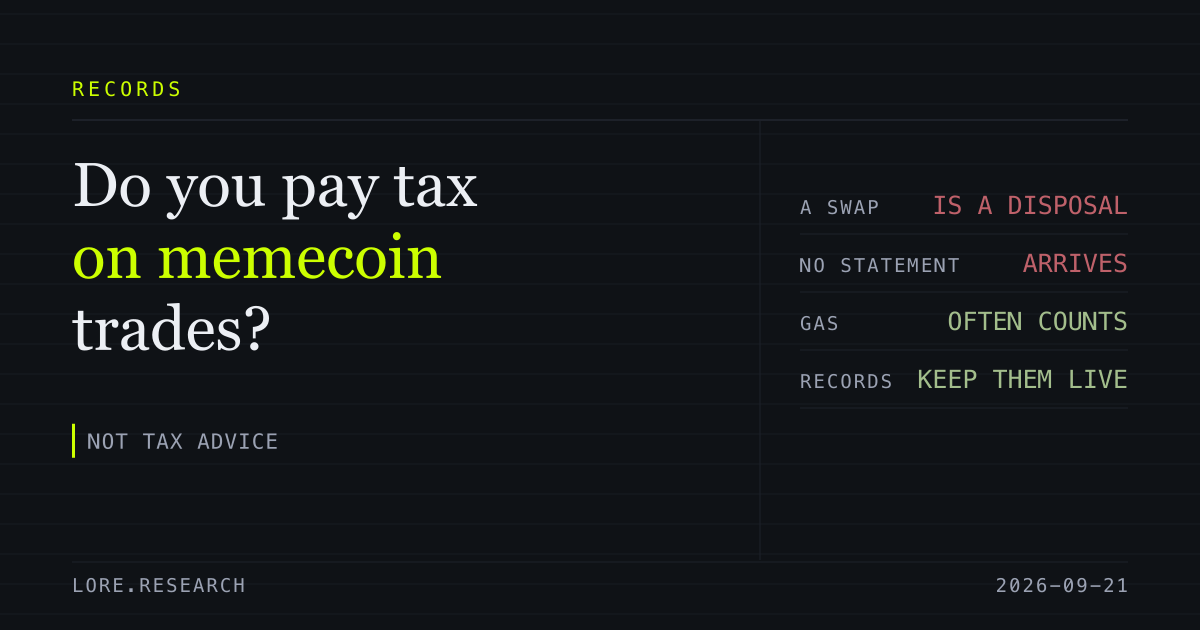
In most jurisdictions that tax crypto, disposing of a token is the event – and a swap is a disposal even when no ordinary money is involved. Trading one memecoin for another is typically two things at once: a disposal of the first and an acquisition of the second, at the value at that moment. That makes an active onchain trader's obligation far larger in record count than an exchange trader's, because there is no statement at the end of the year and every swap counted. Rules differ substantially by country and this is a description of the mechanics, not tax advice – the treatment that applies to you is a question for someone qualified in your jurisdiction.
This article describes how tax authorities generally treat onchain activity and what records the activity produces. It is not tax advice, the rules differ substantially between countries, and the only reliable answer for your situation comes from someone qualified where you live.
The rule most people are missing
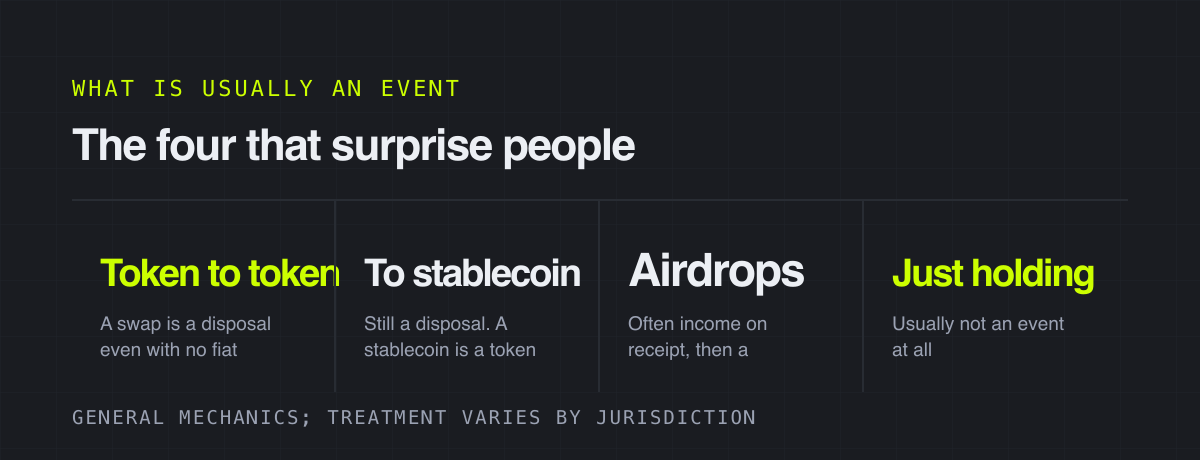
Where crypto is taxed, the trigger is usually disposal rather than cashing out. Selling a token for anything – another token, a stablecoin, ordinary money – is generally a disposal at the value at that moment, and swapping memecoin A for memecoin B is typically counted as disposing of A and acquiring B in one action.
Nobody sent you money and nothing reached a bank, and the event has still occurred. This is the single largest gap between how onchain trading feels and how it is treated.
Why onchain is harder than an exchange
| On an exchange | Onchain | |
|---|---|---|
| Records | A statement, usually with a tax summary | Nothing arrives. The data is public and unassembled |
| Count of events | Your trades | Every swap, including the ones that took four seconds |
| Valuation | Priced in the exchange's own book | Priced at whatever the pool said at that block |
| Costs | Fees itemised | Pool fees, bot fees and gas, spread across transactions |
| Wallets | One account | Often several, which have to be combined |
The cases that catch people
Rotating between memecoins
Forty round trips in a month is not forty positions, it is up to eighty events. A trader who ends the year flat in value can still have a substantial reporting obligation and, in some jurisdictions and some orderings, a liability despite no net gain.
A token that went to zero
A position that is worthless but still in your wallet has generally not been disposed of. Whether and how a loss can be recognised without a disposal varies by jurisdiction, and it is a common misunderstanding in both directions.
Airdrops and rewards
Frequently treated as income when received, valued at that moment, and then as a disposal when sold – two events from something that felt free. Creator and holding rewards paid by launch platforms tend to fall into the same shape.
Gas and failed transactions
Gas on a trade is often treated as a cost of that trade. Gas on a transaction that failed bought nothing at all, and its treatment is one of the more genuinely unclear corners.
What to keep, starting now
- A list of every address you trade from. Reconstructing this later is the step people cannot do.
- A transaction export per wallet, taken periodically rather than once a year.
- The value at the time of each swap – not today's price, which for a dead token does not exist.
- Fees and gas alongside each trade, not as an annual lump.
- Anything received rather than bought, recorded separately, with the date.
A portfolio tracker connected to your addresses – DeBank, Zerion or HoodScan – does most of this continuously, which is the argument for setting one up before you need it rather than in the week the deadline lands.
The honest summary
The mechanics are consistent across most jurisdictions that have taken a position: disposal is the event, a swap is a disposal, and the burden onchain is the reconstruction rather than the rate. The specifics – rates, thresholds, how losses work, whether a wallet-to-wallet transfer of your own funds counts – differ enough between countries that generalising further would be a disservice. Keep the records, then ask someone qualified where you live.
 HoodScan
 DeBank
 Zerion
FAQ
Is swapping one memecoin for another a taxable event?
In most jurisdictions that tax crypto, yes – a swap is generally treated as disposing of the first token and acquiring the second, valued at that moment, even though no ordinary money moved. This is the most commonly missed point in onchain trading. Confirm the treatment where you live.
Do you pay tax if you never cash out to fiat?
Usually the trigger is disposal rather than withdrawal, so trading between tokens can create events without anything reaching a bank account. Holding a token you bought and did nothing with is generally not an event.
How do you track memecoin trades for tax?
Export transactions per wallet regularly rather than once at year end, record the value at the time of each swap instead of today's price, and keep gas and fees alongside each trade. A portfolio tracker connected to your addresses does this continuously, which matters because dead tokens lose their price history.
More from the blog
A Trading Journal for Onchain Trades: What to Record
The chain already logs every transaction you made. What it cannot log is why you made it, and that is the column the journal exists for.

Paper Trading Memecoins When No Paper Mode Exists
There is no demo account on a DEX. Here is how to practise anyway – and the one thing simulation can never teach you.
How to Take Profit Without Trying to Call the Top
Selling all at once needs you to be right about a moment. Selling in pieces only needs you to be roughly right about a range – which you might be.