Tokenized Gold: What the Token Is Redeemable For
Two tokens can both say one ounce and mean completely different things. The difference is in the redemption clause nobody reads.
The short answer
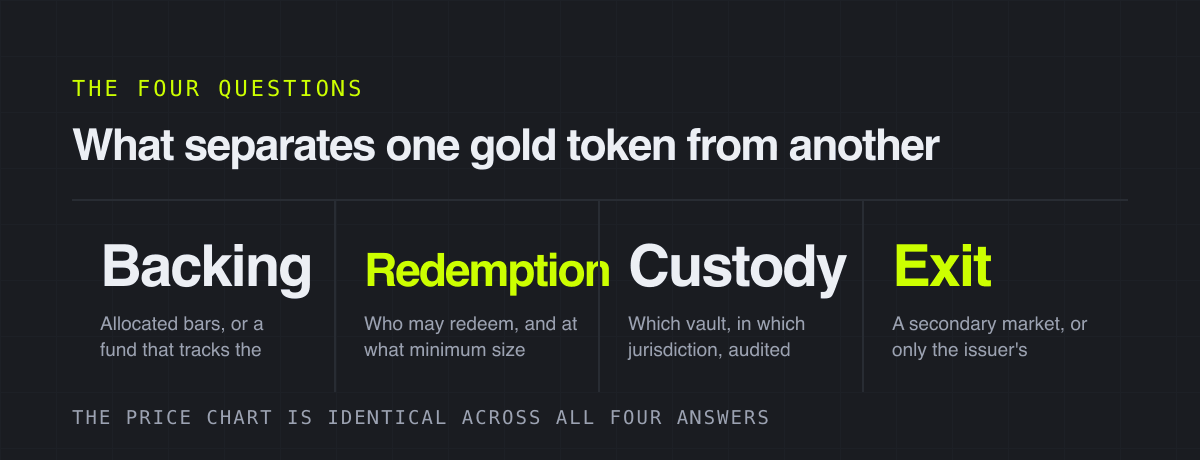
Tokenized gold is an ERC-20 whose issuer holds gold and promises the token can be exchanged for it. The differences that matter are what backs it – allocated bars versus a fund that tracks the price – who can redeem, at what minimum, and whether there is a secondary market or only the issuer's window.
Gold was tokenized before almost anything else, because it is the easiest case: a physical thing that sits still, is fungible by weight, and has a price everyone agrees on. That simplicity hides the part that actually differs between products, which is not the gold at all. It is what your token entitles you to.
Two different things wearing the same label
The first kind is a claim on specific metal. An issuer holds allocated bars in a named vault, and each token corresponds to a defined weight that can, under stated conditions, be taken out as metal. The second kind tracks the gold price through a fund – on this chain that is what a tokenized GLD position is, a token whose reference is a trust's shares rather than a bar with a serial number.
Both charts look the same. Both say gold. Only one of them ends with someone handing you metal, and only under conditions most holders will never meet.
The redemption clause is the product
Redemption is where the marketing and the documentation part company. Typical terms include a minimum size measured in whole bars, delivery only to certain jurisdictions, an identity check, and a fee. None of that is unreasonable – moving physical gold is genuinely expensive – but it means redemption exists for institutions and functionally does not exist for someone holding a fraction of an ounce.
That does not make the token worthless. It means the thing holding the price to the metal is arbitrage by the people who can redeem, not a right you personally hold. Your exit is the market, and the market is only as good as its liquidity.
| Question | Why it decides the answer |
|---|---|
| Allocated or unallocated? | Allocated survives the issuer's insolvency; unallocated is a claim on a balance sheet |
| Minimum redemption? | If it is a whole bar, redemption is not yours |
| Who audits the vault, how often? | An unaudited reserve is a promise, not a reserve |
| Where does it trade? | Without a secondary market, the issuer's window is the only exit |
Where to check rather than trust
The contract itself tells you things the marketing will not. Open it on  Blockscout Explorer and look for freeze and forced-transfer functions – tokens with a compliance layer usually have them, and their existence is a fact about what you own. Supply is worth reading too: a gold token whose supply moves independently of announced vault changes is worth a question.
For the size of the category rather than any one issuer,  DefiLlama RWA is the neutral scoreboard, and it is a fast way to see whether a token you are considering is a real product or a small one with a good website.
Why it matters on a chain like this one
On Robinhood Chain a gold position sits in the same wallet as a memecoin and trades through the same pools, which is genuinely useful – it is collateral with no market hours and no settlement delay. It also means the depth backing your exit is a pool, not a bullion desk, and pool depth is a thing you can read before you need it rather than after.
- Read the redemption terms before the price chart. They define the instrument.
- Check pooled liquidity, because that is your actual exit regardless of what backs the token.
- Treat allocated and unallocated as different products that happen to share a price.
- Look for the audit cadence. Quarterly attestation and a vault name is the minimum worth accepting.
Tools mentioned
FAQ
What is tokenized gold?
An ERC-20 token whose issuer holds gold, or a claim on gold, and promises a defined relationship between the token and that metal. The important differences are what exactly is held, who can redeem it, and whether there is a market to sell into if you cannot.
Can I actually redeem tokenized gold for physical metal?
In most products, only at institutional size. Minimums measured in whole bars, delivery restrictions and identity requirements mean redemption is a mechanism for arbitrage rather than a right most holders can exercise.
Is tokenized gold safe?
It carries the gold price risk plus two risks metal in your own possession does not: the issuer might fail, and the token might be illiquid when you want out. Allocated backing with regular audits addresses the first; pooled liquidity is what you check for the second.
What is the difference between tokenized gold and a gold ETF token?
A gold token backed by allocated bars is a claim on specific metal. A tokenized gold ETF is a token referencing fund shares, which themselves reference gold – one more layer between you and the bar, and a different set of counterparties.
More from the blog
Tokenized Bonds Beyond Treasuries: Credit, Coupons and Who May Hold Them
A tokenized treasury is a short government loan with no credit question. Everything else in the bond market has one, and it changes the product.
Tokenized Private Credit: The Yield Is Someone Else's Loan
The highest yields in RWA come from the part with no public market, no daily price and no easy exit. That is not a coincidence.
Tokenized Commodities: What Is Behind the Barrel
Gold sits in a vault. Oil does not sit anywhere convenient, which is why almost every oil token is a fund and not a barrel.