Paper Trading Memecoins When No Paper Mode Exists
There is no demo account on a DEX. Here is how to practise anyway – and the one thing simulation can never teach you.
The short answer
No decentralised exchange has a paper-trading mode, because there is no account to simulate – a swap either happens onchain or it does not. The workable substitutes are logging hypothetical entries and exits with a timestamp and checking them against the chart later, following wallets and recording what you would have copied, and trading real but trivial amounts. The last is the only one that teaches the part that matters, because simulated money produces simulated decisions: the mistakes that cost people money are made under a pressure a spreadsheet cannot reproduce.
Ask for a demo account and the answer is that there is not one. Exchanges can offer paper trading because they run an account system and can pretend to fill you in it. A decentralised exchange has neither: there is a contract, and a swap either lands or it does not.
Substitute one: log it and check later
Write down the token, the price, the time and your reason at the moment you would have bought. Do the same when you would have sold. Come back a week later and read your own reasoning against what the chart did.
This is worth more than it sounds, because the reason is the part you will misremember. What it teaches is selection – whether the things you notice are things worth noticing – and it teaches nothing at all about execution.
Substitute two: shadow a wallet
Point an alert service at a wallet you find interesting and record, each time it acts, whether you would have followed it. After a few dozen signals you have two track records to compare: theirs, and your judgment about theirs.
This is how to decide whether to copy someone without wiring anything up, and it costs nothing but attention.
Substitute three: real money, trivially small
Trade an amount whose total loss you would not notice by the end of the week. It is not simulation and that is the entire point.
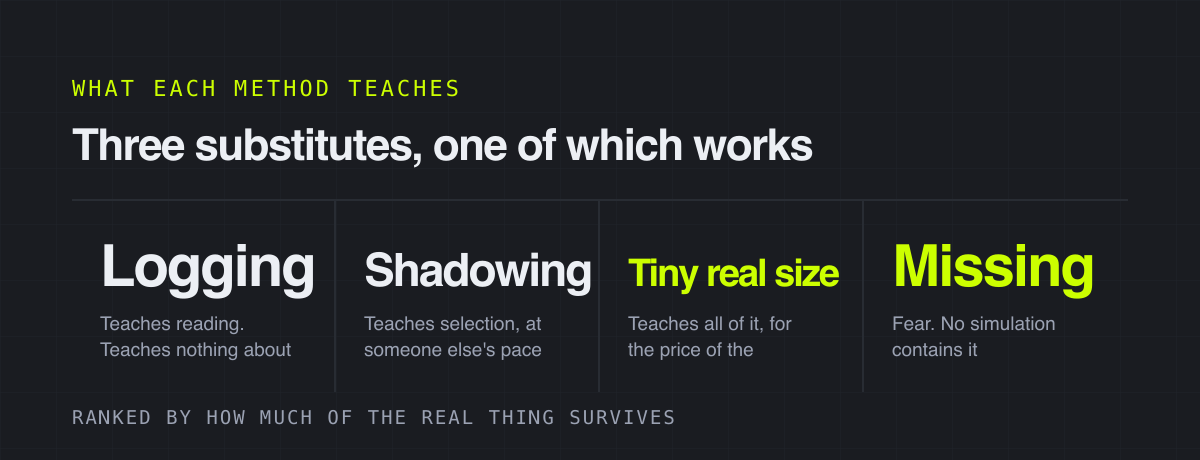
What only real size teaches
- Slippage. A spreadsheet fills you at the price you wrote down; a pool does not.
- Failed transactions, and what you do in the ninety seconds after one.
- Gas, approvals and the small frictions that change behaviour more than they change returns.
- Whether you actually sell at your level, or move it once the position is moving.
- How you behave after a loss, which is the single best predictor of the next one.
Making the small-size period count
- Pick a fixed amount per trade and do not vary it, so the results are comparable.
- Write the exit levels before each entry, exactly as you would at full size.
- Record every trade, including the ones you got out of by luck.
- Run at least thirty trades before drawing any conclusion. Below that you are reading noise.
- Increase size only after a review, and increase it less than you want to.
Why the number thirty
Because the same reason a wallet with three good trades tells you nothing applies to you. A run of five wins at small size feels like evidence and is not, and the most expensive mistake in this whole process is treating it as one and multiplying the size accordingly.
FAQ
Is there a paper trading mode for DEX trading?
No. Paper trading requires an account system to simulate fills in, and a decentralised exchange has none – a swap is an onchain transaction or nothing. The substitutes are logging hypothetical trades, shadowing a wallet's signals, or trading real amounts small enough not to matter.
How much money should you start with?
An amount whose complete loss would not change your week. The purpose of the first period is to learn how you behave, not to make money, and the size only has to be large enough that the behaviour is real.
How long should you practise before trading properly?
Count trades rather than weeks – around thirty gives a sample worth reading, and fewer is noise. A run of early wins is the most common reason people size up too fast, and it is not evidence of anything.
More from the blog
Do You Pay Tax on Memecoin Trades? What Creates an Event
Not advice, and not jurisdiction-specific. A description of which onchain actions tax authorities generally treat as events, and what records you will need if yours does.
A Trading Journal for Onchain Trades: What to Record
The chain already logs every transaction you made. What it cannot log is why you made it, and that is the column the journal exists for.
How to Take Profit Without Trying to Call the Top
Selling all at once needs you to be right about a moment. Selling in pieces only needs you to be roughly right about a range – which you might be.