The DEX Screener API: What It Gives You Free
A free endpoint over an indexer built from raw chain logs. The limits are rate limits, and the gap is everything about holders.
The short answer
DEX Screener publishes a free API over its own indexer, covering pairs, tokens, prices, liquidity and volume, with rate limits per endpoint and no key required. It does not provide holder data, wallet analysis or contract security results, which is the boundary that decides whether you can build what you had in mind.
The API is free, needs no key, and sits on top of an indexer the company built itself –  DEX Screener parses raw blockchain logs rather than calling external data providers, so what you get back is derived from the chain rather than resold from someone else.
What it covers
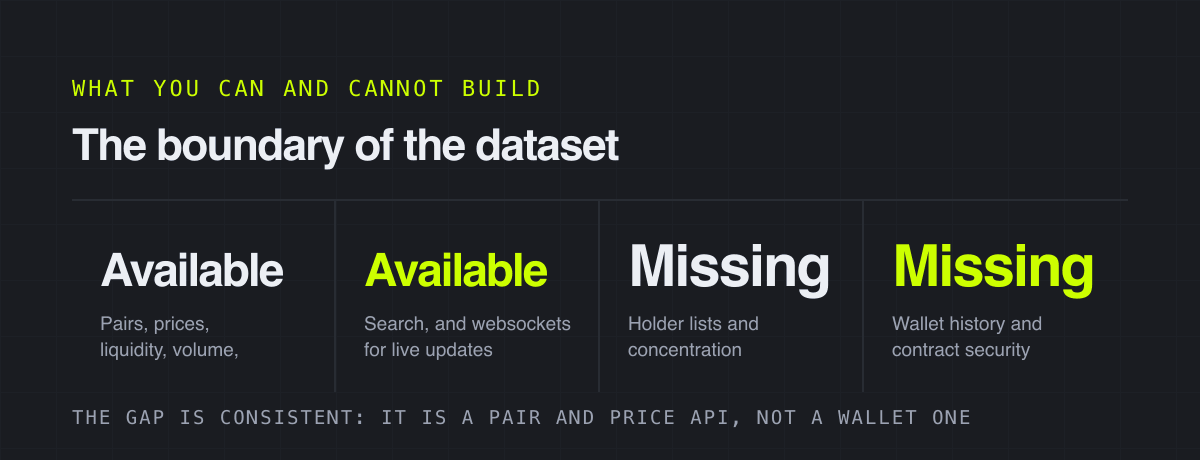
Pairs and the data attached to them: price, liquidity, volume over several windows, transaction counts, and the token metadata the platform has collected. There is a search endpoint, and a websockets interface for live updates rather than polling.
That is enough to build a screener, a price alert bot, a dashboard, a watchlist service, or the data layer under a trading tool. A great many products are quietly running on it.
What it does not cover
Anything about who holds the token. No holder lists, no concentration figures, no clustering, no wallet histories, and no security verdict on a contract. That is not an oversight – it reflects what the platform itself does, which is pairs and prices.
The limits that bite
Rate limits are per endpoint and differ between them, and they are the main constraint on anything that wants to watch many pairs at once. Polling a large watchlist hits them quickly, which is what the websockets interface exists to solve.
| If you are building | This API | Also needed |
|---|---|---|
| A price alert bot | Sufficient | Nothing |
| A new-pairs feed | Sufficient | Nothing |
| A rug checker | Partial | Contract analysis |
| A holder concentration tool | No | An indexer with transfer history |
| A copytrading product | No | Wallet-level transaction data |
On Robinhood Chain specifically
The chain is covered, which matters more here than it sounds. The explorer's own API sits behind a protection layer that blocks programmatic access, so a free pair and price feed removes a real obstacle for anything being built on this chain.
For the holder and transfer data it does not provide, the options are a hosted indexer –  Goldsky and Bitquery both cover this chain – or running your own against the public RPC.
- Read the rate limit for the specific endpoint before designing the polling loop.
- Use websockets for anything watching more than a handful of pairs.
- Cache aggressively. Most of this data does not change as fast as a loop will ask for it.
- Plan the second data source early if holders or wallets are anywhere in the product.
Tools mentioned
FAQ
Is the DEX Screener API free?
Yes, and it requires no key. It is rate limited per endpoint, which is the practical constraint on anything watching many pairs at once.
What data does the DEX Screener API provide?
Pair-level data: prices, liquidity, volume across windows, transaction counts and token metadata, plus search and a websockets interface for live updates.
Does the DEX Screener API have holder data?
No. There are no holder lists, concentration figures or wallet histories, and no contract security verdicts. Those require a different data source such as a hosted indexer.
Does the API cover Robinhood Chain?
Yes. That matters because the chain's own explorer API sits behind a protection layer that blocks programmatic access, so a free pair and price feed removes a real obstacle for building here.
More from the blog
Prediction Markets: A Price That Looks Like a Probability
A contract paying one dollar if something happens trades at the market's estimate of it happening. The gap between that and a forecast is where the money is.
Staking, and Why There Is None on This Chain
Staking pays you for securing a network. An L2 that settles to Ethereum and charges gas in ETH has nothing for you to secure.
Multisig: Removing the Single Point of Failure
Two of three signatures to move anything. It solves theft and loss at once, and introduces a problem of its own.