RWA Tokens: What Is in the Basket, and What It Owns
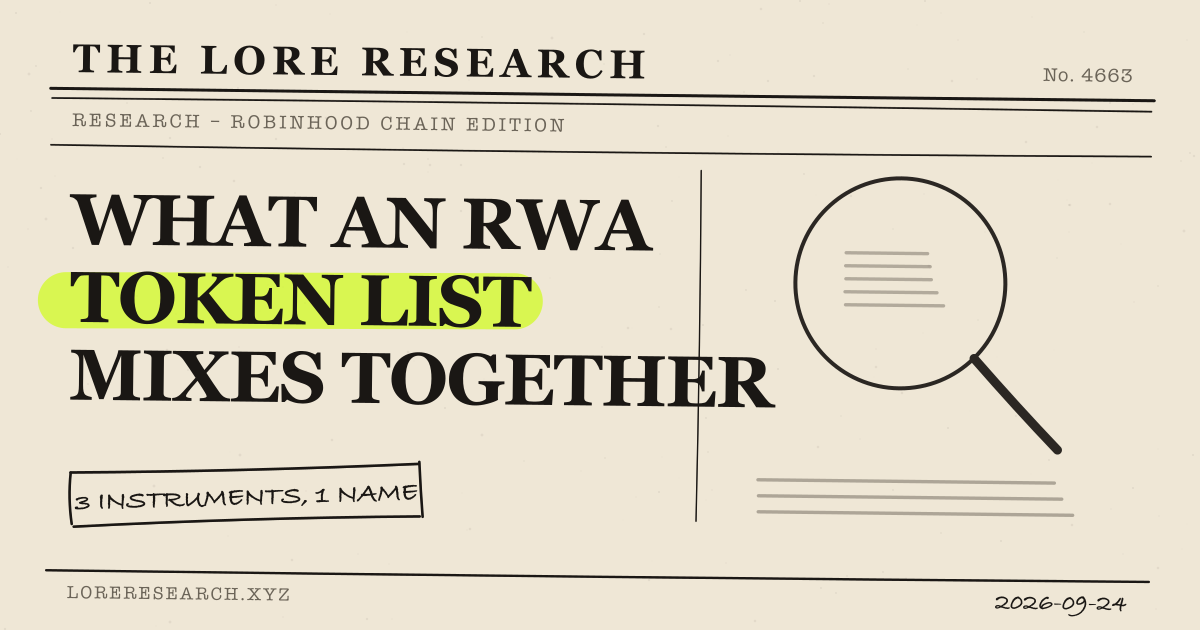
Every list of real-world-asset tokens mixes three unrelated things. Sorting them takes one question, and most lists never ask it.
The short answer
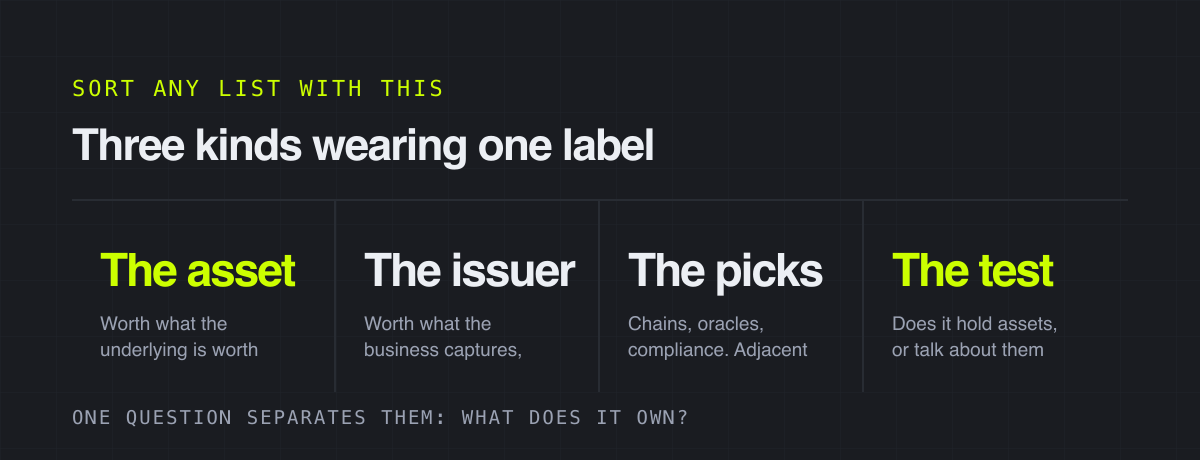
Lists of RWA tokens run together three different instruments. The first is the asset itself – a token representing a share in a Treasury fund or a tokenized equity, whose value is the underlying. The second is the governance or fee token of a protocol that issues such assets, whose value depends on whether it captures anything from that business, which is often nothing. The third is infrastructure – chains, oracles, compliance layers – whose connection is that RWAs would use them. Only the first gives exposure to real-world assets; the other two give exposure to a theme.
Search for RWA tokens and the results are a ranked table with market caps in it, as though the entries were comparable. They are not, and the differences are larger than anything the table shows.
Kind one: the tokenized asset
A token whose value is the thing it represents – a share in a fund holding government debt, a claim on a listed equity. It does not appreciate because RWA is popular; it appreciates because the underlying pays or rises. If you wanted exposure to real-world assets, this is the only kind that gives it.
These are also the ones least likely to be on a list, because many are restricted, most are dull, and none of them ten-times.
Kind two: the protocol token
Issued by a company or protocol that tokenizes assets. Here the crucial question is whether the token captures any of that activity: a share of fees, a buyback, a claim on revenue – or governance rights and nothing else. Both exist under the same label, and the documentation says which. Frequently the answer is that assets under management can grow all year while the token accrues nothing from it.
Kind three: the adjacent infrastructure
Chains hoping to host tokenized assets, oracles that would price them, identity and compliance layers that would gate them. Genuine businesses, and their connection to RWA is that the category would use them if it grows. That is a thesis about share of a future market, not exposure to the assets, and it moves on the same headlines regardless.
Reading a list in two minutes
- For each entry, ask what the token owns. Asset, business, or adjacency – it is always one of the three.
- If it is a business, find whether the token has a claim on revenue. Governance alone is not a claim.
- Find the assets under management and whether they are published –
 DefiLlama RWA collects them. A protocol that does not publish them is asking to be valued on the story.
 - Check whether the number grew because of new issuance or because rates rose. Those are very different achievements.
- Note which entries are restricted. A token you cannot legally hold is not an opportunity you missed.
Why the sorting matters more here than elsewhere
Because this is the one theme in crypto whose underlying business is legible. Issuers publish what they hold and what they redeemed. That is unusual and it is the whole advantage of the category – and it is wasted entirely if the token being bought has no relationship to those numbers.
Tools mentioned
FAQ
What are RWA tokens?
The label covers three different things: tokens representing the asset itself, tokens of protocols that issue such assets, and tokens of infrastructure the category would use. Only the first gives exposure to real-world assets; the others give exposure to a business and to a theme.
Do RWA protocol tokens capture the revenue?
Sometimes, and often not. Some carry a share of fees or a buyback; many carry governance rights and no claim on anything. The design decides it and the documentation states it, which means assets under management can grow all year while the token gains nothing from that growth.
How do you evaluate an RWA token?
Ask what it owns. If it is the asset, the underlying decides its value. If it is a protocol, find the assets under management, whether they are published, and whether the token has a claim on the revenue. If it is infrastructure, you are buying a thesis about future market share, not asset exposure.
More from the blog
Social Trading vs Copy Trading: Not the Same Thing
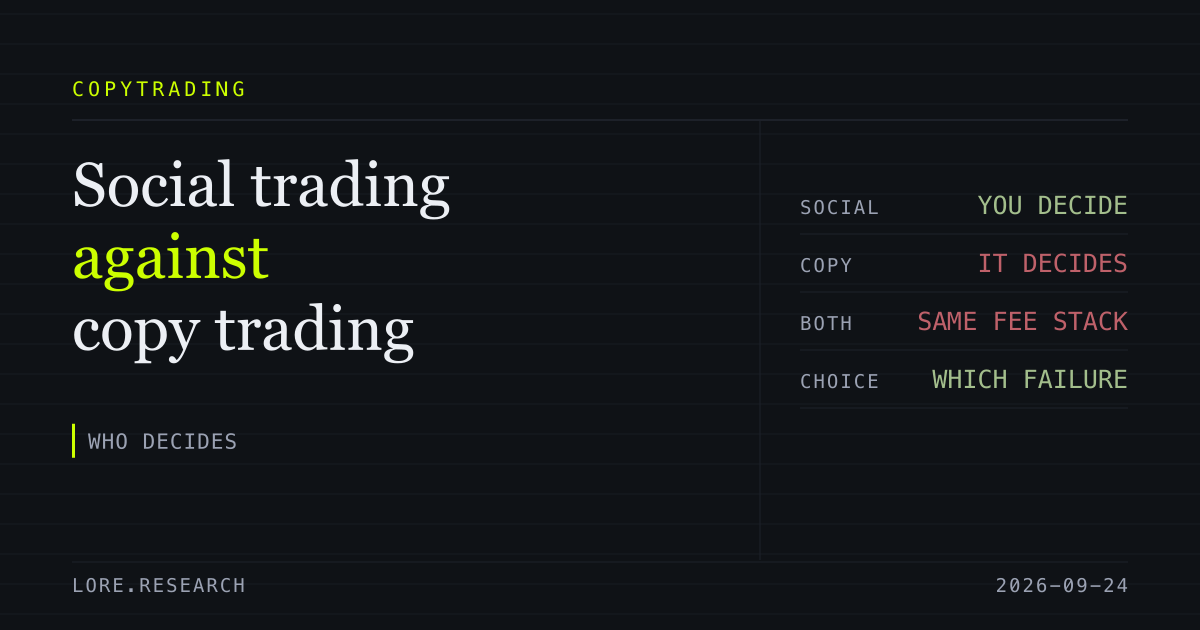
One shows you what people are doing and leaves the decision with you. The other takes the decision away. That difference is the entire product.
Reading a Memecoin Community Before You Buy Into It
A busy Telegram is not demand. Four things separate a community from a room that was paid to look like one.
Where Tokenized Stocks Trade, and Why the Venue Decides
The same ticker exists on several chains as several different instruments. What you can do with it depends entirely on which one you bought.