Borrowing Against Crypto Without Getting Liquidated
The loan is easy. Staying in it through a bad week is the part that takes arithmetic, and the arithmetic is not the one most people run.
The short answer
You post an asset as collateral and borrow against a fraction of its value. The number that matters is not how much you can borrow but how far the collateral can fall before liquidation – and borrowing the maximum leaves almost no room, which is why most liquidations happen to people who took the limit.
Borrowing against an asset is simple to execute and simple to get wrong, and the error is almost always the same: treating the maximum loan as the intended loan. The interface shows what you can borrow. What you need is the distance between where you are and where the position gets sold.
The two ratios
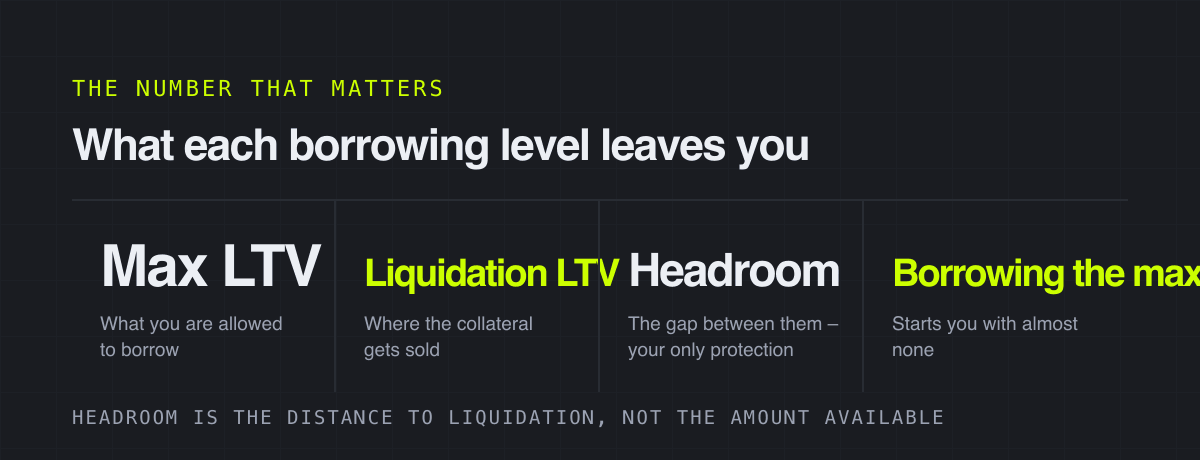
Maximum loan-to-value is the share of your collateral's value you may borrow. Liquidation loan-to-value is the higher share at which the protocol sells your collateral to repay the loan. The gap between them is the entire buffer you have against the market.
Borrow the maximum and you begin at the edge of that gap. A modest fall in the collateral's price moves your ratio into liquidation territory, and the position is closed by a liquidator who is paid a bonus for doing it.
The arithmetic to actually run
- Find both ratios for your specific collateral. They differ by asset, and a volatile asset gets a stricter one.
- Decide the fall you want to survive – not the one you expect. Look at the asset's worst week in the last year.
- Borrow the amount that leaves that much headroom, which will be far less than the maximum.
- Write down the liquidation price as a number, not as a ratio. A ratio does not wake you up; a price does.
- Set an alert well above it, because there is no stop loss and nothing will act for you.
Why the liquidation is worse than the fall
Liquidation does not return you to cash at the market price. A liquidator repays your debt and takes your collateral plus a bonus, so you lose the asset and the penalty at a price you did not choose, typically at the worst moment in the move.
| Borrowed | Headroom | What a 30% drop does |
|---|---|---|
| The maximum | Almost none | Liquidated early in the move |
| Two thirds of the maximum | Modest | Uncomfortably close |
| Half the maximum | Real | Survivable, if you watch it |
| A third of the maximum | Large | Barely noticed |
What you are actually doing
If you borrow a stablecoin against an asset and buy more of that asset, you have taken leverage – with a liquidation price instead of a margin call, and nobody to ring you. That is a legitimate trade and it should be sized like one rather than described as unlocking liquidity.
If you borrow to fund something outside the market, the position is simpler: you are short the stablecoin and long your collateral, and your risk is the collateral falling while the debt stays constant.
- Keep a repayment buffer in the same wallet. Adding collateral during a crash requires having something to add.
- Understand that interest accrues against you – the ratio worsens over time even with the price flat.
- Check which oracle prices your collateral – on this chain that is usually
 Chainlink – since that feed decides when you are liquidated.
- Never borrow against an asset whose liquidity is thin. Check the pool depth on
 Dexscreener first, because the liquidation itself will move the price against you.
Tools mentioned
FAQ
How do you borrow against crypto?
Deposit an asset as collateral in a lending market and borrow against a fraction of its value. The protocol sets a maximum loan-to-value you may take and a higher ratio at which your collateral is sold to repay the debt.
How much should I borrow against my crypto?
Enough less than the maximum that the collateral can fall as far as it has historically fallen in a bad week without reaching liquidation. In practice that is usually about half of what the interface will allow.
What happens if I get liquidated?
A liquidator repays your debt and takes your collateral plus a bonus. You lose the asset at a price you did not choose, usually at the worst point in the move, and the penalty on top.
Does interest make liquidation more likely?
Yes. Interest accrues to the debt, so the loan-to-value ratio worsens over time even if the collateral price never moves. A position left alone drifts toward liquidation on its own.
More from the blog
Prediction Markets: A Price That Looks Like a Probability
A contract paying one dollar if something happens trades at the market's estimate of it happening. The gap between that and a forecast is where the money is.
Staking, and Why There Is None on This Chain
Staking pays you for securing a network. An L2 that settles to Ethereum and charges gas in ETH has nothing for you to secure.
Multisig: Removing the Single Point of Failure
Two of three signatures to move anything. It solves theft and loss at once, and introduces a problem of its own.