Staking, and Why There Is None on This Chain
Staking pays you for securing a network. An L2 that settles to Ethereum and charges gas in ETH has nothing for you to secure.
The short answer
Staking locks a token to help secure a proof-of-stake network, and the network pays you from issuance and fees for doing it. Robinhood Chain is an Arbitrum Orbit layer 2 that settles to Ethereum and uses ETH for gas, so there is no native staking here – the yields available are lending and liquidity instead.
Staking is the most asked-about yield in crypto and the one least likely to be available where someone is asking about it. It has a precise meaning, and the precision is what tells you when the word is being used for something else.
What staking actually is
On a proof-of-stake network, producing blocks requires putting the network's own token at risk. Behave correctly and you are paid from issuance and transaction fees; behave badly and a portion of the stake is destroyed. The yield is payment for providing security, and the security is real because the money is genuinely at risk.
Delegating to a validator is the version most people do: you keep the economic exposure, someone else runs the infrastructure, and they take a commission.
Why none of that exists here
Robinhood Chain is an Arbitrum Orbit layer 2 with chain ID 4663. It does not secure itself with a validator set – it settles to Ethereum, which is where the security comes from. Transactions are ordered by a sequencer rather than by a set of staked participants.
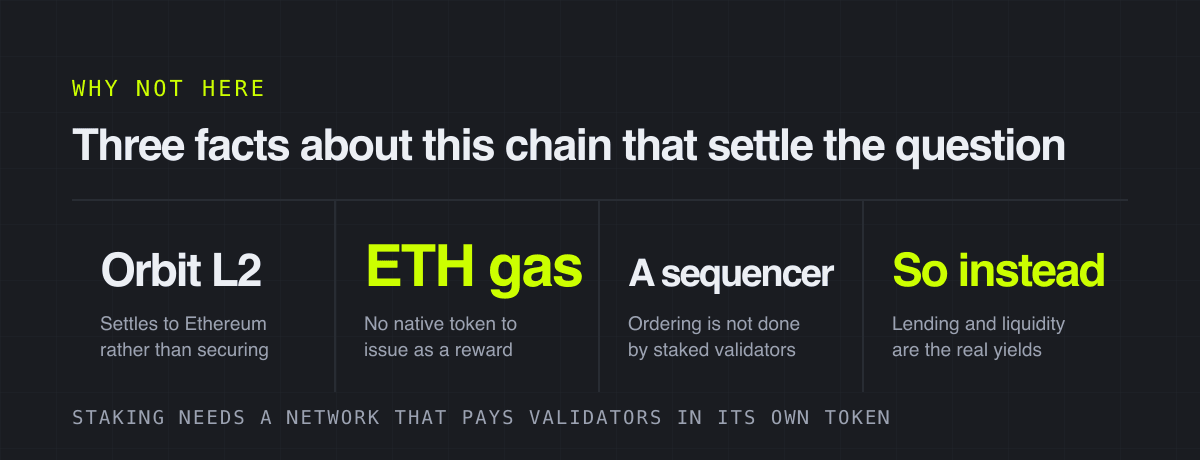
That is not a deficiency. Inheriting Ethereum's security is the point of a layer 2, and not having a gas token to inflate is arguably a cleaner arrangement than the alternative. It just means the word staking does not apply.
What gets called staking and is not
| Called staking | Actually | Paid from |
|---|---|---|
| Proof-of-stake validation | Staking | Issuance and fees |
| Locking a token for rewards | An incentive programme | Emissions, with an end date |
| Depositing into a lending pool | Lending | Borrowers' interest |
| Providing liquidity to a pool | Market making | Traders' fees |
| Depositing with a platform for yield | Unsecured credit to that platform | Whatever they do with it |
The last row is the one worth being careful about. A rate offered by a company for holding your assets is a loan to that company, and the fact that the word staking appears on the page changes nothing about who you are exposed to.
Where the yield here actually comes from
Two places, both legible. Lending pays you interest that borrowers pay, with utilisation setting the rate –  Morpho is the lending market in the catalogue. Liquidity provision pays you a share of trading fees, with divergence loss as the cost. Neither is staking and both have an identifiable payer, which is more than many things that use the word.
- Ask who pays the yield. Staking has a clear answer; so do lending and liquidity. Anything without one is a problem.
- Treat a lock-up with a reward token as an incentive programme with a budget, not as staking.
- Compare rates on
 DefiLlama Yields rather than on the page offering them.
- If a yield on this chain is described as staking, read carefully – it is one of the other four things.
Tools mentioned
FAQ
What is staking in crypto?
Locking a proof-of-stake network's own token to help produce blocks, in exchange for a share of issuance and transaction fees. The stake can be destroyed for misbehaviour, which is what makes the security real.
Can you stake on Robinhood Chain?
No. It is an Arbitrum Orbit layer 2 that settles to Ethereum rather than securing itself with validators, and it uses ETH for gas – so there is no native token to issue as a staking reward.
What is the difference between staking and liquidity mining?
Staking is paid from a network's issuance for securing it. Liquidity mining deposits a pair into a pool and is paid from trading fees plus emissions, which also means it carries divergence loss that staking does not.
If there is no staking, where does yield on this chain come from?
Lending, where borrowers pay interest set by utilisation, and liquidity provision, where traders pay fees. Both have an identifiable payer, which is the test worth applying to any yield.
More from the blog
Prediction Markets: A Price That Looks Like a Probability
A contract paying one dollar if something happens trades at the market's estimate of it happening. The gap between that and a forecast is where the money is.
Multisig: Removing the Single Point of Failure
Two of three signatures to move anything. It solves theft and loss at once, and introduces a problem of its own.
The Seed Phrase: What Those Twelve Words Actually Are
Not a password. A number, written in a dictionary, from which every key you will ever have is derived.