FOMO Copy Trading: What Gets Mirrored and What Does Not
Following a feed and mirroring a wallet are different products. One shows you a trade; the other takes it for you while you sleep.
The short answer
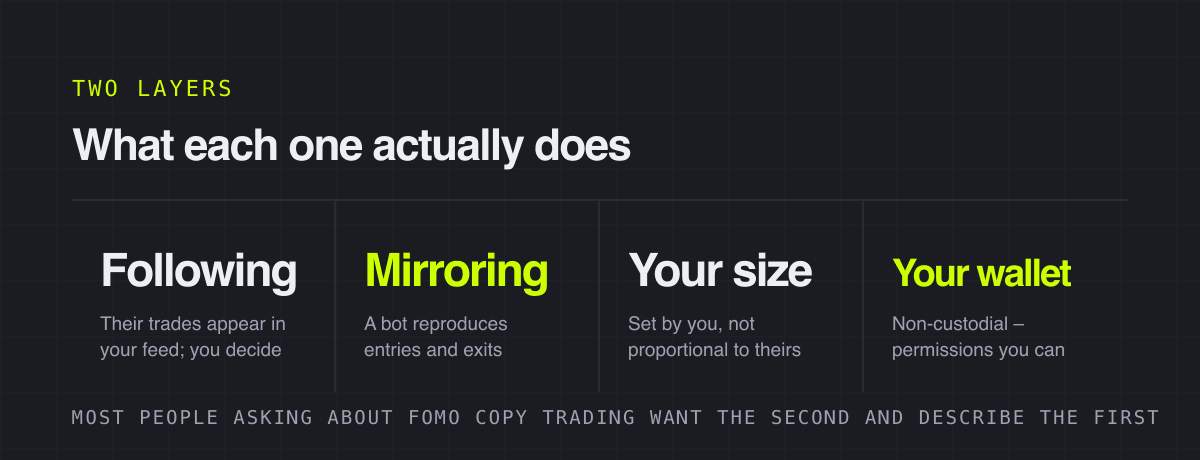
Following a trader on FOMO shows you their trades in a feed; you still press buy. Automatic mirroring is a separate layer – CopyFomo runs it as a Telegram bot that watches a trader from the FOMO leaderboard and reproduces entries and exits in your own wallet at your size, non-custodially.
Two different things get called copy trading on  FOMO, and confusing them is why people are surprised by what happens next. One is a feed you read. The other is an automation that trades without you.
Following: you still press the button
In the app itself, following a trader means their activity appears in your feed. You see what they bought, you decide whether to buy it, and you execute in the same screen. Every decision is still yours, including the one about size and the one about when to leave.
The constraint is obvious once you have done it: the trade happened before you saw it, and the good ones happen at four in the morning.
Mirroring: the trade happens without you
Automatic mirroring is a separate layer built on top.  CopyFomo runs it as a Telegram bot: you pick a trader from the FOMO leaderboard, and it reproduces their entries and exits in your own wallet at a size you set, including while you are asleep.
What does not get mirrored
The reasoning. A trader's position is sized against their portfolio, their time horizon and sometimes a hedge somewhere you cannot see. A mirror reproduces the transaction and none of the context that made it sensible.
| Copied | Not copied |
|---|---|
| The entry, in the same token | Why they entered |
| The exit, when they take it | How large it was relative to their book |
| The timing, minus latency | Any hedge held off this chain |
| Their mistakes, faithfully | Their ability to absorb one |
The settings that decide the outcome
Fixed size per trade rather than a percentage of their position, because proportional sizing transfers their risk appetite onto your account. A liquidity floor, so you skip the thin pools where slippage eats the trade. A cap on trades per day, because a leader having a busy session is not a reason for you to have one.
- Start with one trader, not several. Several is a portfolio nobody designed.
- Watch a trader in the feed for two weeks before mirroring them. It is the cheapest due diligence available.
- Know the round-trip cost – service fee, pool fee, gas, slippage, all twice – before picking anyone.
- Write the stop rule before you start, because deciding mid-drawdown means deciding while losing.
Which one you want
If the appeal is not missing the trade that happened overnight, you want mirroring and should read the costs carefully first. If the appeal is learning how a good trader behaves – what they size up on, what they skip, how long they hold – following is better and free, and the education is the actual return.
FAQ
Does FOMO have copy trading?
Following a trader in the app puts their trades in your feed, but you still execute each one yourself. Automatic mirroring is a separate layer – CopyFomo is a Telegram bot that reproduces a leaderboard trader's entries and exits in your own wallet.
Is FOMO copy trading non-custodial?
CopyFomo trades from your own wallet under permissions you grant and can revoke, rather than holding funds. That removes custody risk and leaves the trading risks – costs, sizing and the trader's own record – unchanged.
Does FOMO copy trading actually work?
Mechanically yes, and the outcome depends almost entirely on settings rather than on the trader. Fixed size per trade, a liquidity floor and a daily cap decide more than which leaderboard name you pick.
What is the difference between following and copying on FOMO?
Following is a feed – you see the trade and choose. Copying is an automation that takes the trade for you, including overnight. The second removes the reaction-time problem and adds every cost twice per round trip.
More from the blog
Prediction Markets: A Price That Looks Like a Probability
A contract paying one dollar if something happens trades at the market's estimate of it happening. The gap between that and a forecast is where the money is.
Staking, and Why There Is None on This Chain
Staking pays you for securing a network. An L2 that settles to Ethereum and charges gas in ETH has nothing for you to secure.
Multisig: Removing the Single Point of Failure
Two of three signatures to move anything. It solves theft and loss at once, and introduces a problem of its own.