How to Check If Liquidity Is Locked, and What That Misses
A two-minute check that rules out one specific way of losing everything – and leaves several others completely untouched.
The short answer
Liquidity is locked when the LP tokens representing the pool position are held by a time-locked contract, and burned when they are sent to an address nobody controls. To check, take the pair's LP token on the block explorer and look at who holds it: a burn address means the liquidity can never be withdrawn, a known locker contract means not until its unlock date, and an ordinary wallet means it can go at any moment. The check takes two minutes and rules out exactly one failure. It says nothing about how much of the token supply the team holds, whether more can be minted, or whether the contract will let you sell.
When somebody adds liquidity to a pool, they receive LP tokens: a receipt proving the position is theirs and entitling them to withdraw it. Everything about locked liquidity comes down to one question – where did that receipt go.
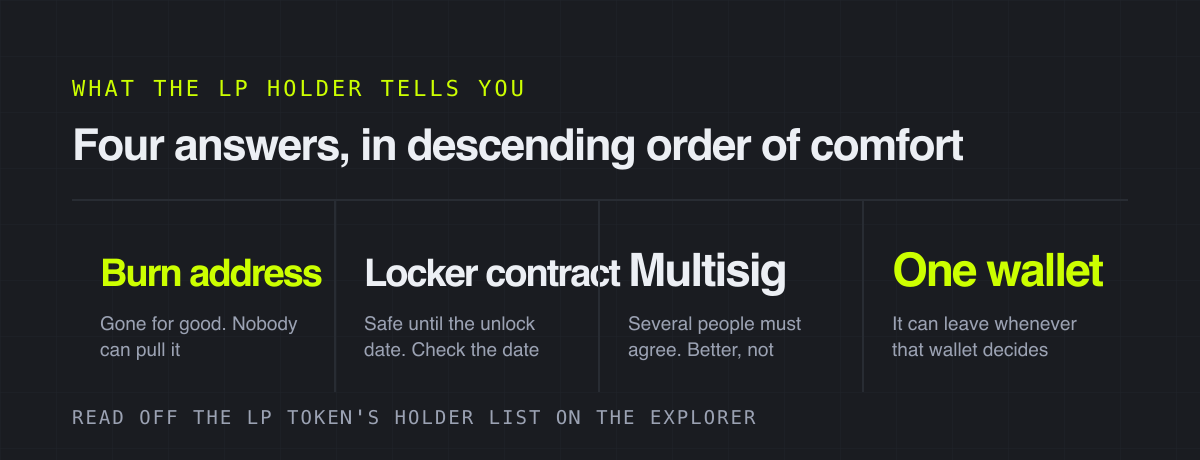
Locked, burned and neither
| Where the LP tokens are | What it means |
|---|---|
| A burn address | Permanent. The receipt is unspendable, so the liquidity can never be withdrawn by anyone |
| A locker contract | Time-limited. Withdrawal is blocked until a date the contract states publicly |
| A multisig | Several signers must agree. Slower to rug, not impossible |
| A single wallet | Withdrawable at any moment, by whoever holds that key |
Burned is the strongest of these and also the most final: it means nobody, including honest founders with good reasons, can ever move that liquidity again.
The check, step by step
- Get the pair address from the screener's pair page, not the token address – the pool is what you are checking.
- Open it on the block explorer and find the LP token for that pair.
- Open the LP token's holder list.
- Read the top holders. A burn address, a recognisable locker, a multisig, or somebody's wallet – that is your answer.
- If it is a locker, open the locker and read the unlock date. A lock expiring in six days is technically a lock.
Where launchpads change the answer
Tokens launched through a bonding curve often do not have a withdrawable pool at all until they graduate, and several launch mechanisms send the resulting LP position straight to a burn address or into locked liquidity by design. That is a property of the launchpad rather than a promise from the team, and it is worth knowing which launchpad a token came from before you go looking.
What a lock does not protect you from
Supply concentration
Locked liquidity and a team holding forty percent of the supply are entirely compatible. The pool stays; the selling comes from the wallets, and the chart goes to the same place. This is the most common shape of loss on a token with a locked pool, and a holder-clustering tool answers it in seconds.
Mint authority
If the contract can still issue new tokens, the pool's size is not the constraint anyone thought it was. Check whether minting has been renounced, which the explorer will also tell you.
A contract that will not let you sell
Locked liquidity and a token you cannot exit are, again, compatible. The lock governs the pool, not the transfer rules of the token.
The lock simply ending
A thirty-day lock on a token you intend to hold for three months has told you about the first thirty days. Dates are the part of this check people read least carefully.
Where it sits in a real check
This is one question of four, and on its own it is the weakest of them. Holder concentration, sell-side behaviour in the transaction feed, and mint authority all cost about as little to check and each rule out a failure that a lock does not. Run them together or the two minutes buy you a false sense of having looked.
FAQ
What does LP burned mean?
The LP tokens – the receipt for the liquidity position – were sent to an address nobody holds the key to. The pool remains, but no one can ever withdraw it, including the people who created it. It is stronger than a time lock and permanent in both directions.
Is locked liquidity safe?
It removes one specific failure: the pool being pulled out from under the price. It does nothing about concentrated supply, a mintable contract, or a token whose transfer rules prevent selling, and those account for most losses on tokens whose liquidity was locked.
How long should liquidity be locked for?
Longer than you intend to hold, which is the only comparison that matters. A short lock on a project describing itself as long-term is a mismatch worth noticing; read the unlock date rather than the presence of a lock.
More from the blog
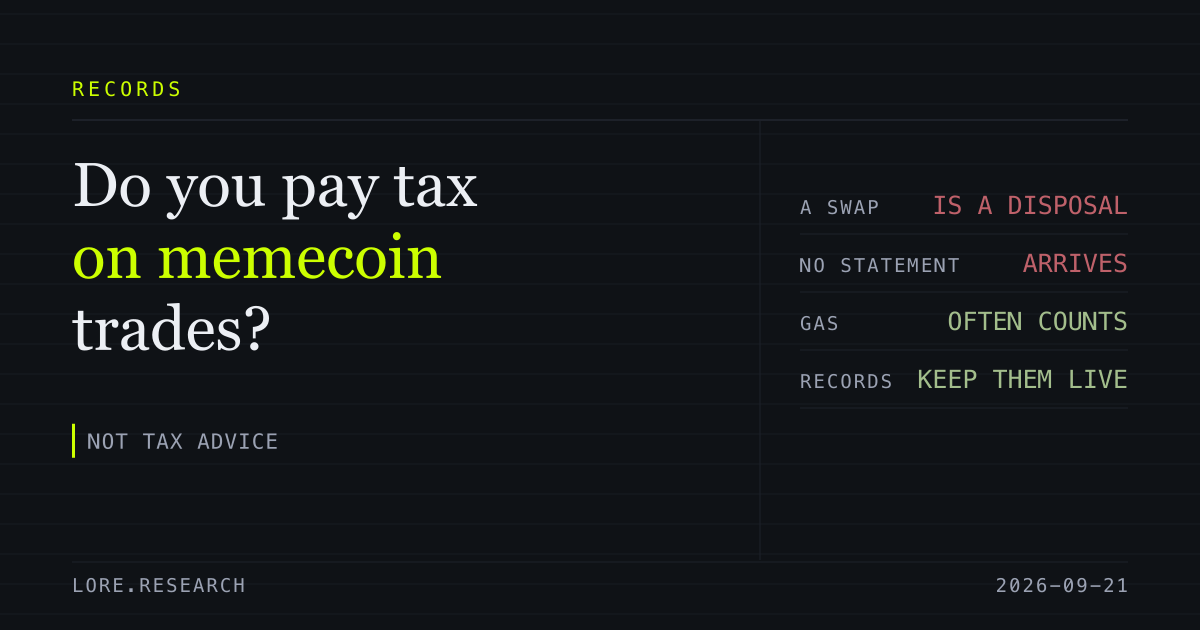
Do You Pay Tax on Memecoin Trades? What Creates an Event
Not advice, and not jurisdiction-specific. A description of which onchain actions tax authorities generally treat as events, and what records you will need if yours does.
A Trading Journal for Onchain Trades: What to Record
The chain already logs every transaction you made. What it cannot log is why you made it, and that is the column the journal exists for.
Paper Trading Memecoins When No Paper Mode Exists
There is no demo account on a DEX. Here is how to practise anyway – and the one thing simulation can never teach you.