Prediction Markets: A Price That Looks Like a Probability
A contract paying one dollar if something happens trades at the market's estimate of it happening. The gap between that and a forecast is where the money is.
The short answer
A prediction market trades contracts that pay a fixed amount if an event occurs and nothing if it does not. The price therefore sits between zero and one and reads as a probability – but it is a price, set by who has capital and conviction, and it diverges from a true probability in predictable ways.
A prediction market contract pays a fixed amount if an event happens and nothing if it does not. Because the payout is one or zero, the price has to sit between them, and a price of sixty-three cents is naturally read as a sixty-three percent chance.
That reading is close enough to be useful and wrong in ways worth knowing, because the gap between a market price and a true probability is where anyone trading these actually makes money.
Why it is a price first
The number is set by whoever is willing to transact, weighted by their capital. A market where one well-funded participant has a strong view prices that view, not the consensus of everyone who has an opinion. On a thin book that is the normal situation rather than the exception.
The cost of being right slowly
Buying a contract at eighty cents to collect a dollar is a twenty-five percent return, which sounds excellent until you ask when. If resolution is a year away, that capital is locked for a year, and the return has to compete with everything else it could have done.
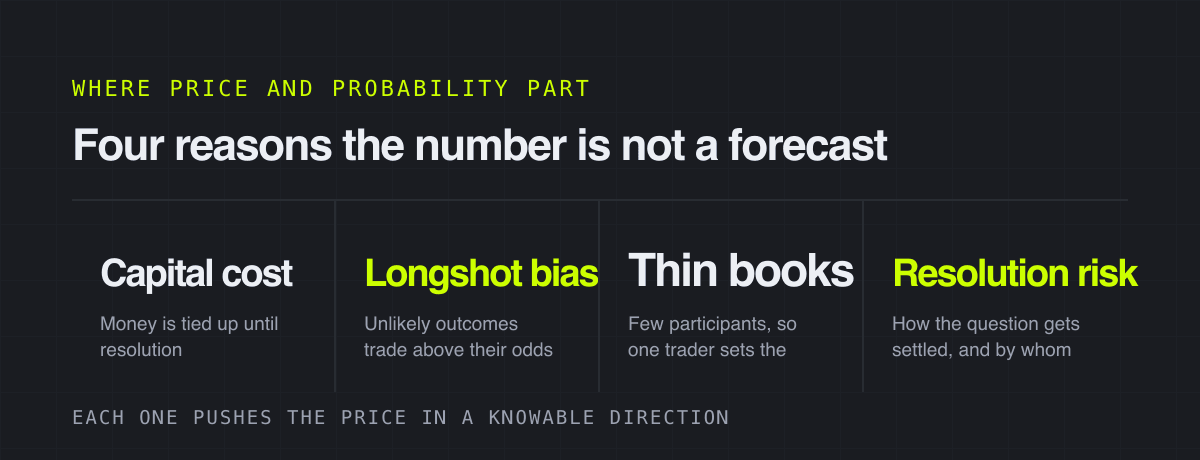
Longshot bias
Unlikely outcomes trade persistently above their real frequency, in prediction markets as in every betting market ever studied. A contract at three cents is usually worth less than three cents, because a small stake on a large payoff is attractive in a way the arithmetic does not justify.
Which means the structurally profitable side is usually selling the longshot rather than buying it – a position that wins quietly and often, and loses loudly and rarely.
The risk that is not the event
| Risk | What it is |
|---|---|
| The event | The one you intended to take |
| Resolution | How the question is settled, and by whom |
| Ambiguity | Wording that turns out to cover two cases |
| Liquidity | Needing to exit before resolution, into a thin book |
| Capital | The return, divided by how long you waited |
Resolution deserves more attention than it gets. Someone or something decides whether the event occurred, and a question whose wording admits two readings becomes a dispute about the wording rather than about the world. Read the resolution criteria before the price.
What they are genuinely good for
As a reference, they are frequently better calibrated than commentary, because having money on it concentrates the mind. As a trade, the edge is in cases where you know something specific about an outcome and the market is thin enough that nobody has already priced it.
- Read the resolution criteria first, every time. It is the contract, and the price is not.
- Divide the return by the time to resolution before calling anything cheap.
- Treat prices under five cents with suspicion – that is where longshot bias lives.
- Check how much is actually traded, not just the quoted price. A thin market has one person's opinion in it.
- Copytrading infrastructure now reaches these markets –
 CopyFomo and similar products list prediction-market leaders alongside spot and perps.
Tools mentioned
FAQ
What is a prediction market?
A market in contracts that pay a fixed amount if an event occurs and nothing otherwise. Since the payout is one or zero, the price sits between them and is commonly read as the market's estimate of the probability.
Are prediction market prices accurate probabilities?
Close, with known distortions. Capital tied up until resolution pulls distant prices toward the middle, unlikely outcomes trade above their real frequency, and a thin book can reflect one well-funded participant's view.
How do you make money on a prediction market?
By knowing something specific the price has not absorbed, usually in a market thin enough that nobody has priced it yet. Structurally, selling overpriced longshots wins often and loses rarely and large.
What is the biggest risk in prediction markets?
Resolution rather than the event. A question whose wording admits more than one reading turns into a dispute about the wording, so the resolution criteria matter more than the price.
More from the blog
Staking, and Why There Is None on This Chain
Staking pays you for securing a network. An L2 that settles to Ethereum and charges gas in ETH has nothing for you to secure.
Multisig: Removing the Single Point of Failure
Two of three signatures to move anything. It solves theft and loss at once, and introduces a problem of its own.
The Seed Phrase: What Those Twelve Words Actually Are
Not a password. A number, written in a dictionary, from which every key you will ever have is derived.