Robinhood Chain RPC, Chain ID 4663 and Network Details
The five fields you need, where to get them safely, and which RPC provider to use when the public one is not enough.
The short answer
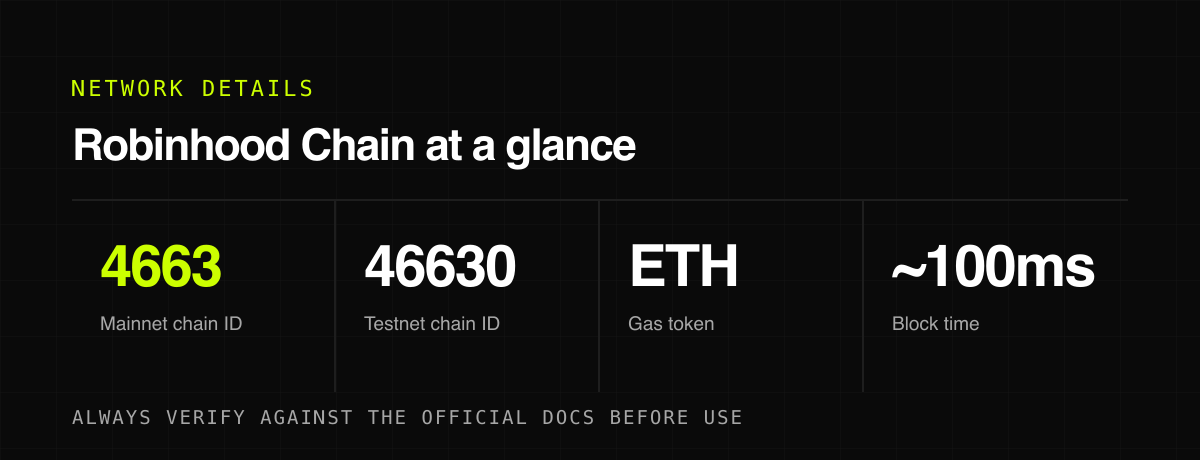
Robinhood Chain uses chain ID 4663 for mainnet and 46630 for testnet. The mainnet RPC is https://rpc.mainnet.chain.robinhood.com, gas is paid in ETH, and the block explorer is robinhoodchain.blockscout.com. It is an Arbitrum Orbit rollup settling to Ethereum with roughly 100ms block times. Alchemy is the recommended infrastructure provider, with QuickNode, Blockdaemon, dRPC, Chainstack, Dwellir and Validation Cloud also supporting the chain for production workloads that need archive access or higher rate limits.
Everything on this page is public information, but where you copy it from matters. Lookalike RPC endpoints are a known phishing pattern on every new chain, and a malicious RPC can show you fabricated balances and quotes.
The network fields
| Field | Value |
|---|---|
| Network name | Robinhood Chain |
| Chain ID | 4663 |
| Testnet chain ID | 46630 |
| RPC URL | https://rpc.mainnet.chain.robinhood.com |
| Testnet RPC | https://rpc.testnet.chain.robinhood.com |
| Currency symbol | ETH |
| Block explorer | https://robinhoodchain.blockscout.com |
What kind of chain this is
Robinhood Chain is built on Arbitrum Dedicated Blockchains — an Orbit rollup — and settles to Ethereum, inheriting its security. It produces a block roughly every 100 milliseconds and uses a first-come, first-served sequencing model for predictable ordering. Mainnet launched 1 July 2026.
It is fully EVM-compatible: Solidity and Vyper contracts deploy unmodified, and Hardhat, Foundry, ethers.js, viem and Wagmi all work out of the box. It also has first-class ERC-4337 account abstraction support, so gas sponsorship, batching and session keys are available natively.
When the public RPC is not enough
The public endpoint is fine for a wallet. It is not fine for an indexer, a bot or anything that needs archive state or a serious rate limit.
- Alchemy — the recommended provider, also supplying the Data API and gasless transaction infrastructure.
- QuickNode — low-latency JSON-RPC, full archive with debug and trace, plus real-time Streams.
- Chainstack, Dwellir, dRPC, Blockdaemon, Validation Cloud — all support the chain; compare on archive depth, rate limits and regional latency.
- Bitquery and Goldsky — for indexed data rather than raw RPC. Goldsky has indexed the chain since launch and is used by Uniswap, Privy, Rainbow, LI.FI and Bubblemaps.
Adding the network to a wallet
Robinhood Wallet and OKX Wallet support the chain natively with no configuration. For everything else: open the network dropdown, choose add network manually, paste the five fields above, save, then switch. MetaMask, Rabby and Trust Wallet all follow the same pattern under their custom network menus.
Chainlist does this in one click and removes the chance of a typo in the RPC field, which is the most common setup error.
Checking whether the chain is the problem
Before assuming an app is broken, check the official status page at status.robinhoodchain.offchain.io. During the chain's early months a meaningful share of stuck-transaction reports traced back to chain or indexer status rather than to the application.
Why a bad RPC is a security problem
An RPC endpoint is how your wallet learns what is true. It reports your balances, estimates gas, and broadcasts your transactions. A malicious endpoint can lie about all three.
The realistic attack is not dramatic. It shows you a balance that is not there, or a quote that is not real, and lets you act on it. By the time the discrepancy surfaces you have already signed. This is why the RPC URL should come from official documentation or Chainlist, and never from a message.
Choosing a provider for real workloads
The public endpoint is rate-limited and not archival. That is fine for a wallet and inadequate for anything that reads history or runs continuously.
- Archive access — needed for any historical query. Ask explicitly; 'full node' does not imply archive.
- debug and trace methods — required to reconstruct what a transaction did internally. Not all providers expose them.
- Rate limits and burst behaviour — the published limit matters less than what happens when you exceed it.
- Regional latency — for anything latency-sensitive, the nearest endpoint beats the best-specified one.
- Websocket or streaming support — polling for new blocks at 100ms block times is a losing design.
Building on the chain: the practical notes
Because this is an Arbitrum Orbit rollup with full EVM compatibility, Solidity and Vyper contracts deploy unmodified and the standard toolchain — Hardhat, Foundry, ethers.js, viem, Wagmi — works without adaptation. The testnet at chain ID 46630 mirrors mainnet for integration work.
The feature worth designing around is first-class ERC-4337 account abstraction. Gas sponsorship, transaction batching and session keys are available natively, which on a chain aimed at users arriving from a brokerage app rather than from crypto is arguably the most important capability it has.
 Alchemy
 Goldsky
 Bubblemaps
 Uniswap
 Robinhood Wallet
 OKX Wallet
 MetaMask
 Rabby
RabbyFAQ
What is the Robinhood Chain RPC URL?
https://rpc.mainnet.chain.robinhood.com for mainnet and https://rpc.testnet.chain.robinhood.com for testnet. Verify against the official documentation rather than copying from third-party posts.
What is the Robinhood Chain chain ID?
4663 for mainnet, 46630 for testnet. Gas is paid in ETH.
How do I add Robinhood Chain to MetaMask?
Either add the network manually with the five fields from the official docs, or use Chainlist and search 4663 for a one-click add. Robinhood Wallet and OKX Wallet support it natively.
Which RPC provider should I use for production?
Alchemy is Robinhood's recommended provider. QuickNode, Chainstack, Dwellir, dRPC, Blockdaemon and Validation Cloud also support the chain — compare archive depth, rate limits and latency for your workload.
More from the blog
How to Find a Wallet Worth Copying on Robinhood Chain
Leaderboards rank by total profit, which is mostly size and luck. Five checks that separate a repeatable edge from one lucky position.
Is Copytrading Profitable? The Arithmetic Nobody Runs First
Copytrading pays you the leader's return minus four deductions. Here is what each one costs, and the win rate a wallet needs before following it makes money.
Copytrading vs Trading Yourself: Which Actually Suits You
One rents someone else's research at a fixed price. The other charges you in time instead of fees. The honest comparison on cost, control and what you learn.