How to Check a Robinhood Chain Token Before You Buy
Four checks, in order, that take ninety seconds and prevent most avoidable losses.
The short answer
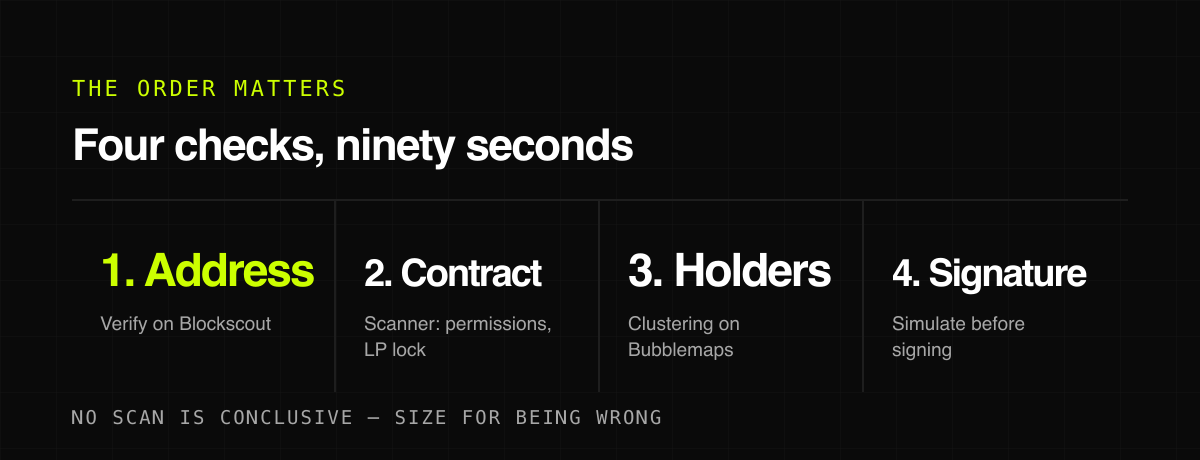
Checking a Robinhood Chain token takes four steps. First, verify the contract address on Blockscout matches the token you were told about — lookalike addresses cause more losses than bad projects. Second, run it through a scanner such as Ruginhood, HoodScan or TokenChecker for simulated buy and sell, mint and blacklist permissions, and liquidity lock status. Third, check holder clustering on Bubblemaps, since supply that looks distributed is often one entity. Fourth, use a wallet that simulates transactions before you sign. No scan is conclusive — size accordingly.
The most common way to lose money on a new chain is not picking a bad token. It is buying a different token than the one you researched. Everything below is ordered by how much loss it prevents per second spent.
Check 1: the address, on Blockscout
Take the contract address from wherever you found it, paste it into Blockscout, and confirm the name, symbol and decimals match. Then confirm the source code is verified.
This sounds trivial and it is the single highest-value check on this list. Lookalike contracts with identical names and symbols are trivially cheap to deploy, and a large share of early losses on Robinhood Chain traced to copy-pasted addresses from replies rather than to genuine rug pulls.
Check 2: the contract, through a scanner
Scanners simulate a buy and a sell and inspect the contract for risky functions. What you are looking for:
- Can you sell? A simulated sell that fails is a honeypot, full stop.
- Mint authority — can the deployer create more supply after launch?
- Blacklist or pause functions — can they stop you selling later?
- Liquidity lock — is the LP locked, by whom, and until when?
- Ownership — is the contract renounced, or does one key still control it?
On Robinhood Chain, Ruginhood and HoodScan are chain-native options. TokenChecker covers the chain alongside Solana, Ethereum, BSC and Base, and scans the deployer wallet rather than only the contract — useful, because serial ruggers reuse wallets. GeckoTerminal's rug checker adds a security score from third-party scans.
Check 3: who actually holds it
Blockscout shows holder counts and top holders. Bubblemaps goes further and visualises clustering — wallets that funded each other, or that were funded from the same source, appear as connected bubbles rather than as independent holders.
A token showing 800 holders where 40% of supply sits in one connected cluster is a token with one holder and 799 decorations.
Check 4: simulate before you sign
Most drains are not exploits. They are approvals people granted without reading. Rabby simulates the transaction and shows the actual balance changes and risk warnings before you sign, which turns an abstract permission into a visible consequence. It is the highest-leverage safety upgrade available and it costs nothing.
Afterwards, run a periodic pass through Revoke.cash to cancel allowances you no longer use. An unused approval is a standing liability with no upside.
What none of this covers
A clean contract with locked liquidity and distributed holders can still go to zero because nobody wants it. These checks eliminate a category of loss — theft and mechanical traps — not market risk. On a chain producing thousands of tokens a day, most go to zero honestly.
Size every position as though the scan missed something, because eventually one will.
The permissions that actually matter
Scanners surface a lot of flags and not all of them mean the same thing. Four are close to disqualifying on their own.
- Mint function still active. The deployer can create supply at will. Nothing else about the token matters if this is true.
- Blacklist or transfer restriction. They can stop you specifically from selling, after you have bought.
- Unlocked or short-locked liquidity. Liquidity can be pulled. A lock expiring next week is a scheduled exit, not protection.
- Upgradeable proxy. The contract you scanned is not necessarily the contract you will be trading against tomorrow.
Modifiable fees sit one tier below. A contract that lets the owner raise the sell tax to an arbitrary number is a soft version of a blacklist, and it is common enough that scanners often report it without emphasis.
Scanning the deployer, not just the contract
A clean contract from a wallet that has deployed nine previous tokens, all of which went to zero within a day, is not a clean opportunity. Serial deployers reuse wallets because creating fresh ones with funding history costs effort.
The explorer makes this checkable in under a minute: open the contract's creation transaction, take the deployer address, and look at its transaction history. Tools like TokenChecker automate part of this by scanning the deployer alongside the contract, which is a meaningfully better default than contract-only scanning.
Approvals are the real attack surface
Almost nobody loses a wallet to a clever exploit. They lose it to an approval granted months earlier to a contract that turned malicious or was always malicious and waited.
An approval is permanent until revoked. It does not expire, it does not reset when you stop using the application, and it does not care that you only meant to trade once. A wallet that simulates transactions catches the moment you grant one; a periodic revocation pass cleans up the ones you already did.
Tools mentioned
 GeckoTerminal
 Ruginhood
 HoodScan
 Bubblemaps
 Rabby
RabbyFAQ
How do I check if a Robinhood Chain token is a rug?
Verify the contract on Blockscout, run it through Ruginhood, HoodScan or TokenChecker for simulated trades, mint and blacklist permissions and liquidity lock, then check holder clustering on Bubblemaps. No single scan is conclusive.
What is a honeypot?
A token you can buy but cannot sell, usually via contract logic that blocks transfers from ordinary holders. Any scanner that simulates a sell will catch the obvious versions.
What is the safest wallet for Robinhood Chain?
A wallet that simulates transactions before signing — Rabby is the common choice — because most losses come from approvals people did not realise they were granting rather than from contract exploits.
Should I revoke token approvals?
Yes, periodically. Revoke.cash lists outstanding allowances per chain and lets you cancel them. Run a pass after any session where you interacted with unfamiliar contracts.
More from the blog
How to Find a Wallet Worth Copying on Robinhood Chain
Leaderboards rank by total profit, which is mostly size and luck. Five checks that separate a repeatable edge from one lucky position.
Is Copytrading Profitable? The Arithmetic Nobody Runs First
Copytrading pays you the leader's return minus four deductions. Here is what each one costs, and the win rate a wallet needs before following it makes money.
Copytrading vs Trading Yourself: Which Actually Suits You
One rents someone else's research at a fixed price. The other charges you in time instead of fees. The honest comparison on cost, control and what you learn.