Why a Copy Trade Failed: Seven Causes, in Order
Most failures are not the bot. They are a transaction that could not execute, and each cause has a different fix.
The short answer
A copy trade that does not execute almost always has a mechanical cause: slippage tolerance too tight, not enough balance for gas, a filter excluding the trade, a position cap below the minimum, a missing approval, a token with a transfer tax, or a pool too thin to fill at your size.
A mirrored trade that did not happen feels like the bot broke. Usually a transaction was attempted and could not complete, or was deliberately skipped by a rule you set. Both are diagnosable, and the order below goes from cheapest to check to hardest.
One: slippage too tight
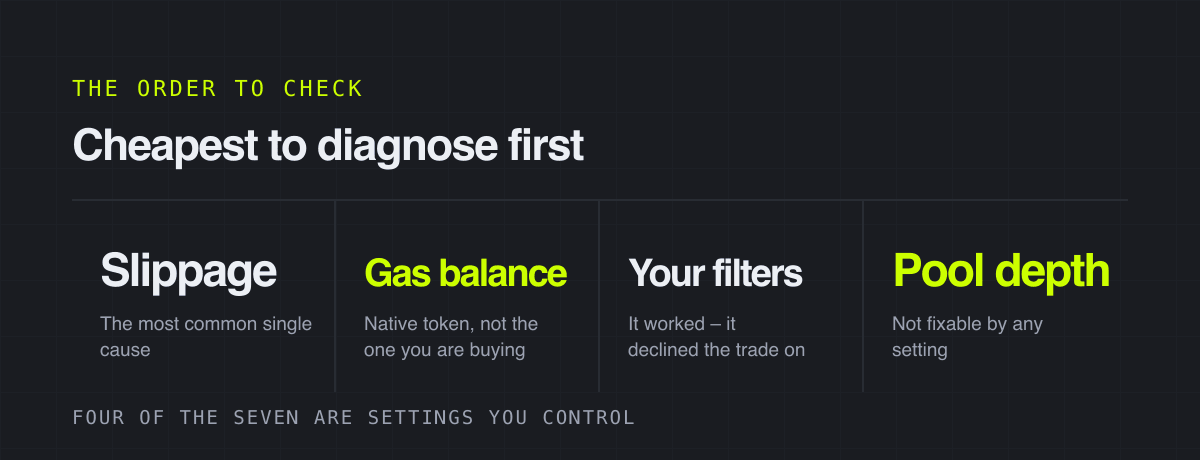
The most common cause by a distance. A tolerance that works on a deep pair will revert constantly on a new launch, because the price moves between the transaction being built and it landing. The failure looks like the bot doing nothing; the chain shows a reverted transaction.
Two: not enough for gas
Every mirrored trade needs the chain's native asset for gas, separately from whatever you are spending on the token. A wallet with its full balance deployed has nothing left to transact with, and the trade fails before it starts.
Three: your own filters declined it
If you set a minimum liquidity floor or a maximum position size, trades outside those bounds are skipped – which is the feature working, not failing. This is worth checking early because it produces exactly the same symptom as a breakage.
Four: the cap is below the minimum
A position cap set very low can produce an order too small to be worth executing after fees, or too small for the pool to fill meaningfully. Nothing is wrong; the arithmetic simply does not clear.
Five: a missing approval
Selling a token requires an approval for the router handling it. A buy can succeed and the matching sell fail for this reason alone, which is the most alarming version of the problem because it looks like being trapped in a position.
Six: the token takes a transfer tax
Some contracts charge on transfer. If the tax exceeds your slippage tolerance, every attempt reverts, and no setting on the bot will fix a rule written into the token. This is also one of the things a contract scanner catches before you buy.
Seven: the pool cannot fill you
The leader traded into a pool with enough depth for their size and not for yours, or the depth has changed since. This one is not a setting and cannot be configured around – it is the trade not being available.
| Symptom | Most likely cause | Fix |
|---|---|---|
| Nothing happens on new launches only | Slippage too tight | Raise it for thin pools |
| Nothing happens at all | No gas, or the bot is not active | Check the native balance first |
| Some trades copy, others do not | Your own filters | Read the rules you set |
| Buys work, sells fail | Missing approval, or a transfer tax | Approve; check the contract |
| Filled at a terrible price | Slippage too wide for the depth | Tighten, and add a liquidity floor |
How to diagnose properly
- Open your wallet on
 Blockscout Explorer and look for a reverted transaction. That single check separates 'did not try' from 'tried and failed'.
- If there is no transaction at all, it is a filter, a cap, or the bot not running.
- If there is a reverted one, it is slippage, gas or a token rule – and the revert reason narrows it further.
- Check the pool's liquidity against your intended size before blaming any setting.
The useful habit is checking the chain before the settings. The chain tells you whether anything was attempted, and that answer cuts the list of seven causes roughly in half.
Tools mentioned
FAQ
Why is my copy trade not working?
Usually slippage set too tight for the pool, no native balance left for gas, or your own filters declining the trade. Checking the chain for a reverted transaction tells you immediately whether anything was attempted at all.
Why did my buy work but the sell fail?
Most often a missing approval for the router, or a token that charges a transfer tax exceeding your slippage tolerance. The second is written into the contract and no bot setting will change it.
Why do only some trades get copied?
Almost always a filter you set – a minimum liquidity floor or a maximum position size – doing exactly what it was configured to do. It produces the same symptom as a failure.
How do I tell if the bot tried at all?
Look at your wallet on a block explorer. A reverted transaction means it tried and could not complete; no transaction at all means a filter, a cap, or the bot not being active.
More from the blog
Prediction Markets: A Price That Looks Like a Probability
A contract paying one dollar if something happens trades at the market's estimate of it happening. The gap between that and a forecast is where the money is.
Staking, and Why There Is None on This Chain
Staking pays you for securing a network. An L2 that settles to Ethereum and charges gas in ETH has nothing for you to secure.
Multisig: Removing the Single Point of Failure
Two of three signatures to move anything. It solves theft and loss at once, and introduces a problem of its own.