Multisig: Removing the Single Point of Failure
Two of three signatures to move anything. It solves theft and loss at once, and introduces a problem of its own.
The short answer
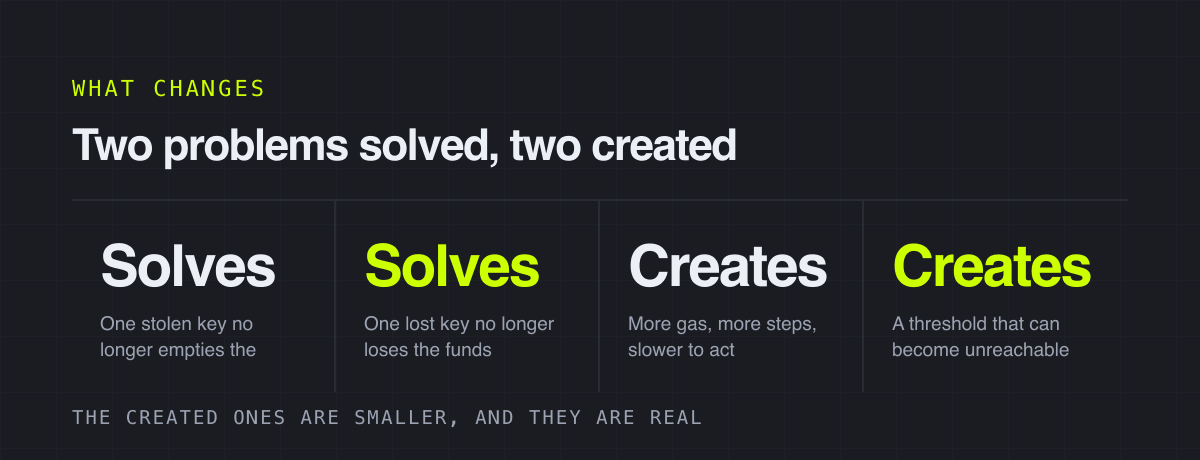
A multisig wallet is a contract that requires several signatures before it executes anything. It removes the single point of failure in a normal wallet – one key stolen or lost no longer means everything gone – at the cost of higher gas, more setup, and a new failure mode where the threshold itself becomes unreachable.
An ordinary wallet has one key, and that key is simultaneously the thing that must never be stolen and the thing that must never be lost. Those two requirements pull in opposite directions – backing it up more makes theft easier, backing it up less makes loss easier – and multisig is the structural answer to that tension.
What it actually is
A contract that holds the funds and will only execute a transaction when enough of its designated signers have approved it. Two of three is the common setup: three keys exist, any two can act, and no single one can do anything alone.
It is not a special kind of key or a wallet application. The funds belong to a contract address, and the keys are inputs to its rules.
Why two of three works
Because it survives both failures. A stolen key is useless on its own, so a compromise gives you time to move funds using the other two. A lost key still leaves two, which is enough to act – and to add a replacement.
What it costs
Every transaction requires multiple approvals, each of which is a transaction, so gas is higher and acting is slower. That slowness is a genuine cost when something needs to move quickly, and it is also a feature – a wallet you cannot drain in thirty seconds is a wallet you cannot be socially engineered into draining in thirty seconds.
| Setup | Theft of one key | Loss of one key | Suited to |
|---|---|---|---|
| Single key | Everything gone | Everything gone | Trading size only |
| 2 of 2 | Survivable | Everything gone | Nothing, really |
| 2 of 3 | Survivable | Survivable | Personal holdings |
| 3 of 5 | Survivable | Survivable twice | Shared treasuries |
The failure mode people do not plan for
Key distribution that looked sensible and becomes unreachable. Three keys in the same drawer is one key. Three keys across three people who stop speaking is a locked wallet. Two keys on devices that both got replaced is a very expensive lesson.
The configuration is a decision about failure, so it should be made by listing the failures: what happens if a device dies, if a person is unreachable for a month, if a house burns down, if you are the one who is unavailable.
- Keep signers genuinely independent – different devices, different locations, different custody methods.
- Write down the recovery procedure somewhere a successor could find, because an undocumented multisig is a trap for anyone who inherits it.
- Test a transaction with a small amount after setup and after any signer change.
- Keep a separate ordinary wallet for trading. A multisig is for holdings, not for reacting to a chart.
For most individuals the honest recommendation is simpler than multisig: a hardware-backed wallet for holdings, a separate hot wallet funded with trading size, and approvals cleared regularly through  Revoke.cash. Multisig earns its complexity when funds are shared, or large enough that a single mistake is unacceptable.
Tools mentioned
FAQ
What is a multisig wallet?
A contract that holds funds and only executes a transaction when a set number of designated signers approve it – commonly two out of three. No single key can move anything alone.
Is multisig safer than a hardware wallet?
It solves a different problem. A hardware wallet protects one key from a compromised computer; multisig removes the single point of failure entirely, so one key being stolen or lost is survivable.
What is the best multisig configuration?
Two of three for personal holdings – it survives both a stolen key and a lost one. Two of two should be avoided, since it protects against theft while making the loss of either key fatal.
What are the downsides of multisig?
Higher gas and more steps per transaction, slower action when speed matters, and a new failure mode where keys end up co-located or unreachable and the threshold can no longer be met.
More from the blog
Prediction Markets: A Price That Looks Like a Probability
A contract paying one dollar if something happens trades at the market's estimate of it happening. The gap between that and a forecast is where the money is.
Staking, and Why There Is None on This Chain
Staking pays you for securing a network. An L2 that settles to Ethereum and charges gas in ETH has nothing for you to secure.
The Seed Phrase: What Those Twelve Words Actually Are
Not a password. A number, written in a dictionary, from which every key you will ever have is derived.