Floor Price: The Most Quoted and Least Useful NFT Number
It is the cheapest ask, not a valuation. One listing moves it, and nobody has to buy anything.
The short answer
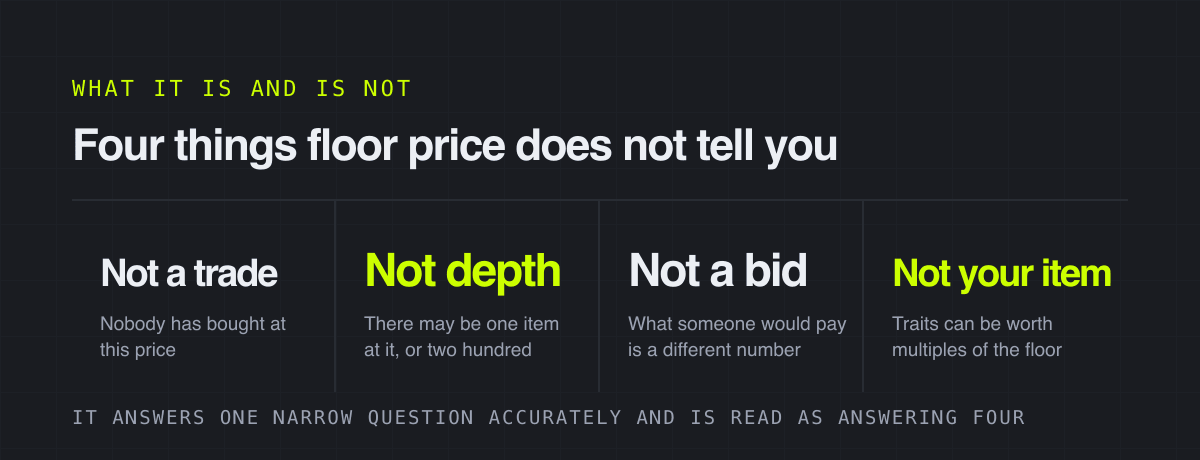
Floor price is the lowest price anyone is currently asking for an item in a collection. It is an ask, not a trade – it can be moved by one person listing or delisting, says nothing about whether anyone would pay it, and ignores every difference between items in the collection.
Floor price is the first and often only number anyone quotes about an NFT collection, and it is an asking price. The cheapest item currently listed. That is the whole definition, and almost everything it gets used for requires more than it contains.
Why one person can move it
Because it is a minimum over listings, not an average over sales. One holder listing below the crowd sets a new floor instantly without anyone buying anything, and one holder cancelling a listing raises it the same way.
That makes the number trivially manipulable in both directions, and it makes a floor chart a record of listing behaviour rather than of demand.
The number on the other side
What matters for selling is the best bid – what someone has actually offered. The gap between the floor and the top bid is the real spread of the collection, and on an illiquid one it is enormous.
Depth, which nobody quotes
How many items sit at or near the floor decides what happens when demand arrives. Five listings near the floor and a bid wave clears them, moving the price sharply. Three hundred listings near the floor and the same demand is absorbed with no movement at all.
| What you see | What to read instead |
|---|---|
| Floor price | The cheapest ask, right now |
| Floor rising | Possibly nobody selling, not more buying |
| Best bid | What you could actually get today |
| Listings near the floor | How much supply absorbs demand |
| Recent sales | The only prices anyone genuinely paid |
Your item is not the floor
In any collection with traits, items are not interchangeable. The floor is set by the least wanted item in the collection, which is precisely the one you are least likely to own if you chose at all. Pricing your own holding at the floor is usually wrong in one direction or the other, and knowing which requires looking at sales of comparable items rather than at a collection-wide number.
How to read a collection properly
- Start with recent sales, not the floor. Only sales are prices someone agreed to.
- Check the best bid – it is your actual exit if you need one.
- Count listings near the floor to understand whether demand would move the price.
- Look at unique holders against supply. A collection held by few wallets has a floor set by few people.
- On Robinhood Chain,
 Blockscout NFT Tokens shows holders and transfers directly, which is the version with no marketplace framing on top.
None of this says the floor is useless. It is a fast, honest answer to one question – what is the cheapest way into this collection right now – and a bad answer to every other question it gets asked.
Tools mentioned
FAQ
What does NFT floor price mean?
The lowest price anyone is currently asking for any item in the collection. It is a listing rather than a completed sale, so no one has necessarily paid it.
Can floor price be manipulated?
Easily, in both directions. It is a minimum over current listings, so one person listing below everyone sets a new floor without a trade occurring, and cancelling listings raises it the same way.
Is floor price what my NFT is worth?
Only if your item is the least desirable in the collection, since that is what sets the floor. For anything with traits, comparable recent sales are the relevant number – and the best bid is what you could actually realise today.
What should I look at instead of floor price?
Recent sales for prices people agreed to, the best bid for what you could get now, and the number of listings near the floor for whether incoming demand would move the price at all.
More from the blog
Prediction Markets: A Price That Looks Like a Probability
A contract paying one dollar if something happens trades at the market's estimate of it happening. The gap between that and a forecast is where the money is.
Staking, and Why There Is None on This Chain
Staking pays you for securing a network. An L2 that settles to Ethereum and charges gas in ETH has nothing for you to secure.
Multisig: Removing the Single Point of Failure
Two of three signatures to move anything. It solves theft and loss at once, and introduces a problem of its own.