Tokenized Commodities: What Is Behind the Barrel
Gold sits in a vault. Oil does not sit anywhere convenient, which is why almost every oil token is a fund and not a barrel.
The short answer
Tokenized commodities split into two groups: things that can be stored and redeemed, like precious metals, and things that cannot, like oil and agricultural products. The second group is tokenized through funds and futures rather than the physical good, which introduces roll cost – the reason an oil token can fall over a year in which oil rose.
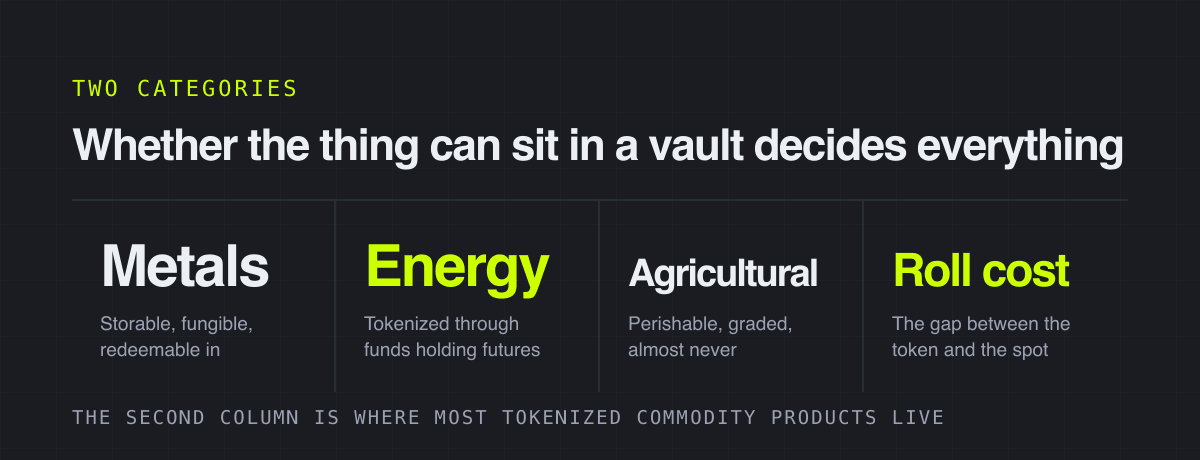
Commodity tokenization gets described as one thing, and it is two. Whether a commodity can be stored cheaply and graded consistently decides what the token can possibly be, and the two answers produce products that behave nothing alike.
The storable half
Precious metals work because a bar is a bar. It does not rot, it does not need refrigeration, it is fungible by weight and purity, and vault storage costs a fraction of a percent a year. That makes a genuine claim on specific metal possible, which is why gold tokenization arrived first and remains the cleanest case in the whole RWA category.
The half that cannot be stored
Oil is the opposite. Storage is expensive, capacity is finite, grades differ, and delivery is a logistics problem rather than a transfer. Nobody is issuing you a barrel. What exists instead is a token referencing a fund that holds futures contracts – on this chain that is what a tokenized USO position is, and the distinction is not academic.
Roll cost, which is not a fee
This is the part that surprises people, and it is worth being precise about. It is not the issuer taking a cut and it is not tracking error in the usual sense. It is structural: the fund cannot hold oil, so it holds a promise about oil in a month, and renewing that promise has a price.
When futures further out are more expensive than near ones, renewal loses money every time. Over a year of that, an oil fund can be down while spot oil is up, and no amount of reading the token's documentation will change the arithmetic – it is a property of the underlying market, faithfully transmitted.
| Commodity | How it is usually tokenized | The main gap to spot |
|---|---|---|
| Gold, silver | Allocated metal in a vault | Storage fee and redemption limits |
| Oil, gas | A fund holding futures | Roll cost, which compounds |
| Agricultural | Futures or a fund, rarely physical | Roll cost plus seasonality |
| Industrial metals | Mixed, often via funds | Storage economics vary by metal |
What to read before buying
- Find out whether the token references a physical holding or a fund. That one answer predicts most of the behaviour.
- If it is a fund, find out what it holds. Futures mean roll cost; physical means storage cost.
- Compare a year of the token against a year of the spot price. The gap is the structure, made visible.
- Check pooled liquidity before size. A commodity token with a thin pool is a commodity you cannot sell at the price you see.
- Read the contract on
 Blockscout Explorer for the usual compliance functions, and check the category's size on
  DefiLlama RWA.
The honest use case
Commodity exposure that settles in minutes, sits in the same wallet as everything else and does not close at the weekend is genuinely useful – particularly as something uncorrelated to hold beside a book of memecoins. That is the case for it.
The case against is holding a futures-based token for a year while believing you hold the commodity. Both things can be true at once, and which one applies to you depends entirely on how long you intend to hold.
Tools mentioned
FAQ
What are tokenized commodities?
Tokens representing exposure to physical goods – metals, energy, agricultural products. Storable commodities like gold can be backed by the actual material; the rest are tokenized through funds holding futures, which behaves differently.
Why does an oil token not track the oil price?
Because it holds futures, not oil. Each month the expiring contract is sold and a later one bought, and when the later one costs more the difference is a loss. Over a year that roll cost can outweigh a rise in spot oil entirely.
Can you redeem tokenized commodities for the physical goods?
For precious metals, sometimes, at institutional minimums. For energy and agricultural tokens, effectively never – there is no physical holding behind them to redeem, only fund shares.
Are tokenized commodities good for diversification?
The exposure is genuinely uncorrelated to crypto, which is the point. But a futures-based token diversifies your price exposure while concentrating your structural risk in one issuer and one pool, so size it as an onchain position rather than as a commodity holding.
More from the blog
Tokenized Bonds Beyond Treasuries: Credit, Coupons and Who May Hold Them
A tokenized treasury is a short government loan with no credit question. Everything else in the bond market has one, and it changes the product.
Tokenized Private Credit: The Yield Is Someone Else's Loan
The highest yields in RWA come from the part with no public market, no daily price and no easy exit. That is not a coincidence.
Tokenized ETFs: A Wrapper Around a Wrapper
An ETF is already a basket you do not hold directly. Tokenizing it adds a second layer, and the second layer is where the differences live.