Robinhood Chain: A Beginner's Guide That Skips the Marketing
What the chain is, what you can actually do on it, and the five things that go wrong first.
The short answer
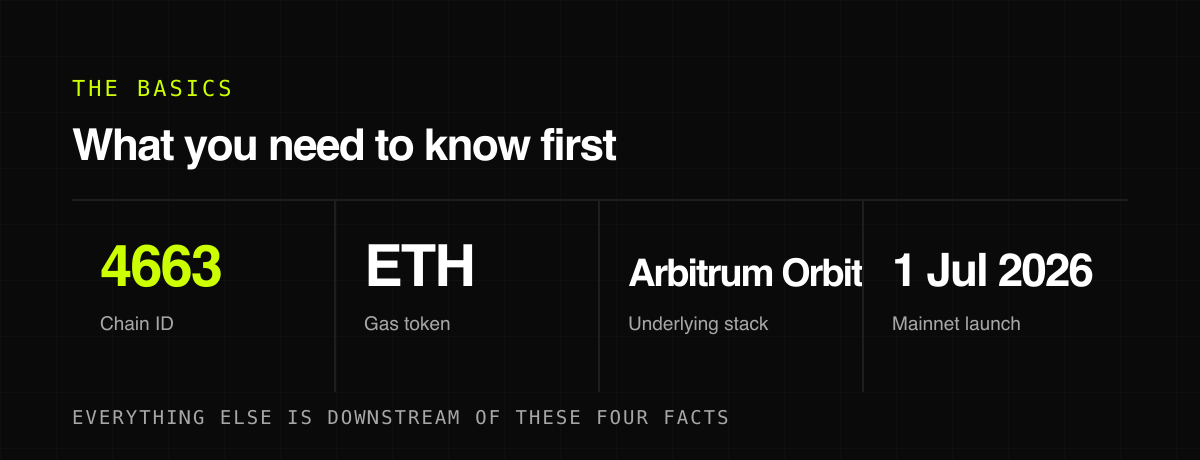
Robinhood Chain is an Ethereum Layer 2 built by Robinhood Crypto on the Arbitrum Orbit stack, with chain ID 4663 and gas paid in ETH. Mainnet launched 1 July 2026. Four things drive activity: trading 190+ tokenized stock tokens around the clock, trading memecoins from bonding-curve launchpads, supplying liquidity to Uniswap pools, and minting or trading NFTs on OpenSea. You do not need a Robinhood brokerage account to use it — any EVM wallet connects directly.
Most introductions to this chain repeat a press release. Here is what actually matters if you intend to use it.
What it is
Robinhood Chain is a permissionless, Ethereum-compatible Layer 2 built on the Arbitrum Orbit stack. It settles to Ethereum, uses ETH as its gas token, and produces a block roughly every 100 milliseconds. It is fully EVM-compatible, so ordinary Ethereum wallets and developer tools work without modification.
Its stated purpose is tokenized real-world assets — equities, ETFs and other financial instruments represented on-chain. That is genuinely what distinguishes it. What drove its early activity, however, was memecoins.
What you can actually do on it
- Trade stock tokens. 190+ tokenized stocks and ETFs — NVIDIA, Apple, Alphabet, QQQ — as standard ERC-20s, trading around the clock. Not available to US persons.
- Trade memecoins. Bonding-curve launchpads produce thousands of tokens; PONS alone has launched 167,000+.
- Earn yield. Lending on Morpho, liquidity provision on Uniswap, or higher-risk incentivised farms.
- Trade NFTs. OpenSea supports the chain; the first season produced 80,000 secondary sales.
Getting on, in four steps
- Wallet. Robinhood Wallet and OKX Wallet support the chain natively. Everything else adds chain 4663 manually or via Chainlist. For active trading, use a wallet that simulates transactions before signing.
- Bridge ETH. Canonical Arbitrum route for size, or Relay / Across / Jumper for speed. Bridge ETH first even if you want a different asset — you need it for gas.
- Verify. Confirm your balance on Blockscout before connecting to anything.
- Start small. A test transaction on a new route or a new app costs almost nothing and catches most mistakes.
The five things that go wrong first
- Arriving with no ETH. You bridge USDC to buy something, then discover you cannot pay gas. Bridge ETH first.
- Copy-pasting the wrong contract address. Lookalike tokens are trivially cheap to deploy. Verify on Blockscout every time.
- Signing an unlimited approval. Most drains are approvals, not exploits. Use a wallet that shows you what you are signing.
- Chasing a trending list. By the time something trends, the first move has happened. Trending is a lagging indicator by construction.
- Treating an emission APR as yield. A four-figure APR paid in a farm's own token is a directional bet on that token, not interest.
Where to go next
Read the official chain documentation for the technical base, Uniswap's launch post for how liquidity is structured, and Robinhood's stock-token pages for the RWA side. Those three cover the mechanics behind almost everything else on the chain.
Your first week, if you want a plan
- Day one. Set up a wallet, add the network, bridge a small amount of ETH — an amount you would not mind losing entirely. Send a transaction. Confirm it on the explorer.
- Day two. Do one swap on Uniswap. Read the transaction on the explorer afterwards and find the token transfer line. This is the single most useful habit you can build.
- Day three. Look at the chain's actual data. Open the TVL page, the DEX volume page, and one dashboard. Form your own view of whether this chain is growing.
- Day four. Pick one thing you are curious about — stock tokens, launches, LP — and read about only that. Breadth is a trap at the start.
- Day five onward. Do that one thing at sizes that cannot hurt, and keep a record of what you did and why.
The record matters more than it sounds. Nearly everyone who improves at this reviews their own trades; nearly everyone who does not, does not.
The costs you should expect
Gas is paid in ETH and is low, but the real costs sit elsewhere. Bridging in costs a fee or origin-chain gas. Swapping costs a pool fee plus slippage, and slippage on thin pairs dwarfs everything else. Terminals add 0.5–1% per side. Nothing here is expensive individually; the total on an active week is larger than people expect.
Budget for it explicitly. If your position sizes are small enough that fees are a meaningful share of the trade, the honest answer is to trade less often in larger size rather than to hunt for a cheaper venue.
How to tell when you are being sold something
- An APR with no explanation of where the yield comes from is a red flag, not an opportunity.
- A tool that cannot explain what it does without invoking the chain's name is selling the chain.
- 'Guaranteed' and 'risk-free' do not exist here. Nor does a confirmed airdrop nobody has announced.
- Urgency is the oldest technique in this industry. Anything that must be done in the next ten minutes is usually best not done.
Tools mentioned
 PONS
PONS Uniswap
 Morpho
 Robinhood Wallet
 OKX Wallet
 Relay
RelayFAQ
Do I need a Robinhood account to use Robinhood Chain?
No. The chain is permissionless and any Ethereum-compatible wallet connects directly. A Robinhood account is only needed for in-app products such as Stock Tokens and Robinhood Earn.
What can I do on Robinhood Chain?
Trade 190+ tokenized stock tokens around the clock, trade memecoins from bonding-curve launchpads, lend on Morpho or provide liquidity on Uniswap, and mint or trade NFTs on OpenSea.
Is Robinhood Chain safe?
The chain itself is an Arbitrum Orbit rollup settling to Ethereum and inherits Ethereum's security. The applications on it are independent and unaudited by Robinhood — the risk is at the application layer, not the chain layer.
How much does it cost to use?
Gas is paid in ETH and is low relative to Ethereum mainnet. Robinhood covered gas fees for the first 90 days after launch; that programme has ended, so keep an ETH balance.
More from the blog
How to Find a Wallet Worth Copying on Robinhood Chain
Leaderboards rank by total profit, which is mostly size and luck. Five checks that separate a repeatable edge from one lucky position.
Is Copytrading Profitable? The Arithmetic Nobody Runs First
Copytrading pays you the leader's return minus four deductions. Here is what each one costs, and the win rate a wallet needs before following it makes money.
Copytrading vs Trading Yourself: Which Actually Suits You
One rents someone else's research at a fixed price. The other charges you in time instead of fees. The honest comparison on cost, control and what you learn.