Arbitrum Orbit: The Stack Robinhood Chain Is Built On
Not a brand on a box. A specific set of choices about who orders transactions, where the data goes, and what you are trusting when you bridge in.
The short answer
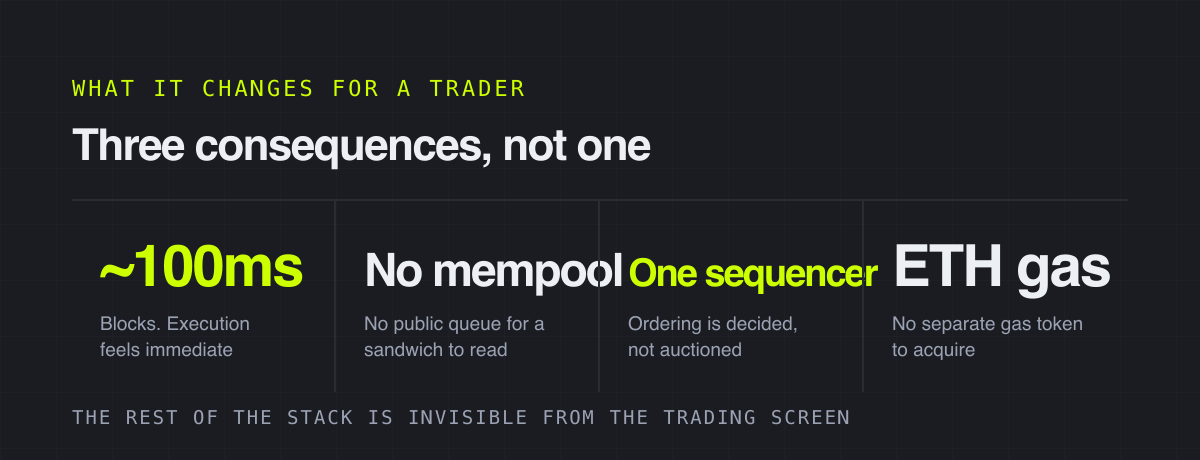
Arbitrum Orbit is a framework for launching a chain that uses Arbitrum's technology and settles elsewhere rather than being part of Arbitrum One. Robinhood Chain is one: an Ethereum Layer 2 on the Orbit stack, chain ID 4663, gas paid in ETH, live since 1 July 2026. The practical consequences for a trader are three. Blocks arrive roughly every hundred milliseconds, so execution feels immediate. There is no public mempool, so the classic sandwich attack has no queue to read. And ordering is decided by a sequencer run by one party, which is a different trust assumption from a public fee auction rather than the absence of one.
Most chain-architecture writing is for people deploying chains. This is the version for someone who trades on one and wants to know which parts of the design they are actually exposed to.
What Orbit is
A framework from Offchain Labs for launching your own chain using Arbitrum's proven technology, rather than deploying onto Arbitrum One alongside everyone else. An Orbit chain gets its own block space, its own fee market and its own rules, and settles to a parent chain for security.
The trade is the usual one: a chain of your own means no competition for block space and full control of the parameters, at the cost of a smaller ecosystem and having to bootstrap liquidity from nothing.
What Robinhood Chain chose
| Stack | Arbitrum Orbit, settling to Ethereum |
| Chain ID | 4663 |
| Gas token | ETH, so no separate asset to acquire first |
| Block time | Roughly 100 milliseconds |
| Mempool | None public |
| Live since | 1 July 2026 |
The three that reach the trading screen
Fast blocks
A hundred milliseconds means a confirmation arrives faster than you can react to it, which is why trading here feels closer to a centralised venue than to Ethereum. It also compresses the window in which anything can happen between your click and your fill, which is quietly good for execution.
No public mempool
Transactions go to the sequencer rather than sitting in an open queue. The classic sandwich attack reads that queue, and there is not one to read. A great deal of MEV advice written for other chains assumes a mempool that is not here, and applying it produces solutions to a problem in a different shape.
One sequencer
Somebody decides the order, and on this chain it is a single party rather than an open auction. That removes the fee-bidding war and replaces it with a trust assumption: you are relying on that party to order fairly and to keep running.
The questions worth asking of any Orbit chain
- Where does it settle, and is that where its security actually comes from?
- Who runs the sequencer, and what happens if it halts – is there a forced-inclusion path or an escape hatch to the settlement layer?
- Where does the data go, and can you read it on
 Blockscout? A chain posting data to Ethereum inherits more of Ethereum's guarantees than one posting it elsewhere.
 - What is the gas token, and does using the chain require acquiring something first?
- How do the canonical bridges work, and which of them is the one with the strongest guarantee rather than the fastest transfer?
What this means in practice
For day-to-day trading, very little – which is the point of a well-chosen stack. Where it matters is in the failure cases: sequencer downtime, a slow exit under stress, and bridging decisions where the cheap route and the trust-minimised route are not the same route. Those are the places to have read the documentation rather than a summary of it.
Tools mentioned
FAQ
What is Arbitrum Orbit?
A framework from Offchain Labs for launching a chain that uses Arbitrum's technology and settles to a parent chain, rather than deploying onto Arbitrum One. The chain gets its own block space, fee market and parameters, at the cost of bootstrapping its own ecosystem.
Is Robinhood Chain an Arbitrum chain?
It is built on the Arbitrum Orbit stack and settles to Ethereum, which makes it an Ethereum Layer 2 using Arbitrum's technology rather than a part of Arbitrum One. Chain ID 4663, gas paid in ETH, live since 1 July 2026.
Does Robinhood Chain have a mempool?
Not a public one. Transactions go to the sequencer instead of sitting in an open queue, which removes the input the classic sandwich attack depends on. In exchange, ordering is decided by a single party rather than by an open fee auction.
More from the blog
What Volume Means, and When the Number Is Manufactured
Volume is how much traded, not how many wanted to. Two wallets with a script can produce a week of it in an afternoon.
How to Swap Tokens, and the Four Screens That Matter
The swap itself is two clicks. Everything that decides whether it was a good one happens on the screens around it.
What a Contract Address Is, and Why It Is the Real Name
A token's name and ticker are text anyone can copy. The address is the only part that cannot be faked, which is why every safety check starts there.