How to Bridge to Robinhood Chain: Every Route, Ranked by Cost and Speed
The canonical Arbitrum route, the fast third-party bridges, and the mistake that strands most first-time users.
The short answer
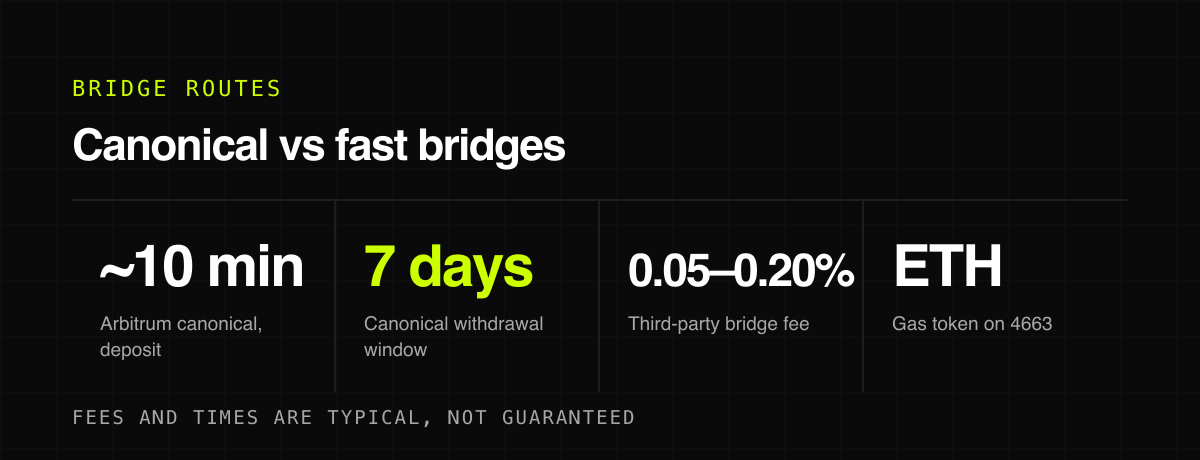
To bridge to Robinhood Chain you move ETH from Ethereum or another network onto chain ID 4663. The canonical route is the Arbitrum bridge portal, which is trust-minimised and inherits Ethereum's security but is slow to withdraw. For speed, third-party bridges — Relay, Across, and LI.FI/Jumper — settle in minutes for a 0.05–0.20% fee. Gas on Robinhood Chain is paid in ETH, so always bridge ETH first even if your real target is a stock token or a memecoin; arriving with only ERC-20s and no ETH leaves you unable to transact.
Robinhood Chain is an Ethereum Layer 2 built on the Arbitrum Orbit stack. It settles to Ethereum, produces a block roughly every 100 milliseconds, and uses ETH as its gas token. Mainnet went live on 1 July 2026. None of that changes how you get funds in — but it does decide which bridge is the right one for the size you are moving.
Step 1: add the network before you move anything
Robinhood Wallet and OKX Wallet support the chain natively, with no setup. Every other EVM wallet needs the network added manually. The values come from the official documentation, and you should take them from there rather than from a forum post — lookalike RPC entries are a known phishing vector.
| Field | Value |
|---|---|
| Network name | Robinhood Chain |
| Chain ID | 4663 (testnet: 46630) |
| RPC URL | https://rpc.mainnet.chain.robinhood.com |
| Currency symbol | ETH |
| Block explorer | robinhoodchain.blockscout.com |
Chainlist can add the network in one click if you search 4663, which avoids typos in the RPC field.
Step 2: pick the route that matches your size
There are two categories, and the choice is a genuine trade-off rather than a matter of preference.
Canonical: the Arbitrum bridge portal
The canonical route is trustless — security is inherited directly from Ethereum, and no third-party validator set stands between you and your funds. Deposits typically confirm in about ten minutes. The catch is the withdrawal leg: getting back out through the canonical bridge means waiting through the optimistic rollup challenge window, which runs to seven days.
Fast: Relay, Across, Jumper
Third-party bridges front you the funds on the destination chain and settle among themselves afterwards. That turns a ten-minute deposit into seconds and a seven-day withdrawal into minutes, at a cost of roughly 0.05% to 0.20%. Robinhood's own developer documentation names LI.FI, Relay, Across, Stargate and Chainlink CCIP as partner integrations, so these are not fringe options.
- Relay — usually the cheapest route for small transfers; the fee barely moves on sub-$1,000 amounts.
- Across — intent-based, competitive on plain ETH transfers.
- Jumper (LI.FI) — an aggregator that compares routes across providers, which saves you checking three sites.
Step 3: bridge ETH first, always
This is where most first-time users get stuck. Gas on Robinhood Chain is paid in ETH. If you bridge only USDC because you intend to buy a stock token, you arrive with a balance you cannot spend — every swap needs gas, and you have none. The fix is another bridge transaction, which is annoying rather than expensive, but it is entirely avoidable.
Robinhood covered gas fees for the first 90 days after the July mainnet launch, which hid this problem for early users. That programme has run its course; assume you need ETH.
Step 4: verify before you interact
Once funds land, confirm them on Blockscout rather than trusting the bridge UI. Paste your address, check the balance and the incoming transaction, and only then connect to an application. If something looks stuck, check the official chain status page before assuming the bridge failed — during the chain's early months, a meaningful share of 'stuck transaction' reports traced back to indexer or chain status rather than the bridge.
The short version
- Add chain 4663 via Chainlist or the official docs.
- Bridge ETH — canonical Arbitrum route for size, Relay or Across for speed.
- Send a small test transaction first, every time, on a new route.
- Confirm arrival on Blockscout.
- Keep a gas buffer in ETH before you go hunting for a mint or a launch.
What bridging actually costs
The advertised bridge fee is rarely the number you pay. A canonical deposit charges no protocol fee but costs Ethereum mainnet gas on the way in, which on a busy day can exceed a fast bridge's entire percentage fee on a small transfer. A fast bridge charges 0.05–0.20% but its origin-chain gas is usually trivial if you are coming from another L2.
The crossover point sits somewhere in the low thousands of dollars, and it moves with Ethereum gas. The practical rule: if you are bridging under a few thousand dollars, a fast bridge is almost always cheaper all-in. Above that, the canonical route's zero percentage fee starts to dominate and its security model is the better trade anyway.
Getting back out
Most guides stop at the deposit. The exit is where the routes genuinely diverge. A canonical withdrawal means waiting through the optimistic rollup challenge window — up to seven days — before funds are claimable on Ethereum. That is not a failure state, it is how the security model works, but it surprises people who bridged in expecting symmetry.
Third-party bridges collapse that to minutes because a liquidity provider fronts you the funds and absorbs the wait. You are paying a fee to rent someone else's patience, and taking on that provider's risk while you do.
Things that go wrong, and what they actually mean
- Funds not showing after the bridge confirmed — check the explorer for your address before assuming loss. If the transaction landed, the bridge worked and the interface is behind.
- Transaction pending far longer than quoted — check the official chain status page. Chain or indexer issues explain more of these than bridge failures do.
- Wrong token arrived — bridged assets sometimes arrive as a wrapped representation rather than the canonical token. Confirm the contract address matches the one the application expects.
- No gas on arrival — the most common one, and the only one that is entirely self-inflicted. Bridge ETH first.
Tools mentioned
 Robinhood Wallet
 OKX Wallet
 Chainlink
 Relay
RelayFAQ
What is the Robinhood Chain chain ID?
4663 for mainnet and 46630 for testnet. Gas is paid in ETH, and the network is an Arbitrum Orbit rollup that settles to Ethereum.
Can I send ETH directly from an exchange to Robinhood Chain?
Usually not. Most exchanges do not yet support withdrawals directly to Robinhood Chain, so the practical path is exchange → your wallet on Ethereum or Arbitrum → bridge. Check your exchange's withdrawal network list before assuming otherwise.
How long does bridging to Robinhood Chain take?
About ten minutes for a canonical Arbitrum deposit. Fast bridges such as Relay, Across and Jumper settle in seconds to minutes. Withdrawing through the canonical bridge takes up to seven days because of the optimistic rollup challenge window.
Which bridge is cheapest?
For small amounts, a fast bridge is usually cheapest in practice because the canonical route still costs Ethereum gas on the deposit leg. For large amounts the canonical bridge wins, since its percentage fee is zero.
More from the blog
How to Find a Wallet Worth Copying on Robinhood Chain
Leaderboards rank by total profit, which is mostly size and luck. Five checks that separate a repeatable edge from one lucky position.
Is Copytrading Profitable? The Arithmetic Nobody Runs First
Copytrading pays you the leader's return minus four deductions. Here is what each one costs, and the win rate a wallet needs before following it makes money.
Copytrading vs Trading Yourself: Which Actually Suits You
One rents someone else's research at a fixed price. The other charges you in time instead of fees. The honest comparison on cost, control and what you learn.