DEX Screener Boosts: Buying a Multiplier on Attention
A boost does not put a token on the trending list. It multiplies a score the token already had, for twelve to twenty-four hours.
The short answer
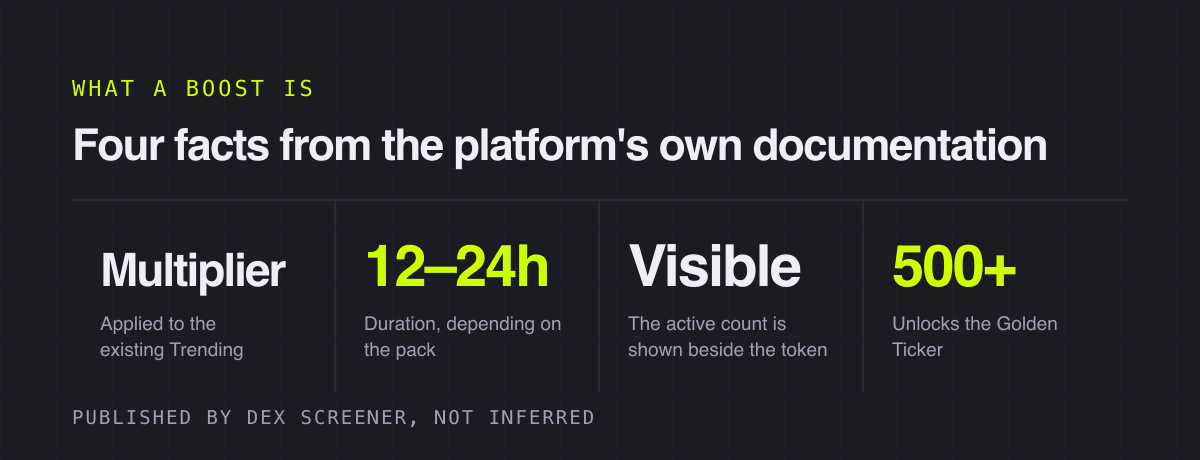
Boosts are purchased packs that temporarily multiply a token's Trending Score, lasting 12 to 24 hours depending on the pack, with the active count shown next to the token. At 500 or more active Boosts the ticker turns gold. DEX Screener states plainly that Boosts do not replace the other ranking inputs.
Boosts are the paid layer on  DEX Screener's ranking, and the platform is unusually straightforward about what they do. A pack is purchased, it applies a multiplier to the token's existing Trending Score, and it expires after twelve to twenty-four hours depending on which pack was bought.
The part people get wrong
A Boost multiplies. It does not add, and it does not replace the other inputs. DEX Screener says so directly: Boosts can help a well-performing token rise further, but a token with weak fundamentals will not reach the top of the list by buying them.
The Golden Ticker
At 500 or more active Boosts, the token's symbol turns gold across the screener and its token page, and stays gold as long as that count holds. It is explicitly a status display rather than a ranking mechanism – a visible signal that somebody spent a great deal on visibility.
Which makes it informative in a direction people do not usually read it. A golden ticker tells you a budget exists. It tells you nothing about what the budget was spent to distract from.
What you can read from the count
| What you see | What it tells you |
|---|---|
| No boosts, high rank | The ranking came from activity and attention |
| Boosts, high rank | Both – and the multiplier needed something to multiply |
| Many boosts, modest rank | Spending without underlying activity |
| Golden ticker | A large budget, allocated to visibility |
| Boosts expiring, rank falling | The attention was rented |
The practical reading
The most useful thing about Boosts is that they are visible and they expire. A token whose rank collapses as its Boosts run out was being carried by them, and that is readable within a day – which is faster than almost any other signal available on a new token.
- Check the boost count alongside the rank, not instead of it.
- Note when boosts expire and look again. The score after is the honest one.
- Treat a golden ticker as evidence of spending, which is neither good nor bad on its own.
- Remember what boosts cannot touch: liquidity, holder concentration, and whether the contract is safe.
A correction worth making
It is often said that DEX Screener has no stake in what you buy because it takes no cut of your trade. The first half is true – it does not execute and charges nothing on a swap. The second half needs qualifying: Boosts are a paid product that directly multiplies ranking position, which is a commercial interest in the ranking even though it is not one in your trade.
Disclosed, visible, and time-limited, which is about as well as that can be handled. But worth stating accurately.
Tools mentioned
FAQ
What are DEX Screener Boosts?
Purchased packs that temporarily multiply a token's Trending Score. They last 12 to 24 hours depending on the pack, and the number of active Boosts is displayed next to the token across the platform.
Do Boosts guarantee a token will trend?
No, and DEX Screener says so explicitly. Boosts apply a multiplier to the existing score rather than replacing the other ranking inputs, so a token with weak activity will not reach the top by buying them.
What is the Golden Ticker on DEX Screener?
A visual status unlocked at 500 or more active Boosts, which turns the token's symbol gold on the screener and its page. It lasts as long as the count stays above 500.
Can every token be boosted?
Most can, with exceptions – tokens that have been inactive for over 24 hours or that carry certain flags are excluded. Boosting is also only available in a web browser, not in the mobile app.
More from the blog
Prediction Markets: A Price That Looks Like a Probability
A contract paying one dollar if something happens trades at the market's estimate of it happening. The gap between that and a forecast is where the money is.

Staking, and Why There Is None on This Chain
Staking pays you for securing a network. An L2 that settles to Ethereum and charges gas in ETH has nothing for you to secure.
Multisig: Removing the Single Point of Failure
Two of three signatures to move anything. It solves theft and loss at once, and introduces a problem of its own.