What Slippage Is, and Why You Got Fewer Tokens Than the Quote
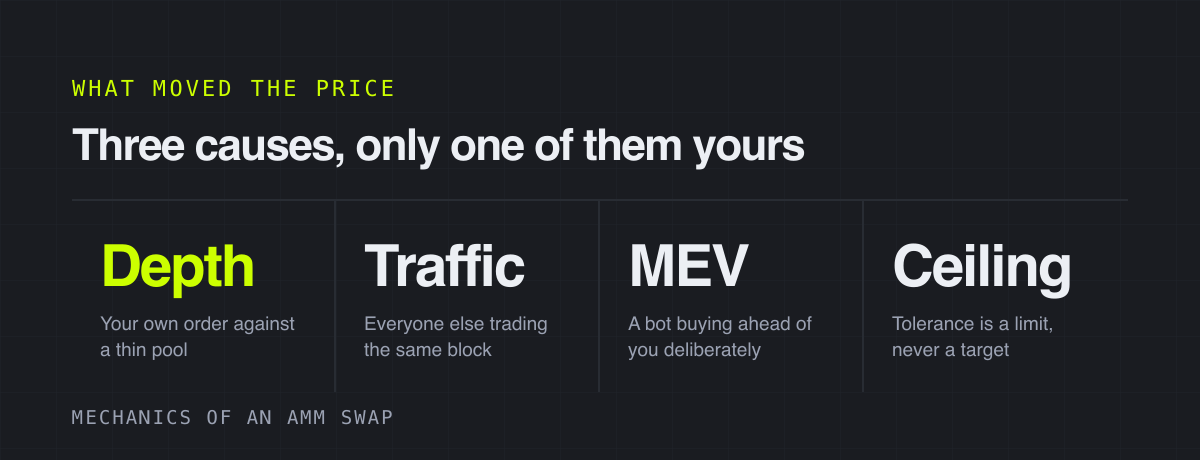
The quote is a prediction about a pool that other people are also trading. Three things move it before your transaction lands.
The short answer
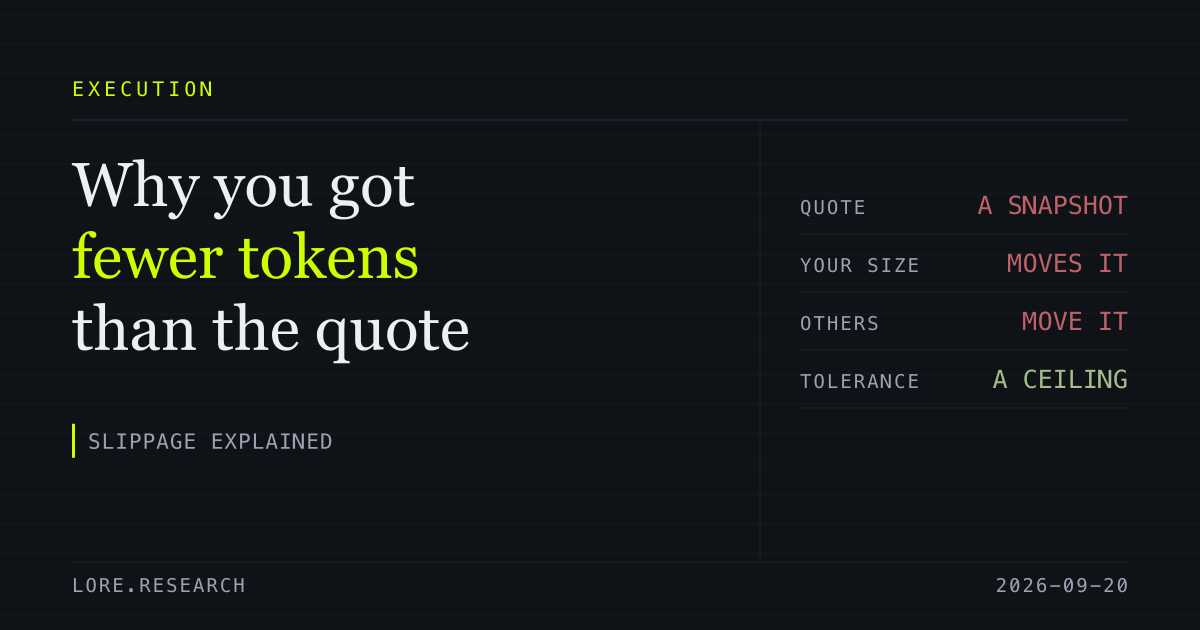
Slippage is the gap between the price a swap quotes you and the price you actually get. It exists because a quote is a snapshot of a pool taken before your transaction is included, and the pool keeps moving in between. Three things cause it: your own order size relative to the pool's depth, other people trading the same pool in the same moment, and on some chains a bot deliberately trading ahead of you. Slippage tolerance is not a target – it is the worst fill you are willing to accept, and setting it loose on a thin pool is how people pay far more than the number they were shown.
You entered one ETH, the interface said you would receive some number of tokens, you confirmed, and fewer arrived. Nothing went wrong. What you were shown was a quote, and a quote on an automated market maker is a calculation about the pool as it stood a moment ago.
Why a quote is a prediction
A pool holds two assets and prices them against each other by ratio. Buying moves the ratio, which moves the price – that is the whole mechanism, and it applies to your own order too. The quote you see is what you would get if nothing changed between the click and the block. Something almost always changes.
Cause one: your own size
The larger your order relative to the pool, the more of the price movement is yours. In a deep pool a modest buy barely registers. In a pool with a few ETH of liquidity the same buy can be most of the volume in that block, and you are quite literally paying yourself a worse price as you go. This is why reading liquidity before sizing matters more than reading the chart.
Cause two: everyone else
Other buyers and sellers are in the same block. On a new launch there may be hundreds of them, all of whom saw the same chart you did. Their orders move the pool between your quote and your fill, and on a token that is moving quickly this alone can be the whole difference.
Cause three: MEV, and why this chain is different
On a typical public chain, pending transactions sit in a mempool where anyone can read them. A bot that sees a large buy can place its own buy in front of yours, let your order push the price up, and sell into it. That is a sandwich, and it is a real cost that looks exactly like ordinary slippage on your screen.
Robinhood Chain has no public mempool, which removes the simplest version of that attack – there is no queue to read. It is worth knowing this rather than assuming, because much of the advice written about slippage assumes a mempool that is not there. It does not make execution free, and it does not help with the first two causes at all.
Setting tolerance properly
- Treat tolerance as the worst price you will accept, not the price you expect.
- Start low. If the transaction fails, that is the pool refusing your order at a price you said you would not exceed – which is the setting working.
- Raise it deliberately and by small amounts, knowing that each step widens what you might pay.
- On a thin pool, size down instead of loosening tolerance. The tolerance does not make the pool deeper.
- Check the pool on Dexscreener before a large order rather than after a bad fill.
Where tools help
Terminals with MEV protection route the order so it is harder to front-run, which addresses the third cause. Definitive splits large orders across time and venues with TWAPs, which addresses the first. Neither does anything about the second, and no tool makes a thin pool deep.
Tools mentioned
 Dexscreener
 Definitive
FAQ
What is slippage tolerance?
The maximum difference between quote and fill you are willing to accept. If the price moves past it before your transaction lands, the swap fails instead of executing at a price you did not agree to. It is a safety limit, not a setting to raise until things work.
What is a good slippage setting?
The lowest one that lets your trade complete. Deep pools fill at very low tolerance; new launches may need more, and the fact that they need more is itself a warning about the pool you are buying into.
Is slippage the same as a fee?
No. A fee is a known amount taken by the pool or the tool. Slippage is a price movement, it varies with conditions, and it can occasionally go in your favour – though on a token everyone is buying at once, it rarely does.
More from the blog
How to Start Trading Memecoins
Six things to set up before the first buy, in the order that stops the common mistakes.
What “Smart Money” Means, and When the Label Lies
A wallet that made money is not the same as a wallet that knows something. Telling them apart is the whole skill.
What to Do After a Rug Pull
Nothing gets the money back. Several things stop the next hour being worse than the last one.