Robinhood Chain Trading Terminals Compared
Six terminals, one liquidity layer. What you are actually paying for is the data around the trade.
The short answer
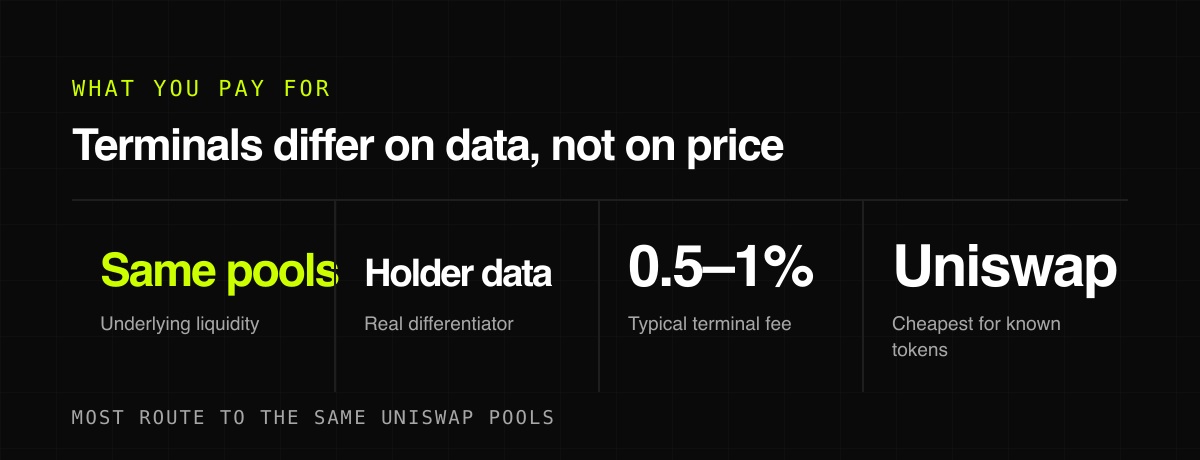
Trading terminals on Robinhood Chain almost all route to the same Uniswap liquidity, so the differentiator is the data wrapped around execution: holder distribution, dev wallet tracking, safety scans and wallet following. GMGN is the broadest all-in-one, Axiom is the pro-grade execution layer, FOMO merges a social feed with trading, BasedBot focuses on discovery, Nock Terminal pairs execution with wallet research, and HyperHood covers perps. For swapping a token you already know, plain Uniswap is enough and cheaper.
Here is the thing nobody selling a terminal will tell you: they mostly trade against the same pools. Uniswap holds the majority of public spot liquidity on Robinhood Chain, and most terminals route there. You are not buying better prices. You are buying the information that surrounds the decision.
When a terminal is worth it
If you are swapping a token you already researched, open Uniswap and save the fee. A terminal earns its cut on new launches, where you need holder distribution, dev wallet behaviour, liquidity lock status and a safety scan in the same screen as the buy button — because the decision window is minutes and switching tabs costs you the trade.
The six
| Terminal | Strongest at | Watch out for |
|---|---|---|
| GMGN | All-in-one: new pairs, holder analysis, wallet tracking, security scan, copytrade | Breadth over depth in any single area |
| Axiom | Pro execution — orderbook-style management, hotkeys, limit orders | Fee is meaningfully above a plain swap |
| FOMO | Social layer — a live feed of who is buying what, merged with execution | Signal quality depends on who you follow |
| BasedBot | Discovery via Discover/Pulse feeds with one-click execution | Lighter on post-trade analytics |
| Nock Terminal | Execution paired with wallet research and PnL leaderboards | Newer, smaller data history |
| HyperHood | High-density perpetual trading | Perps only — not a spot terminal |
The Robinhood-Chain-native ones
A second wave built specifically for this chain is worth knowing: Robin Terminal positions itself as institutional-grade and chain-exclusive; Stock Terminal puts tokenized stocks and memecoins on one screen, non-custodial, with a 1% flat fee streamed from its own archive node; Terminal Assistants took the stranger route of 6,666 on-chain trading agents.
Being chain-native is a real advantage on data freshness and a real risk on longevity. Weigh both.
What to compare when you test
- Total cost per round trip — terminal fee plus slippage plus gas, not the advertised fee alone.
- Data latency — how long after a pool is created does the token appear.
- Safety surface — does it show mint and blacklist permissions, liquidity lock and holder clustering, or just a price chart.
- Custody — does it hold your keys, and can you export them.
- Exit tooling — limit orders and stop-losses matter more than entry speed over a full cycle.
The honest recommendation
Run two. One broad terminal for discovery and holder data, and plain Uniswap or an aggregator for anything you already decided to buy. Paying a terminal fee to swap a blue-chip token is a tax you are volunteering for.
The fee maths nobody runs
A 1% terminal fee sounds small next to a token that moved 300%. Run it across a realistic trading pattern and it stops sounding small.
At 1% in and 1% out, a round trip costs 2% before slippage. Twenty round trips a week is 40% of your capital turned over in fees, and that is before you have been right or wrong about anything. The fee is charged on gross size, not on profit, which means a losing trade costs you the fee too.
This is why the terminal-versus-Uniswap decision matters more than the terminal-versus-terminal decision. The gap between a 0.5% and a 1% terminal is smaller than the gap between paying a terminal fee and not paying one on trades where the terminal adds nothing.
Custody, and what you are actually agreeing to
Terminals sit on a spectrum. Some connect to your existing wallet and never touch keys. Some generate a wallet for you and hold the key so they can execute without a signature prompt — that is what makes one-click and Telegram trading possible. Some let you export that key, some do not.
None of this is inherently wrong; speed genuinely requires it. But the question to answer before funding is not 'is this a scam', it is 'what is the maximum I lose if this team disappears tomorrow'. Fund accordingly and sweep profits out on a schedule.
A test protocol before you commit
- Pick one token and buy the same size on two terminals within a short window. Compare the fills, not the advertised speed.
- Check whether the safety data shown actually matches an independent scan. Some terminals show a score with no underlying check.
- Place a limit order and a stop, then verify they execute. Entry tooling is universally good; exit tooling is where terminals differ.
- Try withdrawing everything. A withdrawal you have never tested is a withdrawal you do not have.
 Uniswap
 GMGN
GMGN Axiom
Axiom FOMO
FOMO BasedBot
 Lighter
 Nock Terminal
FAQ
Do I need a trading terminal on Robinhood Chain?
Not for tokens you already know — Uniswap is cheaper. A terminal earns its fee on new launches, where holder analysis, dev-wallet tracking and safety scans need to sit next to the buy button.
Which terminal is best for Robinhood Chain?
GMGN for breadth, Axiom for execution quality, FOMO for social signal, Nock Terminal for wallet research. They mostly route to the same Uniswap liquidity, so pick on data, not on price.
Are trading terminals custodial?
It varies. Several Telegram-based bots hold your keys so they can trade from chat; some terminals are explicitly non-custodial. Check before funding, and never hold more than your active trading budget there.
What do terminals charge?
Typically 0.5% to 1% per trade, sometimes with a subscription on top. Compare total round-trip cost including slippage rather than the headline fee.
More from the blog

How to Find a Wallet Worth Copying on Robinhood Chain
Leaderboards rank by total profit, which is mostly size and luck. Five checks that separate a repeatable edge from one lucky position.
Is Copytrading Profitable? The Arithmetic Nobody Runs First
Copytrading pays you the leader's return minus four deductions. Here is what each one costs, and the win rate a wallet needs before following it makes money.

Copytrading vs Trading Yourself: Which Actually Suits You
One rents someone else's research at a fixed price. The other charges you in time instead of fees. The honest comparison on cost, control and what you learn.