Robinhood Chain vs Base vs Solana: Where Should You Actually Trade?
One of these has tokenized equities. That is the entire argument, and it is a strong one.
The short answer
Solana remains the deepest memecoin market with the most mature tooling and the largest share of DEX spot volume. Base has the strongest consumer distribution and the widest EVM app coverage. Robinhood Chain's differentiator is neither speed nor fees — it is the only one of the three with liquid tokenized equities trading 24/7 as composable ERC-20s, which enables stock-paired tokens, equity collateral and weekend premium trades that do not exist elsewhere. Pick by instrument, not by benchmark.
Chain comparisons usually devolve into throughput benchmarks nobody trades on. For a trader the question is narrower: which instruments exist here that do not exist there, and where is the liquidity for the thing I want to trade.
Solana: the deepest memecoin market
Solana-based DEX spot trading has captured roughly 30% of total DEX market share, the single largest of any chain, and its tooling is the most mature in the category — Photon, Axiom, BullX, Trojan, BONKbot, GMGN all grew up there. Pump.fun defined the modern launchpad.
If your entire strategy is trading memecoin launches, Solana still has the most shots on goal and the best-developed infrastructure around them.
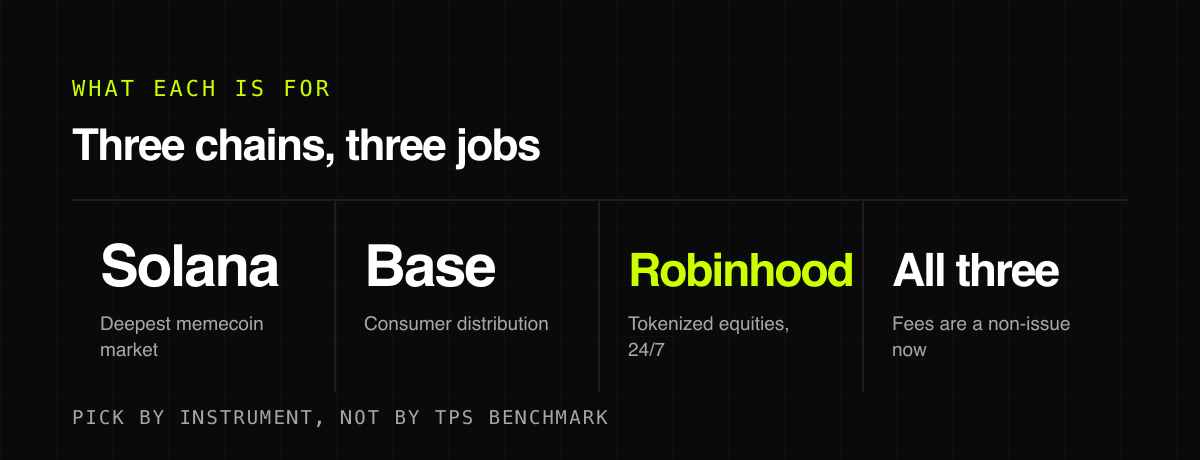
Base: distribution and EVM coverage
Base's advantage is the consumer funnel and the breadth of EVM applications that deploy there by default. Ethereum L2s including Base dominate stable and blue-chip swaps for their low costs.
Notably, Robinhood Chain flipped Base in daily active users and DEX volume within weeks of launch — which says less about Base than about what a brokerage with 23 million customers can do to a distribution curve.
Robinhood Chain: the instrument nobody else has
Here is the honest case. Robinhood Chain is not faster than Solana, not cheaper in a way you would notice, and has fewer applications than Base. What it has is 190+ tokenized stocks and ETFs as liquid, composable ERC-20s trading around the clock.
That single fact creates instruments that exist nowhere else:
- Stock-paired memecoins — a token whose liquidity pair is TSLA or NVDA, so the position carries embedded equity exposure.
- Equity collateral in DeFi — posting NVDA or AAPL as collateral in lending markets like Morpho or Ripe.
- Weekend premium trades — on-chain stock tokens trade when equity markets are closed, so they drift from reference price in a measurable, tradeable way.
- Leveraged tokenized equity — Arcus offers perps across stock tokens, not just crypto.
The practical comparison
| If you want to… | Go to |
|---|---|
| Trade memecoin launches at maximum volume | Solana |
| Trade blue-chip DeFi cheaply on EVM | Base |
| Trade equities on-chain, 24/7 | Robinhood Chain |
| Use stocks as DeFi collateral | Robinhood Chain |
| Farm the newest, least-contested SEO and airdrop surface | Robinhood Chain |
The risk nobody prices
Robinhood Chain's tokenized equities are issued as tokenized debt securities by a Jersey entity, with jurisdictional restrictions including a complete exclusion of US persons. That is a regulatory surface Solana and Base memecoins simply do not have. It cuts both ways — it is why the instrument exists, and it is the reason its availability could change.
The tooling gap, stated honestly
Solana's trading tooling has had years and enormous volume to mature. Photon, Axiom, BullX, Trojan, BONKbot and GMGN all iterated against a market that was punishing them for every millisecond and every missed safety check.
Robinhood Chain's equivalents are months old. Some are competent deployments of proven products; others are first versions. That gap shows up in the places you notice only when something goes wrong — error handling, edge cases at graduation, whether a limit order actually fires.
This closes over time and is closing quickly. But if your strategy depends on execution quality at the margin, it is the honest reason to keep trading where the tools are older.
The distribution argument nobody on Solana can make
Robinhood Chain flipped Base in daily active users within weeks. That did not happen because the technology is better. It happened because the chain is attached to a brokerage with more than 23 million customers and a product surface that puts on-chain yield inside an app people already have.
Whether that distribution converts into durable on-chain activity is the open question of this chain. Brokerage customers using an in-app yield product are not the same population as people running a wallet, and the second group is who actually trades.
A reasonable allocation of attention
| If your edge is… | Where to spend time |
|---|---|
| Execution speed on launches | Solana — the tooling is a generation ahead |
| Understanding a new instrument before it is priced | Robinhood Chain — tokenized equities in DeFi |
| Breadth of EVM applications | Base |
| Being early to a content or directory surface | Robinhood Chain — least contested by far |
The multi-chain answer is not a cop-out here. Keeping memecoin execution on Solana while learning the stock-token side of Robinhood Chain is a coherent position, and probably the right one for most people reading this.
 Axiom
Axiom GMGN
GMGN Morpho
 Arcus
ArcusFAQ
Is Robinhood Chain better than Solana?
For memecoin trading, no — Solana has deeper markets and more mature tooling. For trading tokenized equities on-chain, Robinhood Chain has instruments that do not exist on Solana at all.
Did Robinhood Chain really flip Base?
It flipped Base in daily active users and in DEX volume within weeks of its July 2026 launch, helped by Robinhood's existing user base of more than 23 million customers.
What can I trade on Robinhood Chain that I cannot trade elsewhere?
Stock-paired memecoins, tokenized equities as DeFi collateral, weekend premium and discount trades on stock tokens, and leveraged perps on tokenized equities through Arcus.
Are fees a reason to choose one of these chains?
Not meaningfully. All three are cheap enough that fees rarely change a retail trading decision. Liquidity for your specific instrument matters far more.
More from the blog
How to Find a Wallet Worth Copying on Robinhood Chain
Leaderboards rank by total profit, which is mostly size and luck. Five checks that separate a repeatable edge from one lucky position.
Is Copytrading Profitable? The Arithmetic Nobody Runs First
Copytrading pays you the leader's return minus four deductions. Here is what each one costs, and the win rate a wallet needs before following it makes money.
Copytrading vs Trading Yourself: Which Actually Suits You
One rents someone else's research at a fixed price. The other charges you in time instead of fees. The honest comparison on cost, control and what you learn.