How Much Do Trading Bots Cost, and When They Pay for Themselves
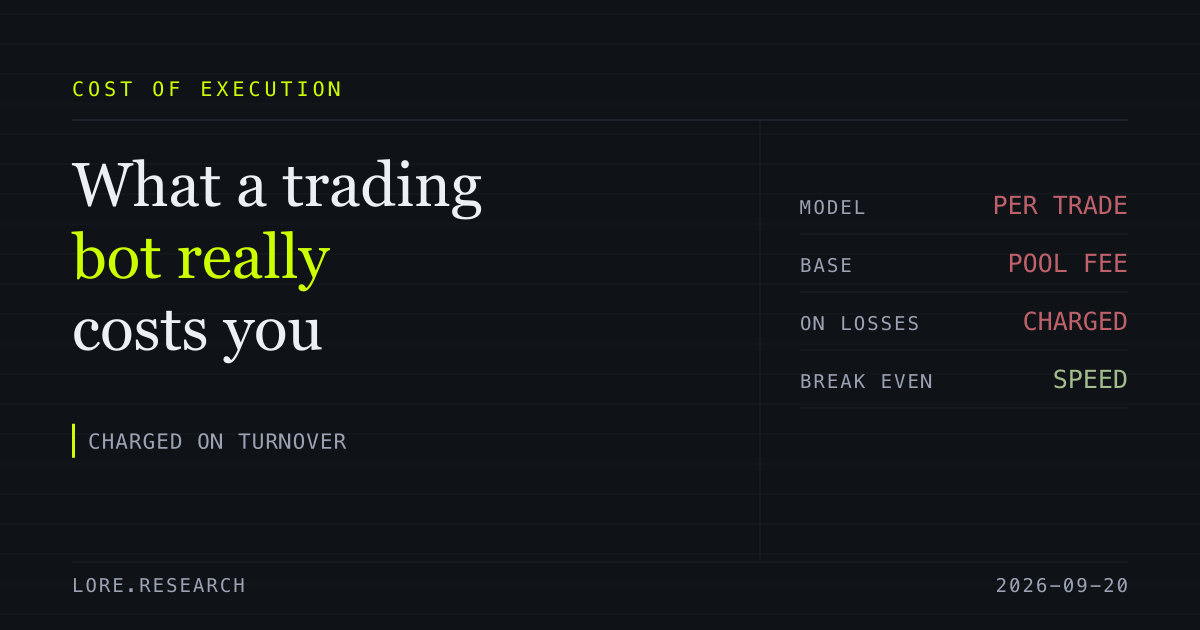
The fee is a percentage of turnover, not of profit. That distinction decides whether a bot is cheap or ruinous for you.
The short answer
Memecoin trading bots almost all charge a percentage of each trade rather than a subscription, typically around one percent per side, on top of the pool fee the DEX already takes. That structure matters more than the number: you pay on turnover, not on profit, so the cost scales with how often you trade and is charged in full on the trades that lose. A bot pays for itself when the speed it buys you changes your entry price by more than the fee – which is realistic on new launches and almost never true on a token you had already decided to buy. Cashback and referral rebates reduce the rate but do not change the shape.
Most people compare bots by their headline rate and stop there. The rate is the least interesting part of the cost, because every mainstream bot sits in the same narrow band. What differs is how much you trade, and that is the variable that decides whether the fee is trivial or the largest line in your year.
The three layers
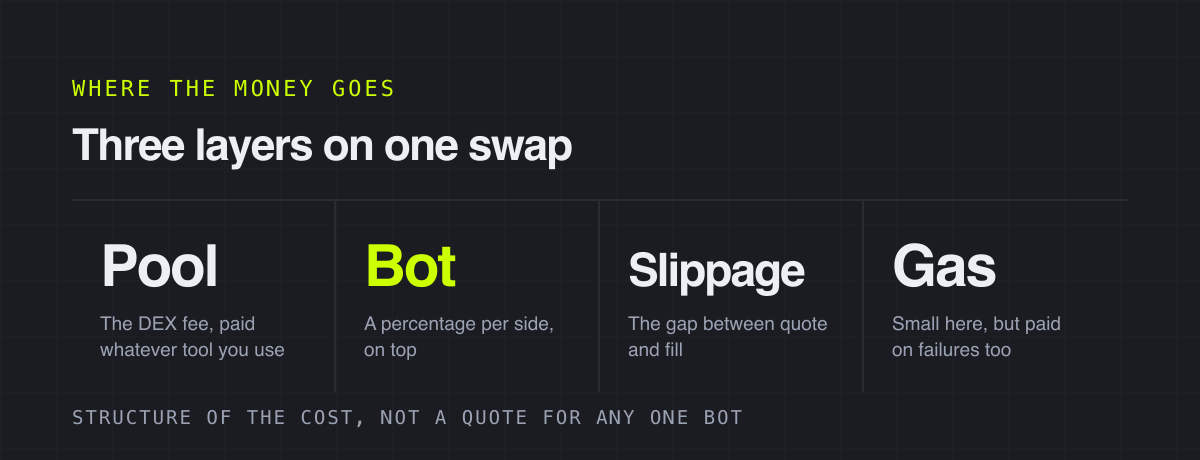
A single buy through a bot costs you the pool fee, which you would pay on Uniswap anyway; the bot's own cut, which is new; and slippage, which is the difference between the quote you saw and the price you got. Gas on this chain is small enough to ignore in most sizes, though you still pay it on transactions that fail.
The bot's cut is the only one you are choosing. Routing through a bot does not get you a better pool price – every one of these tools ends up in the same liquidity.
Why turnover is the number that matters
A percentage per side charged on turnover behaves very differently from a subscription. Trade once a month and the fee is invisible. Trade forty times a week and you are paying a percentage of a large multiple of your capital, every week, regardless of whether the week went well. A bot fee is charged in full on the trades that lose money, which is where the compounding hurts.
When it pays for itself
The honest case for paying is speed on a launch. In the first seconds of a bonding-curve token the price moves faster than the fee, so landing thirty seconds earlier can be worth several times what the bot takes. That is a real edge and it is why these products exist.
The honest case against is everything else. On an established token with deep liquidity, where you could have swapped on the DEX at your leisure, the bot's cut is pure cost and buys you nothing. Most people pay it on both kinds of trade because the bot is the tool that is already open.
Cashback and rebates
Several bots return part of the fee, either as a volume tier or through a referral arrangement. It is worth taking – it is a discount on a cost you were paying anyway – but read what it changes. A rebate lowers the rate; it does not change the fact that you are charged on turnover, and it should never be the reason to trade more.
The comparison worth making
| Route | What you pay | What you get |
|---|---|---|
| Uniswap directly | Pool fee only | Nothing but the swap |
| Web terminal | Pool fee plus a per-trade cut | Discovery, holder data, speed |
| Telegram bot | Pool fee plus a per-trade cut | Automation, sniping, custody risk |
Pick the route per trade rather than per habit. The people who do this well use a bot for launches and the DEX for everything else, and the difference over a year is larger than any rate they could have negotiated.
Tools mentioned
 Uniswap
FAQ
Are trading bots worth it?
On new launches, where thirty seconds changes your entry price by more than the fee, yes. On tokens you had already decided to buy, no – you are paying a percentage for convenience you did not need. The same bot can be both, depending on the trade.
Do trading bots charge a subscription?
Memecoin bots mostly charge per trade rather than monthly, which means the cost scales with your activity instead of being fixed. Some offer paid tiers for advanced features on top.
How much do trading bots make?
That question belongs to the bot's operator, not to you. They make a percentage of everyone's turnover, which is why the business exists. What you make depends on your entries, and the fee is subtracted from it either way.
More from the blog
How to Start Trading Memecoins
Six things to set up before the first buy, in the order that stops the common mistakes.
What “Smart Money” Means, and When the Label Lies
A wallet that made money is not the same as a wallet that knows something. Telling them apart is the whole skill.
What to Do After a Rug Pull
Nothing gets the money back. Several things stop the next hour being worse than the last one.