Best Robinhood Chain Wallet and How to Set It Up
Native support, manual setup, and the one wallet feature that prevents most drains.
The short answer
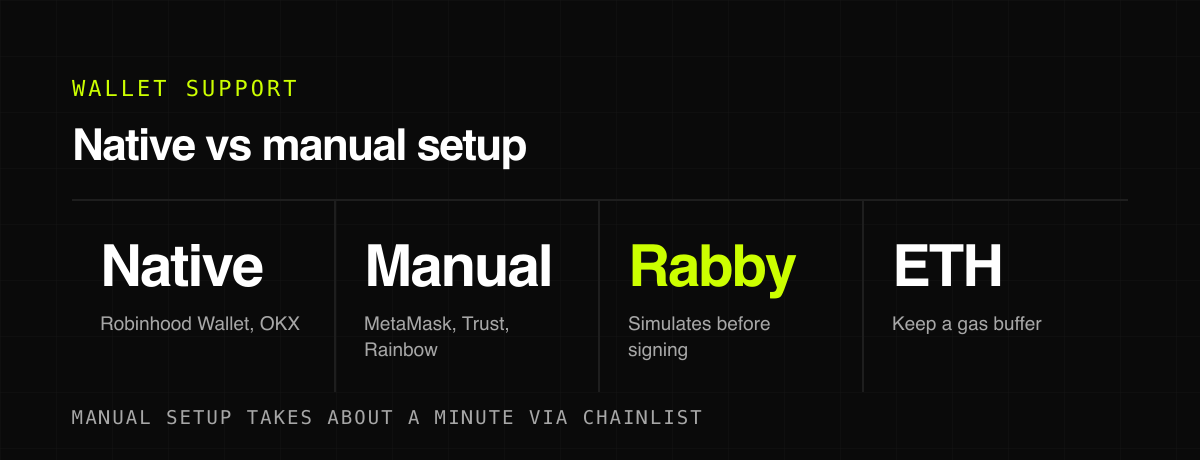
Robinhood Wallet and OKX Wallet support Robinhood Chain natively with no configuration. MetaMask, Rabby, Trust Wallet, Rainbow and Backpack work after adding chain 4663 manually or via Chainlist. For active on-chain trading the best choice is Rabby, because it simulates the transaction and shows actual balance changes and risk warnings before you sign — most losses on any chain come from approvals granted without understanding them, not from contract exploits.
Wallet choice on a new chain usually gets decided by whichever one already has your seed phrase. That is a reasonable default and a bad one if you are going to trade new launches.
Wallets with native support
Robinhood Wallet is the official self-custody wallet with Robinhood Chain built in — no RPC fields, no chain ID, no manual setup. It has also added bridging, swaps and app discovery. OKX Wallet supports the chain directly out of the box.
Rainbow, Backpack and Safe Smart Accounts also added support, with Safe active from day one — relevant if you want a multisig rather than a hot wallet.
Adding it manually
Every other EVM wallet needs the network added once. The fastest safe route is Chainlist: search 4663 and connect. Manually, the fields are network name Robinhood Chain, chain ID 4663, RPC https://rpc.mainnet.chain.robinhood.com, symbol ETH, explorer robinhoodchain.blockscout.com.
Why Rabby, if you are trading
Rabby simulates a transaction before you sign it and shows what will actually change — which balances move, which approvals you are granting, and what its risk engine flags. That converts an opaque signature request into a readable consequence.
This matters because the dominant loss mechanism in on-chain trading is not a clever exploit. It is a user approving unlimited spend on a contract they did not read, then forgetting about it. Simulation catches that at the moment it can still be cancelled.
The hot wallet discipline
If you are going to interact with fresh contracts — and on this chain, that is the whole point — separate your wallets.
- A trading wallet holding only what you are actively trading. It touches unfamiliar contracts.
- A holding wallet that never signs anything except a transfer to itself. Ideally a hardware wallet.
- Move profits out of the first into the second on a schedule, not when you remember.
This sounds obvious and almost nobody does it, which is why it keeps being worth writing down.
Keep ETH for gas
Gas on Robinhood Chain is paid in ETH. Arriving with only stablecoins or stock tokens leaves you unable to transact, which is the most common first-day problem on the chain. Keep a buffer before a mint or a launch, not during it.
Reading a signature request
Three kinds of request arrive at your wallet and they carry completely different risk.
- A transaction — moves a specific amount, once. Lowest risk, and the easiest to verify: check the amount and the destination.
- An approval — grants a contract permission to move a token on your behalf, indefinitely, up to a limit. Check the limit. An enormous number means unlimited.
- An off-chain signature — costs no gas and looks harmless, which is why it is the most dangerous. It can authorise a transfer, a listing, or a delegation. If you cannot read what it says, do not sign it.
The gasless signature is the one that catches experienced people. It produces no transaction, no fee and no obvious footprint, and a permit-style signature can be all an attacker needs.
A wallet structure that survives a mistake
The single-wallet setup fails badly the first time you sign something wrong, because everything you own is behind that one key. Splitting it costs a few minutes and changes the worst case from catastrophic to annoying.
- Trading wallet — funded with your active budget only. Signs unfamiliar contracts daily. Assume it will eventually be compromised.
- Holding wallet — hardware-backed, signs almost nothing, receives transfers from the trading wallet on a schedule.
- Mint wallet (optional) — for NFT drops and airdrop farming, where you sign the most and know the least about what you are signing.
The discipline that makes this work is the sweep. Profits move out of the trading wallet on a schedule you decide in advance, not when you remember or when you feel nervous.
Seed phrase basics that still get people
No legitimate support channel asks for a seed phrase. No wallet migration requires typing it into a website. No airdrop verification needs it. Every single request for one is theft, without exception, and the requests are convincing because they arrive exactly when you are already frustrated by something.
Store it offline, store a second copy somewhere else offline, and never photograph it. A phrase in a cloud-synced note is a phrase in someone else's cloud eventually.
Tools mentioned
 Robinhood Wallet
 OKX Wallet
 Rabby
RabbyFAQ
What is the best wallet for Robinhood Chain?
Robinhood Wallet for native support and simplicity; Rabby for active trading, because it simulates transactions and shows risk warnings before you sign. OKX Wallet also supports the chain natively.
How do I add Robinhood Chain to my wallet?
Use Chainlist and search 4663 for a one-click add, or enter the fields manually: chain ID 4663, RPC https://rpc.mainnet.chain.robinhood.com, symbol ETH, explorer robinhoodchain.blockscout.com.
Do I need a Robinhood account to use Robinhood Chain?
No. The chain is permissionless. Any EVM-compatible wallet connects to it directly, with or without a Robinhood brokerage account.
Can I use a hardware wallet?
Yes — the chain is standard EVM, so hardware wallets work through any compatible interface. Safe Smart Accounts have also been active on the chain since day one if you want multisig.
More from the blog
How to Find a Wallet Worth Copying on Robinhood Chain
Leaderboards rank by total profit, which is mostly size and luck. Five checks that separate a repeatable edge from one lucky position.
Is Copytrading Profitable? The Arithmetic Nobody Runs First
Copytrading pays you the leader's return minus four deductions. Here is what each one costs, and the win rate a wallet needs before following it makes money.
Copytrading vs Trading Yourself: Which Actually Suits You
One rents someone else's research at a fixed price. The other charges you in time instead of fees. The honest comparison on cost, control and what you learn.