What GMGN Is, and What You Pay For It
Discovery, holder clustering, a safety scan and a buy button on one screen. The fee is for the screen, not for the price.
The short answer
GMGN is an all-in-one trading terminal: new-pair feeds, holder clustering, wallet tracking, a contract safety scan and execution in one interface, across Robinhood Chain, Solana, Base and BNB Chain. It routes into the same pools as everything else and charges a fee per swap, so the case for it rests entirely on the research sitting beside the buy button.
 GMGN is a terminal rather than an exchange. It does not hold a market – it routes into the same public pools every other tool on this chain routes into, and it charges a percentage of each swap for doing so. Everything that justifies the fee is on the screen around the button.
What is on that screen
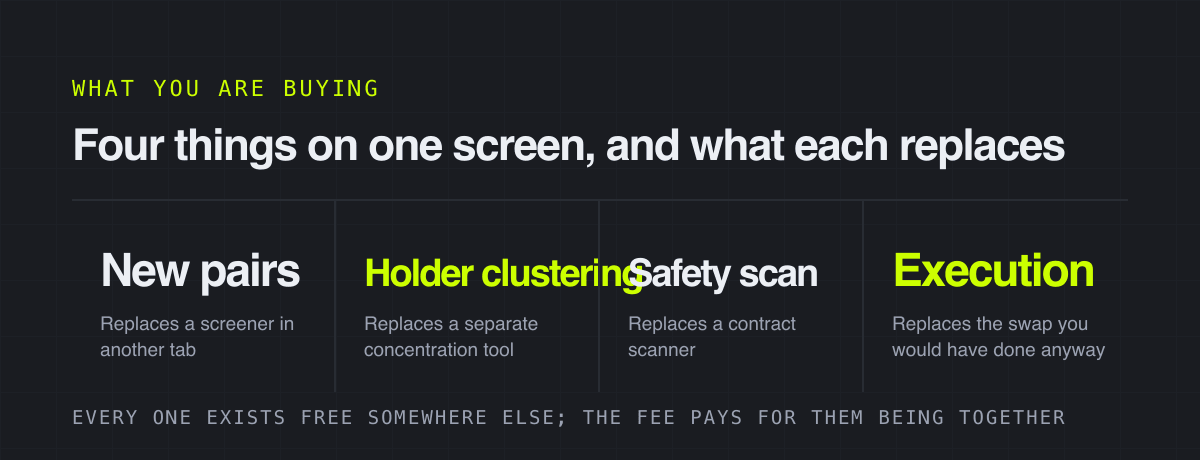
A feed of new pairs as they appear. Holder analysis with clustering, which is the part that distinguishes it from a plain screener. Wallet tracking, so an address you care about surfaces its activity. A contract safety scan. And the swap itself, so that acting on any of the above does not require a second tab.
It covers Robinhood Chain alongside Solana, Base and BNB Chain, with a chain selector that is the first thing to set and the easiest thing to forget.
What you actually pay
A percentage per swap, on top of the pool fee you would pay anywhere. Nothing recurring. That structure matters: the cost scales with how often you trade, so it is close to free for someone making a few decisions a week and substantial for someone making forty.
Where it is strong and where it is not
| Situation | Worth the fee? |
|---|---|
| A launch you are seeing for the first time | Yes – clustering and the scan are the value |
| A token you already researched elsewhere | No – route it through a plain swap |
| Tracking a wallet you have chosen | Yes, for having it next to execution |
| Large size | Check routing first – a fee on size is a real number |
| A chain it covers poorly | No – coverage is uneven across chains |
Using it well
- Set the chain selector before anything else. Most confusion with this tool starts there.
- Start from new pairs rather than trending. By the time something trends you are closer to being the exit than the entry.
- Open the holders tab before the chart. Concentration tells you more than a candle does.
- Read the safety scan as a filter rather than a verdict – it catches mechanical traps and cannot see a deployer who simply sells.
- If you use the hosted wallet, fund it with trading size only.
The honest comparison
Everything GMGN does exists free somewhere.  Dexscreener covers pairs and liquidity and takes nothing from your trade.
 Bubblemaps does clustering properly. A scanner does the contract.
 Blockscout Explorer has the raw truth. What GMGN sells is all of it in one place at the moment you need it, which is a real product and a real cost.
Whether that trade is good depends almost entirely on whether you act on new information or on decisions you had already made.
Tools mentioned
FAQ
What is GMGN?
An all-in-one trading terminal combining new-pair discovery, holder clustering, wallet tracking, a contract safety scan and execution in one interface, across Robinhood Chain, Solana, Base and BNB Chain.
Does GMGN charge fees?
Yes – a percentage per swap on top of the pool fee, with nothing recurring. Since it applies per trade, the cost scales with how often you trade rather than with how long you use it.
Does GMGN give a better price than a plain swap?
No. It routes into the same public pools, so the price is the pool's price minus its fee. What you pay for is the research sitting next to the button, not execution quality.
Is GMGN worth it?
On a token you are seeing for the first time, the clustering and safety scan are genuine value. On a token you had already decided to buy, you are paying a fee for research you will not use.
More from the blog
Prediction Markets: A Price That Looks Like a Probability
A contract paying one dollar if something happens trades at the market's estimate of it happening. The gap between that and a forecast is where the money is.
Staking, and Why There Is None on This Chain
Staking pays you for securing a network. An L2 that settles to Ethereum and charges gas in ETH has nothing for you to secure.
Multisig: Removing the Single Point of Failure
Two of three signatures to move anything. It solves theft and loss at once, and introduces a problem of its own.