Best Robinhood Chain DEX: Where the Liquidity Actually Is
Uniswap took the chain on day one. Arcus, Lighter and Rialto each took a slice it could not.
The short answer
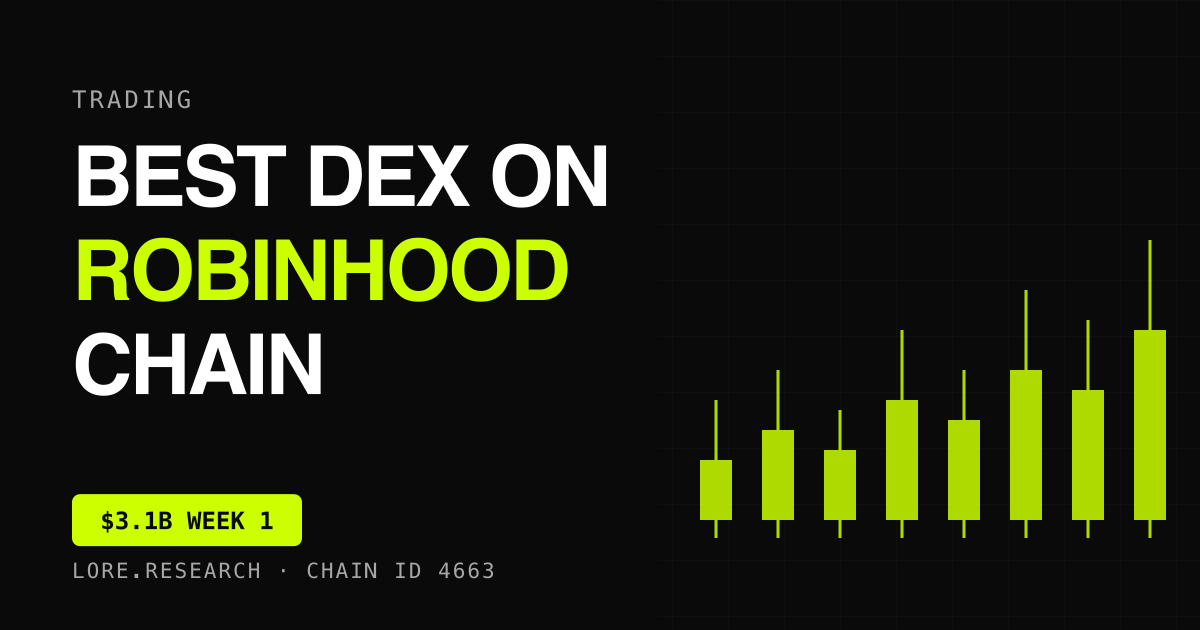
Uniswap is the primary DEX on Robinhood Chain and holds the majority of public spot liquidity, with v2, v3, v4 and UniswapX all deployed from day one. For leverage, Lighter runs a ZK-powered perpetuals venue and Arcus — built by dYdX Labs with Robinhood Crypto — covers perps across both crypto and stock tokens. Rialto operates a PropAMM-driven spot venue, and Pleiades runs a proprietary AMM aimed at institutional flow. In practice: route plain swaps through Uniswap, use Lighter or Arcus when you want leverage, and check both before assuming one has the better price.
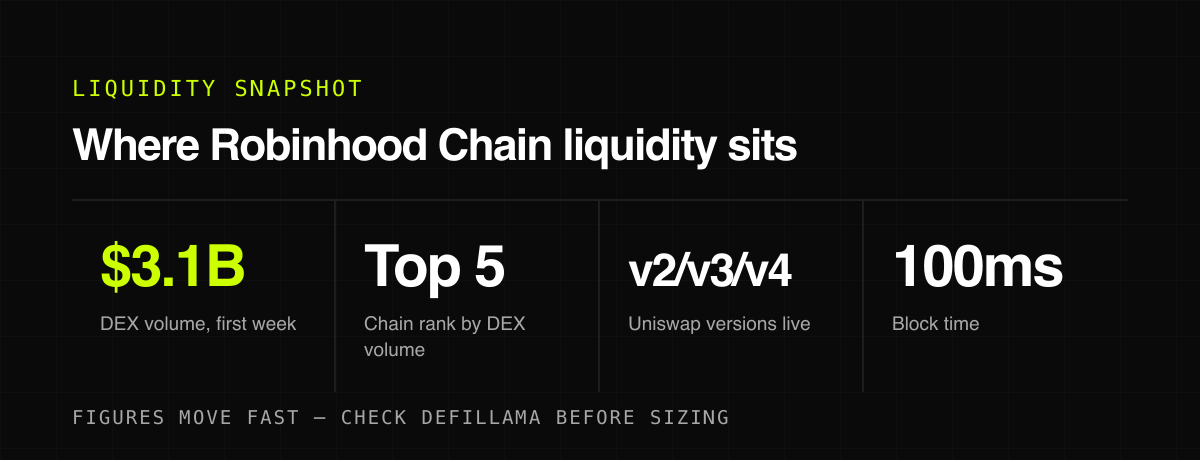
Robinhood Chain did something unusual for a new L2: it had real liquidity on the first day. Within two weeks of the 1 July 2026 mainnet launch it was a top-five chain by DEX volume, clearing roughly $3.1 billion in its first week. That changes the calculation for traders — you are not waiting for depth to arrive, you are choosing between venues that already have it.
Uniswap is the default, and it is not close
Uniswap deployed as a day-one partner and is cited by Robinhood itself as the primary public liquidity protocol. All of v2, v3 and v4 are live, plus the UniswapX spot layer. That matters more than version-number trivia: v4 hooks are what let stock tokens, stablecoins and memecoins share one liquidity layer with different pool logic.
If you are swapping a token you already know, Uniswap is the answer. Most terminals on the chain route their orders through it anyway, so you are usually trading against the same pools regardless of which front-end you use.
The perp venues: Lighter and Arcus
Two venues cover leverage, and they are aimed at different things.
- Lighter — a ZK-powered perpetuals DEX native to the chain. Orderbook-style, built for crypto and index markets.
- Arcus — built by dYdX Labs together with Robinhood Crypto. Covers perps and derivatives across both crypto and stock tokens, with pTokens for cross-market exposure. It crossed $100M in weekly volume across 240K+ trades within its first month.
The stock-token angle is what makes Arcus structurally interesting. Being able to take leveraged exposure to a tokenized equity, on-chain, around the clock, is a primitive that does not exist on most chains.
The venues built for someone else
Two more are live but were not designed with retail flow in mind.
Rialto runs a PropAMM-driven spot exchange and supports 25+ stock-token markets including TSLA, MU and QQQ with 24/7 trading. Pleiades deployed a proprietary AMM positioned as a prop trading venue — where Uniswap serves public market-makers, Pleiades is aimed at institutional inventory. You will rarely route through either by hand, but their depth feeds the prices you see elsewhere.
How to actually choose
| What you are doing | Where to go |
|---|---|
| Swapping a known token | Uniswap |
| Trading a fresh launch | A terminal routing to Uniswap — you need the safety data, not a different pool |
| Leverage on crypto | Lighter |
| Leverage on stock tokens | Arcus |
| Large size, price-sensitive | An aggregator quote first, always |
One caveat about 'best'
Liquidity on a three-month-old chain rotates fast. Uniswap V3 on Robinhood Chain has appeared among the largest DEXs by volume across all chains, which tells you the depth is real — but the split between v3 and v4, and between Uniswap and the newer venues, has moved every few weeks since launch. Treat any ranking, including this one, as a snapshot and check DefiLlama's DEX volume page before you size a position.
Where the fees actually go
A swap on this chain charges you in three places and most people only see one. There is the pool fee, set per pool and typically running from a few basis points on stable pairs to 1% on volatile ones. There is slippage, which is not a fee but behaves like one and is usually larger than the fee on thin pools. And there is gas, paid in ETH, which is small here but non-zero.
If you trade through a terminal rather than directly, add its cut on top — commonly 0.5% to 1%. On a round trip that is a meaningful drag, and it is the single easiest cost to eliminate when you already know what you are buying.
Why the venue split exists at all
A chain with five spot venues sounds redundant until you look at who each serves. Uniswap is a public AMM optimised for anyone to provide liquidity. Pleiades is a proprietary AMM built for prop trading, where the counterparty is a firm rather than a crowd. Rialto's PropAMM sits between the two, running professional market-making against stock-token inventory.
That structure is unusual and it is downstream of the chain's purpose. Tokenized equities need inventory financing and post-settlement mechanics that a purely public AMM does not provide. The venue you route through as a retail trader is almost always Uniswap; the others shape the prices you see there.
Checking depth before you size
- Look at the pool's total liquidity, not its 24-hour volume. Volume can be manufactured; depth is what fills your order.
- Estimate your trade as a share of pool liquidity. Above roughly 1% you should expect visible slippage on a volatile pair.
- Compare the direct pool quote against an aggregator quote. On a multi-venue chain the router frequently splits the order and wins.
- For stock tokens specifically, check whether the underlying equity market is open. Spreads widen materially when it is not.
 Uniswap
 Lighter
 Arcus
ArcusFAQ
What is the main DEX on Robinhood Chain?
Uniswap. It deployed as a day-one partner with v2, v3, v4 and UniswapX, and holds the majority of public spot liquidity on the chain.
Can I trade perpetuals on Robinhood Chain?
Yes. Lighter runs a ZK-powered perp DEX, and Arcus — built by dYdX Labs with Robinhood Crypto — offers perps across both crypto and tokenized stock markets.
Is there a DEX aggregator on Robinhood Chain?
Yes. 1inch and LI.FI both support the chain. On a network with several structurally different venues, an aggregator quote often beats picking a pool by hand.
How much volume does Robinhood Chain do?
It cleared roughly $3.1 billion in DEX volume in its first week and reached top-five among all chains by DEX volume within two weeks of launch.
More from the blog

How to Find a Wallet Worth Copying on Robinhood Chain
Leaderboards rank by total profit, which is mostly size and luck. Five checks that separate a repeatable edge from one lucky position.
Is Copytrading Profitable? The Arithmetic Nobody Runs First
Copytrading pays you the leader's return minus four deductions. Here is what each one costs, and the win rate a wallet needs before following it makes money.

Copytrading vs Trading Yourself: Which Actually Suits You
One rents someone else's research at a fixed price. The other charges you in time instead of fees. The honest comparison on cost, control and what you learn.