Token Vesting: Reading the Schedule Before the Unlock
Supply that arrives on a date is the most predictable selling pressure in crypto, and it is published in advance.
The short answer
Vesting releases allocated tokens gradually on a schedule instead of all at once, usually with a cliff followed by linear unlocks. The schedule is the most predictable supply event in crypto – it is published, dated, and priced in far less often than it should be.
Vesting exists so that the people given tokens before anyone else cannot sell them all immediately. It replaces one large risk with a series of scheduled ones, and because the schedule is written down, it is the rare piece of supply information that is knowable ahead of time.
How a schedule is built
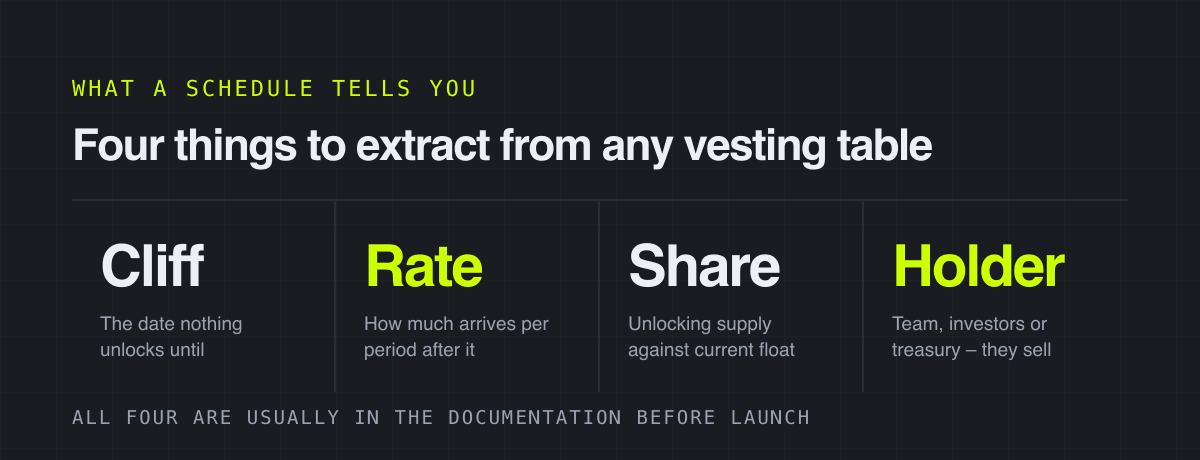
Two components. The cliff is a period during which nothing unlocks at all – commonly six or twelve months, designed so that anyone leaving early leaves with nothing. After it, tokens release linearly over a further period, either continuously or in monthly tranches.
The cliff date is the one that matters most, because it is the first moment a previously locked allocation can move, and it usually releases a chunk rather than a trickle.
The number to compute
Not the percentage of total supply unlocking – the percentage of currently circulating supply. Those are wildly different numbers, and only the second one describes what is about to hit the market.
This is the same arithmetic as the gap between market cap and fully diluted valuation, read forwards rather than as a static ratio. A large gap is not automatically bad – it is a schedule of future supply, and the schedule tells you when.
Who is unlocking changes what happens
| Holder | Typical behaviour at unlock |
|---|---|
| Early investors | Sell, often immediately – it is a return on a fund's position |
| Team | Mixed, and publicly visible, which slows it |
| Treasury | Usually not sold directly, but can fund things that are |
| Advisors | Small allocations, sold quickly and predictably |
| Liquidity provision | Not selling at all – it is going into a pool |
On memecoins the question is different
Most memecoins have no vesting at all. Supply is fully circulating from the first block, which is why the equivalent risk shows up as concentration rather than as a schedule – there is no unlock date because there is nothing locked.
That makes a memecoin claiming a vesting schedule worth verifying rather than trusting. Look for the lock in the contract or on a locker service; a schedule that exists only in a document is a promise, and promises unlock on request.
What to do with the dates
- Write the cliff date down before you buy, not after you are wondering why the price fell.
- Compute unlocking supply as a share of circulating float, not of total supply.
- Watch the receiving addresses in the week after an unlock –
 Cielo Finance will tell you whether tokens moved to an exchange or sat still.
- Remember the market often prices an unlock in the days before it, not on the day. The dip can precede the date.
None of this predicts the price. It tells you when supply arrives and who receives it, which is more than you know about almost anything else in this market.
Tools mentioned
FAQ
What is token vesting?
A schedule that releases allocated tokens gradually instead of all at once, typically with a cliff period where nothing unlocks followed by linear releases over months or years.
What is a vesting cliff?
A period at the start during which no tokens unlock at all. It usually ends with a single larger release, which makes the cliff date the most significant supply event in most schedules.
Do token unlocks always crash the price?
No, but they reliably add supply. The size that matters is the unlock as a share of currently circulating tokens rather than of total supply, and markets often price the event in the days before the date rather than on it.
Do memecoins have vesting?
Usually not – supply is typically fully circulating from launch. That means the equivalent risk appears as holder concentration instead, and any memecoin claiming a vesting schedule is worth verifying onchain rather than taking on trust.
More from the blog
Prediction Markets: A Price That Looks Like a Probability
A contract paying one dollar if something happens trades at the market's estimate of it happening. The gap between that and a forecast is where the money is.
Staking, and Why There Is None on This Chain
Staking pays you for securing a network. An L2 that settles to Ethereum and charges gas in ETH has nothing for you to secure.
Multisig: Removing the Single Point of Failure
Two of three signatures to move anything. It solves theft and loss at once, and introduces a problem of its own.