Rabby vs MetaMask: One Shows You What You Are Signing
Both connect to the same chains and hold keys the same way. The difference is a single screen, and it is the screen where money is lost.
The short answer
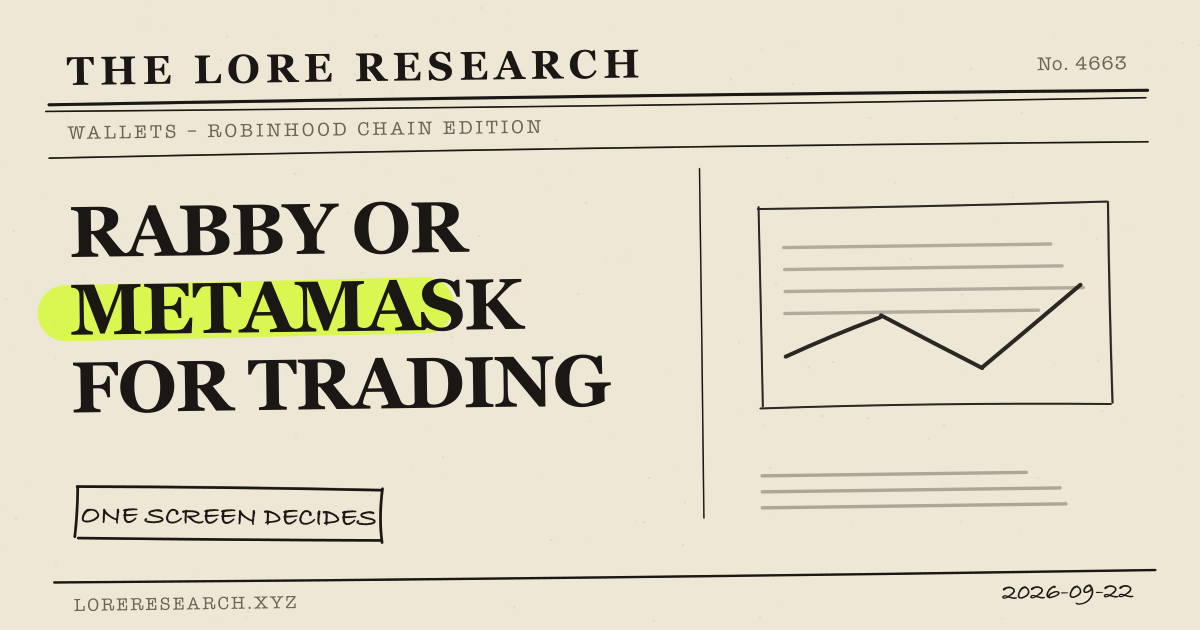
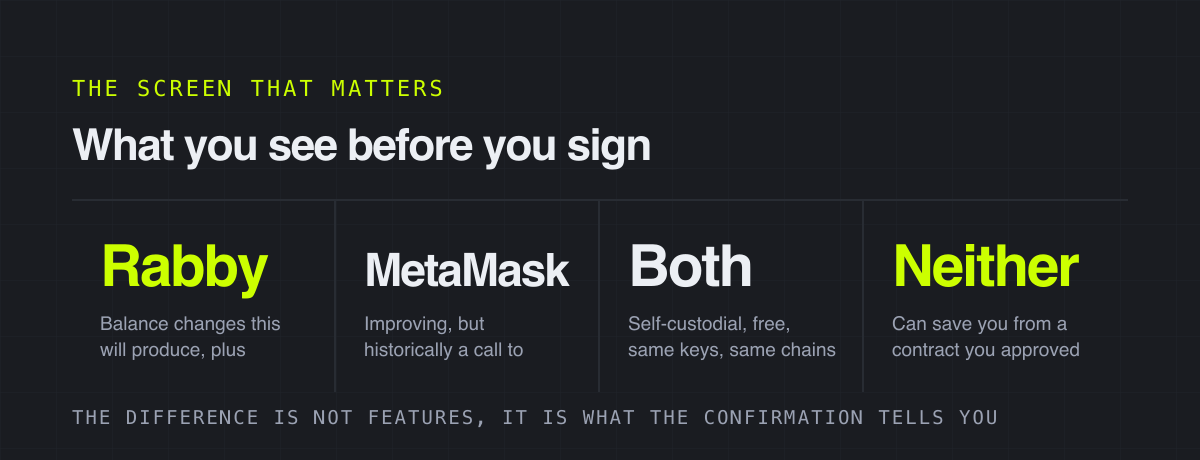
MetaMask is the default EVM wallet with the widest compatibility and the longest track record. Rabby's advantage is pre-transaction simulation: before you sign, it shows the balance changes the transaction will actually produce and flags known risks, where MetaMask historically showed a contract call you had to interpret. For onchain trading, where most losses come from signing something that did not do what it appeared to do, that one screen is the whole argument. Both are self-custodial and free, both support Robinhood Chain after adding the network, and running both is a normal setup.
This comparison is usually framed as which wallet is better, which is the wrong question because they are not competing on most things. Both are browser-extension wallets, both hold your keys locally, both are free, and both talk to any EVM chain you add. A seed phrase moves between them in a minute.
Where they genuinely differ
The confirmation screen. When a site asks you to sign, Rabby simulates the transaction first and tells you what it will do in terms of your balances: this token leaves, that token arrives, this approval is granted. It also flags patterns it recognises as dangerous.
MetaMask has improved here and continues to, but its confirmation grew out of a general-purpose wallet rather than a trading one, and for a long time it showed you a contract interaction you were expected to understand.
Side by side
| Rabby | MetaMask | |
|---|---|---|
| Pre-sign simulation | Yes, balance changes shown before signing | Partial, and improving |
| Risk warnings | Built in, on known dangerous patterns | Some, via integrations |
| Chain handling | Detects and switches automatically in most cases | Manual add, or via a list service |
| Approval management | Built in, visible from the wallet | Possible, generally via an external tool |
| Compatibility | Very good, occasionally the site expects the other one | The one every site is tested against |
| Custody | Yours | Yours |
| Cost | Free | Free |
The honest case for MetaMask
Ubiquity is a real feature. It is what every dapp is built and tested against, what every guide assumes, and what hardware wallets document first. When something behaves strangely, the answer exists already because someone has hit it before. For anyone who is not trading actively, that is worth more than a better confirmation screen.
What neither of them does
- Neither stops you approving a contract that then does exactly what it said it would.
- Neither recovers funds. Signing is final, and support is not a thing that exists.
- Neither protects a seed phrase you typed into a website.
- Neither makes a token sellable if the contract says otherwise.
- Simulation can be wrong on a contract designed to behave differently when it is simulated.
The setup most active traders end up with
- A hot wallet for trading, small enough that its total loss is survivable.
- Rabby on that wallet, for the confirmation screen.
- MetaMask kept installed, for the occasional site that expects it.
- A separate wallet for holdings, which never connects to anything new.
- An approval clear-out after any session that touched unfamiliar contracts.
Note that the wallet is the least important line in that list. Separation of funds does more for your safety than either choice, and it costs nothing.
 Rabby
Rabby MetaMask
FAQ
Is Rabby safer than MetaMask?
It is more informative at the moment that matters. Both are self-custodial and hold keys the same way, so neither is inherently more secure – but Rabby simulates the transaction and shows the balance changes it will cause before you sign, which prevents the most common way people lose funds.
Can you use Rabby and MetaMask together?
Yes, and many active traders do. They are separate extensions and can hold different wallets, or the same seed imported into both. Rabby handles day-to-day trading and MetaMask stays for sites that specifically expect it.
Do both support Robinhood Chain?
Yes, after the network is added – neither ships with it enabled by default. The chain ID is 4663 and the details come from the official documentation; a network-list service can add it in one click for either wallet.
More from the blog
Is Crypto Arbitrage Profitable? Yes, and Not for You
The opportunity is real and it is measured in milliseconds. By the time a price difference is visible on a screen, it has been taken.
What a DEX Aggregator Does, and When It Costs You
It searches every pool for the best route and splits your trade across them. That is worth real money on a large order and worth nothing on a small one.
Token Approvals: The Permission You Forgot You Gave
Every swap asks for permission to move a token, and most of those permissions are unlimited and permanent. They stay live long after the trade is done.