How to Choose a Liquidity Pool
The advertised yield is the last thing to look at. Four numbers above it decide whether the position works.
The short answer
Choose a pool on four things before the yield: how correlated the two assets are, the ratio of volume to pooled liquidity, whether the fee tier matches the pair's volatility, and how deep the pool is relative to your position. Yield is the output of those four, not an input you can select for.
Every pool list sorts by yield, which is the one column that cannot be used to choose. Yield is what came out last week. The four inputs that produced it are all knowable in advance, and reading them in order kills most candidates before the number on the right matters.
One: how correlated are the two assets
This is the biggest single determinant of whether a position works, and it is a property of the pair rather than of the pool. Two assets that move together produce almost no divergence loss. Two that can decouple entirely produce a great deal of it, and the fee yield has to be large enough to pay for that.
A stablecoin pair and a memecoin-against-ETH pair are not the same activity with different numbers. They are different trades.
Two: volume against pooled liquidity
The ratio of daily volume to total liquidity tells you how hard the capital in the pool is working. A pool with large liquidity and little volume pays badly however deep it is. A pool doing several times its liquidity in daily volume is generating real fees for whoever is in it.
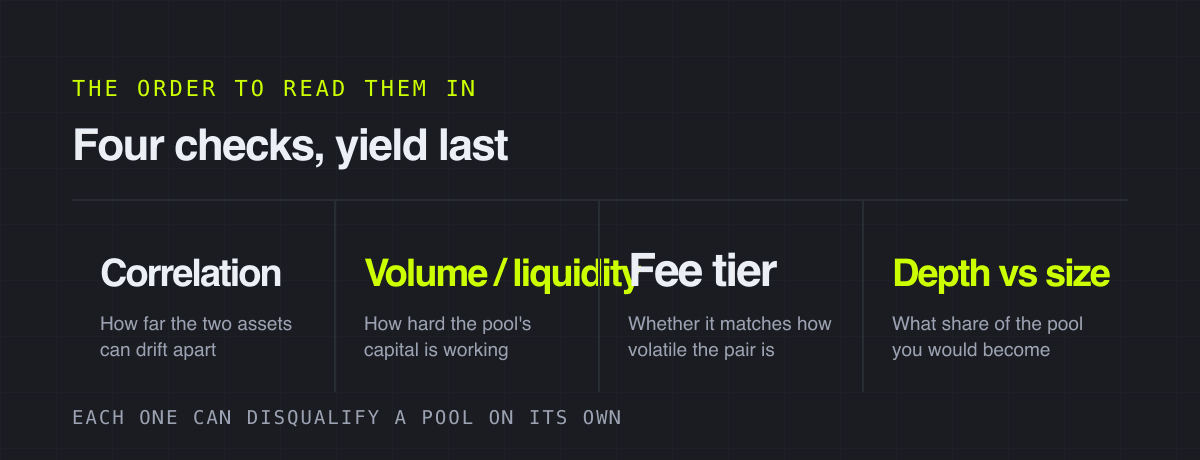
Three: does the fee tier fit the pair
 Uniswap offers several fee tiers on the same pair, and the choice is not free money. A low tier attracts more volume and earns less per trade; a high tier earns more per trade and sends routing elsewhere. The right tier is a function of how volatile the pair is, because volatility is what providers need paying for.
| Pair type | Typical fit | Why |
|---|---|---|
| Stablecoin to stablecoin | Lowest tier | Almost no divergence to compensate |
| Major to major | Low or middle | Correlated, high volume |
| Major to volatile | Middle or high | Real divergence risk to be paid for |
| Memecoin pairs | Highest | The risk is the whole position |
Four: how big would you be in it
Your share of the pool is your share of the fees, which sounds like an argument for small pools. It is, right up until you try to leave. A position that is a large fraction of a pool cannot be withdrawn without moving the price against itself, and that cost lands at exactly the moment you decided to get out.
- Check what percentage of the pool your deposit would be before checking the yield.
- Assume you will want to exit on a bad day, when the pool is thinner than today.
- Compare candidates on
 DefiLlama Yields, but verify the volume on the pool itself rather than trusting the aggregate.
 - For Robinhood Chain specifically, Uniswap Positions shows what is already deployed and at what ranges, which is a better guide than any list.
Then, finally, the yield
Once the pair, the ratio, the tier and your size all pass, the advertised rate is worth reading – and worth splitting into fee yield and emissions, because those two have very different lifespans. A pool that survives all five questions is rarely the one at the top of the list, which is the point.
Tools mentioned
FAQ
How do I choose a liquidity pool?
In order: how correlated the two assets are, the ratio of daily volume to pooled liquidity, whether the fee tier matches the pair's volatility, and how large your position would be relative to the pool. Yield is the result of those four rather than a way to pick between pools.
What makes a liquidity pool profitable?
High trading volume relative to the liquidity sitting in it, on a pair whose two assets do not drift far apart. Volume creates the fees; correlation determines how much of them you keep after divergence loss.
Which fee tier should I pick?
The one that matches the pair's volatility. Stable pairs work at the lowest tier because there is little divergence to compensate. Volatile pairs need a higher tier, because the fee is what pays you for the risk of holding the pair at all.
Is a bigger pool safer?
Usually easier to exit, which matters more than it sounds. A large position in a small pool cannot be withdrawn without moving the price against itself, and that cost arrives precisely when you want out.
More from the blog
Tracking Whale Wallets Without Mistaking Size for Skill
A large balance is evidence of a large balance. Whether it means anything about the next trade is a separate question, and usually the answer is no.
Wallet Tracking You Will Actually Read
Everyone sets up alerts. Almost nobody survives the second week, because the setup was designed to catch everything.
Risk-Reward on a Token With No Floor
The ratio assumes you know where you get out. On a DEX with no stop loss, half the formula is missing – and it is the half that matters.