The Four Numbers to Calculate Before Opening a Position
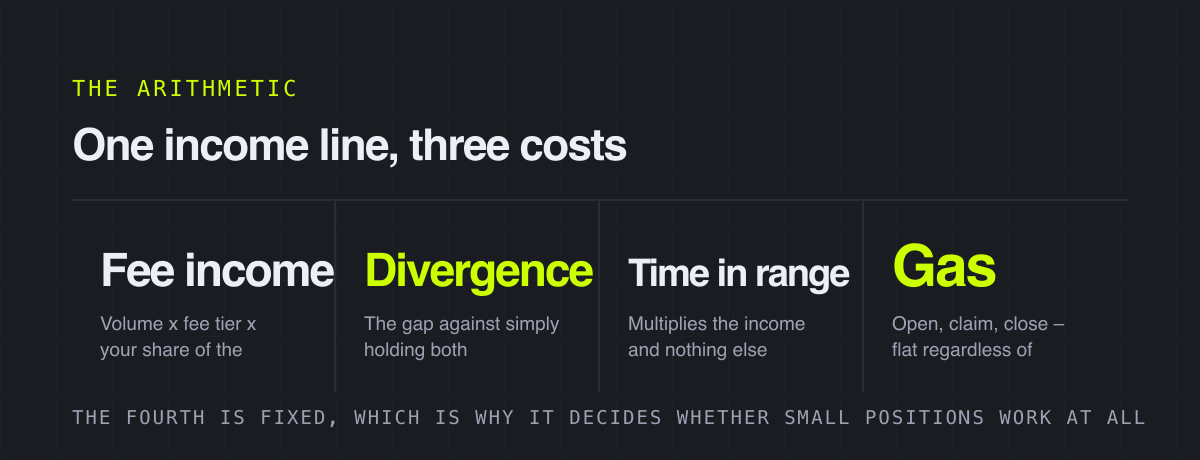
Fee income, divergence loss, time in range and gas. Three of them can be estimated in advance, and the fourth ruins small positions.
The short answer
Before opening a liquidity position, calculate four things: expected fee income from the pool's volume and your share of it, divergence loss at the price moves you consider likely, the share of time the position will be in range, and total gas for opening, claiming and closing. The position works only if the first exceeds the other three combined.
Most people compute nothing before opening a liquidity position and everything after closing one. The four numbers below are all estimable in advance, and together they answer the only question that matters: would this have beaten holding the two tokens.
One: fee income
Your income is the pool's volume, times the fee tier, times your share of the liquidity at the prices where trading actually happens. The first two are published. The third is the one you control, and it is where a concentrated range changes the arithmetic – a narrow range means a larger share of a smaller stretch of prices.
Read the pool's real volume rather than an annualised estimate.  DefiLlama DEX Volume covers the venue and the pool page covers the pair, and a quiet week is more informative than a loud one.
Two: divergence loss
This is the number people skip because it requires a forecast. It does not require a good one – it requires a range of scenarios. Pick three price moves you consider plausible and compute the gap against holding for each.
The impermanent loss calculator on this site takes an entry price, a current price and a range, and returns the comparison directly. Running three scenarios before depositing takes about a minute and is the single highest-value minute in this whole activity.
Three: time in range
Fee income only accrues while the price is inside your bounds, so the estimate in step one has to be multiplied by the fraction of time you expect to be earning. This is the step that turns an impressive headline rate into a realistic one.
| If the range is | Expect in range | Effective rate |
|---|---|---|
| Wide | Most of the time | Close to the quoted rate |
| Moderate | A majority of the time | Meaningfully below quoted |
| Narrow | Sometimes | A fraction of quoted |
| Very narrow | Briefly | Whatever it earned before it stopped |
Four: gas, which does not scale
Opening a position, claiming fees and closing it are three transactions minimum, and rebalancing adds more. Gas is charged per transaction and does not care how much capital is in the position, which means there is a size below which providing liquidity cannot work regardless of how good the pool is.
- Count the transactions you will realistically make, not the minimum possible.
- Express the total as a percentage of your position. If it is a meaningful share, the position is too small.
- Remember that rebalancing a narrow range is repeated gas, which is part of why narrow ranges underperform their advertised rate.
- Add the cost of claiming fees, since uncollected fees do not compound.
Putting it together
Fee income, multiplied by time in range, minus divergence loss, minus gas. If that is positive across the scenarios you think are plausible, the position is worth opening. If it is only positive in the scenario where the price does not move, you have not found a yield – you have found a bet on stability, which is a different thing and should be sized like one.
Tools mentioned
FAQ
How do you calculate liquidity pool returns?
Fee income is the pool's volume times the fee tier times your share of the liquidity where trading occurs. Multiply that by the fraction of time your position is in range, then subtract divergence loss and total gas.
How do I calculate impermanent loss?
Compare the value of the position against the value of simply having held both assets at the same prices. A calculator that takes your entry price, the current price and your range does this directly – the formula alone is easy to apply to the wrong scenario.
What APR do liquidity pools actually return?
Considerably less than the quoted figure in most cases, because the quote assumes you are always in range and that fees compound. Both assumptions fail on a concentrated position left alone.
How much capital do I need for liquidity provision to be worth it?
Enough that the gas for opening, claiming and closing is a small share of the position. Gas is flat per transaction, so the same three transactions are a rounding error on a large position and a decisive cost on a small one.
More from the blog
Prediction Markets: A Price That Looks Like a Probability
A contract paying one dollar if something happens trades at the market's estimate of it happening. The gap between that and a forecast is where the money is.

Staking, and Why There Is None on This Chain
Staking pays you for securing a network. An L2 that settles to Ethereum and charges gas in ETH has nothing for you to secure.
Multisig: Removing the Single Point of Failure
Two of three signatures to move anything. It solves theft and loss at once, and introduces a problem of its own.