Tokenized ETFs: A Wrapper Around a Wrapper
An ETF is already a basket you do not hold directly. Tokenizing it adds a second layer, and the second layer is where the differences live.
The short answer
A tokenized ETF is a token referencing shares in a fund that itself holds a basket of assets. You are two layers from the underlying: the fund's structure decides what the basket does, and the token's structure decides whether you can get to the fund. The second layer is where tracking error, redemption limits and trading hours mismatches come from.
An ETF is already an abstraction. You do not own five hundred companies, you own a share in a fund that does, and the fund's price tracks the basket through a creation and redemption mechanism operated by a small number of authorised participants. Tokenizing it puts another layer on top, and the useful question is what each layer can do independently of the other.
What you own, precisely
A token referencing an index fund gives you exposure to the fund's share price. Not to the index, and not to the companies. The fund tracks the index with some error; the token tracks the fund with some more. Both are usually small and neither is zero.
On this chain the practical examples are the broad index and sector funds available as  Robinhood Stock Tokens. The behaviour is the same as a single stock token except the underlying is itself a basket, which changes the risk profile in one specific way: idiosyncratic risk is diversified away, and structural risk is not.
The hours problem, doubled
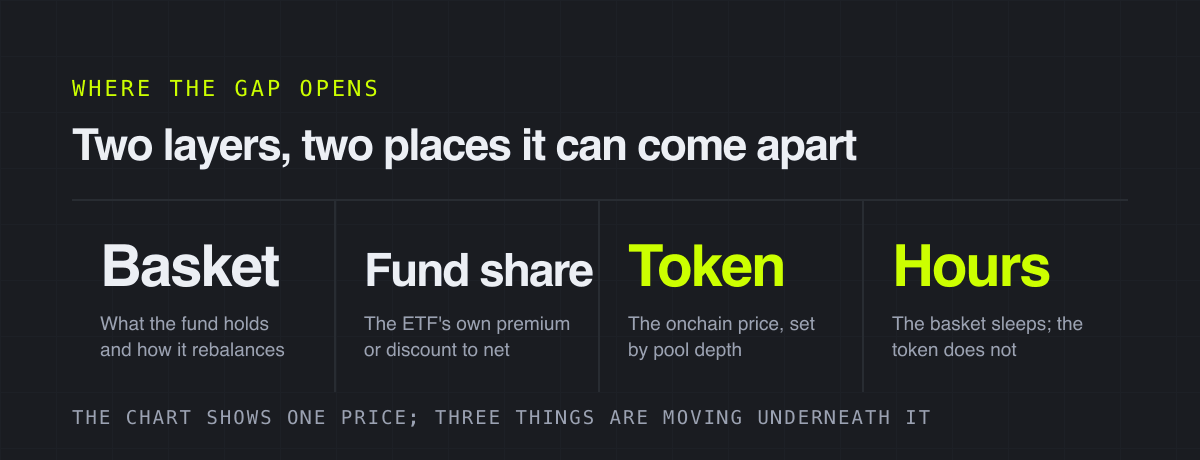
A single stock token drifts when the market is shut because there is no reference price to anchor it. A basket drifts for the same reason, plus one more: the components do not all trade in the same session. A fund holding names across time zones has a stale net asset value for part of every day, and the token quoting it is quoting a number that was already an estimate.
This is not a flaw so much as the thing you are buying. Continuous trading on a discontinuous underlying means the price is always partly a forecast. What matters is knowing which part.
| Layer | What can go wrong | Who fixes it |
|---|---|---|
| Index to fund | Tracking error, fees, rebalancing drag | The fund manager, over time |
| Fund to token | Premium or discount to the fund's price | Arbitrage, if the issuer allows redemption |
| Token to market | Thin pools, wide spreads | Nobody – it is your exit |
| Market hours | Drift while the underlying is shut | The next session's open |
What to check before buying one
- Find whether redemption to the fund exists at all, and for whom. That is what holds the token to its reference.
- Read the pooled liquidity on
 Uniswap. Diversification in the basket does not make the token easier to sell.
 - Compare the token's price to the fund's last close and note the size of the gap at different times of day.
- Check the contract on
 Blockscout for freeze or forced-transfer functions, which tell you what the issuer retains.
 - Look at whether it trades on a venue built for these instruments –
 Arcus exists specifically for this category on this chain.
When the extra layer is worth it
It is worth it when the alternative is not having the exposure at all, when you want it in the same wallet as everything else, or when you need it outside market hours. It is not worth it when you already have a brokerage account, want the dividend treatment the fund actually provides, and do not care about settlement speed.
That is a narrower case than the marketing implies, and a real one. Most people asking about tokenized ETFs want a thing they cannot otherwise hold beside their onchain positions. That is a good reason. Believing the token is the fund is not.
Tools mentioned
FAQ
What is a tokenized ETF?
A token that references shares in an exchange-traded fund, which itself holds a basket of assets. You are two structures away from the underlying holdings, and each structure adds its own tracking error and its own set of counterparties.
Do tokenized ETFs pay dividends?
It depends entirely on the issuer's design. Some pass distributions through as additional tokens or a balance adjustment; others reflect them in the reference price. The fund pays its shareholders, and whether that reaches you is a question about the token's terms, not about the fund.
Are tokenized ETFs the same as owning the ETF?
No. You own a token whose value references the fund. You are not a shareholder of the fund, you have no voting or redemption rights unless the issuer grants them, and your exit is the token's market rather than the fund's.
Why does a tokenized ETF price differ from the real one?
Three reasons stacked: the fund's own premium or discount to its net asset value, the token's premium or discount to the fund, and drift while the underlying market is closed. The token trades continuously and the basket does not.
More from the blog
Tokenized Bonds Beyond Treasuries: Credit, Coupons and Who May Hold Them
A tokenized treasury is a short government loan with no credit question. Everything else in the bond market has one, and it changes the product.
Tokenized Private Credit: The Yield Is Someone Else's Loan
The highest yields in RWA come from the part with no public market, no daily price and no easy exit. That is not a coincidence.
Tokenized Commodities: What Is Behind the Barrel
Gold sits in a vault. Oil does not sit anywhere convenient, which is why almost every oil token is a fund and not a barrel.