Robinhood Chain Launchpads: All 15 Compared
PONS runs the volume. The interesting ones are the stock-paired launchpads that exist nowhere else.
The short answer
Robinhood Chain has 15+ launchpads competing on fee model, creator payouts and RWA integration rather than technology. PONS is the largest with 167,000+ tokens and roughly $4 billion cumulative volume, using fixed supply with locked Uniswap V3 liquidity. hood.fun offers free gas-only launches, pools.trade is Uniswap Labs' own flow, and TrustSwap sits at the vetted end with KYC and locked liquidity. The chain's distinctive category is stock-paired launchpads — Long, Bankr and Stoxes — which pair new tokens against tokenized equities like TSLA or NVDA.
Most launchpads on any chain do the same thing: deploy a fixed-supply ERC-20 and either sell it through a bonding curve before creating a pool, or list it straight into an AMM. Robinhood Chain has 15+ of them. The differences that matter are economic, not technical.
The volume leader
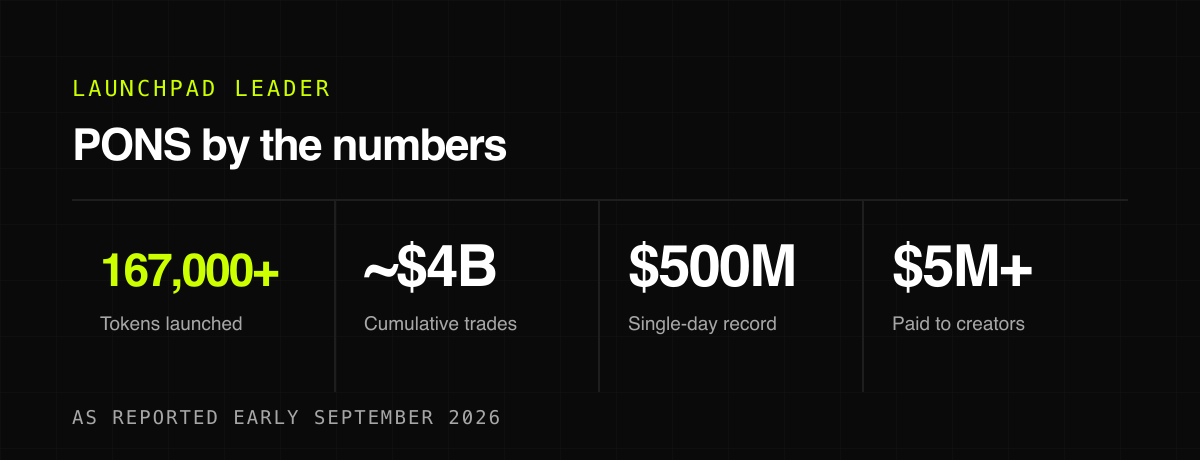
PONS is the largest by a wide margin: 167,000+ tokens live, fixed supply, locked Uniswap V3 liquidity, non-custodial. It posted a $500 million single-day volume record with roughly $4 billion cumulative, and has paid out over $5 million in creator earnings. Pons v2 added RWAs and fees paid in ETH.
The free-and-fast tier
- hood.fun — free launches, gas only, no platform fee, with anti-snipe protection and community-takeover mechanics.
- pools.trade — Uniswap Labs' own launch flow, issuing directly into a Uniswap pool.
- bow.fun, Klik, Launchhood — competing on fee share and creator rewards; Launchhood runs SushiSwap V3 with sniper protection and a 50% creator fee share.
- Ape Store and Retake — cheapest launches, party launches with shared dev buy.
The stock-paired tier — the one that is actually new
This category does not exist on other chains, because other chains do not have liquid tokenized equities.
- Long — memecoins paired against stock tokens. $15M+ volume with $710K in stock TVL, accounting for the large majority of RWA activity on the chain at one point.
- Bankr — stock-paired tokens launched against TSLA, AAPL or SPY, with $612K+ paid to builders. Launches can be triggered from X.
- Stoxes — multi-chain RWA dividend launchpad using Chainlink oracles for live stock prices.
- Robin Pad — dual reflection tokens with stock exposure.
The vetted end
TrustSwap runs a launchpad with KYC, due diligence and locked liquidity — the low-variance end of the spectrum, aimed at projects raising rather than memecoins launching. MintPlus from Team Finance offers no-code token creation with auto-locked liquidity and vesting.
How to evaluate one before you buy a launch
- Is liquidity locked, and for how long? PONS locks Uniswap V3 liquidity; not every competitor does.
- Is supply fixed, or can the deployer mint more?
- What is the graduation mechanic, and what happens to unsold curve supply?
- Does the platform take a cut of creator fees, and does that change the deployer's incentive to dump?
- Is there anti-snipe protection, and does it actually work — check the first blocks of a recent launch on Blockscout.
Most launchpads on Robinhood Chain are independent, permissionless applications. Robinhood Markets does not operate, review or endorse them, whatever the naming suggests.
Follow the fee, not the feature list
Launchpads market on features and compete on economics. The fee split is the part that changes deployer behaviour, and deployer behaviour is what decides whether a launch is survivable.
A platform paying creators a large share of trading fees gives deployers a reason to keep a token alive rather than to dump and move on. A platform charging the deployer nothing up front lowers the cost of spraying dozens of launches to see which sticks. Neither model is better in the abstract; they produce different populations of token.
When a launchpad advertises millions paid to creators, read it as a statement about incentives rather than as a proof of quality. It tells you the deployers there have a reason to care about volume after launch.
Reading a launch in its first minutes
- Open the contract on the explorer and check the deployer address. Look at what else it has deployed and how those performed.
- Check the first blocks of trading. A cluster of buys from freshly funded wallets in block one is a bundle, not organic demand.
- Confirm the liquidity lock exists, and read its duration. 'Locked' with a one-week unlock is a countdown, not a guarantee.
- Check supply concentration after the first minutes. If the top ten wallets hold most of it, the float is an illusion.
- Compare the token's claimed socials against the contract's creation time. Accounts created the same day are the norm and tell you which game you are in.
The graduation cliff
Graduation is the moment a bonding-curve token deploys real liquidity into an AMM. It is also the single most predictable inflection in a launch's life, which means everyone watching knows it is coming.
Curve buyers who were early frequently exit into the liquidity that graduation creates. That is not manipulation, it is the design: the curve rewards early entry and graduation provides the depth to realise it. Entering at graduation means buying from people whose entire thesis was getting there first.
 PONS
PONS Uniswap
 Chainlink
FAQ
What is the biggest launchpad on Robinhood Chain?
PONS, with 167,000+ tokens launched, around $4 billion in cumulative trades, a $500 million single-day record and $5 million+ paid to creators. It uses fixed supply with locked Uniswap V3 liquidity.
What is a stock-paired launchpad?
One that pairs a new token's liquidity against a Robinhood Stock Token such as TSLA or NVDA instead of ETH or a stablecoin. Long, Bankr, Stoxes and Robin Pad operate in this category, which is unique to Robinhood Chain.
Are Robinhood Chain launchpads official?
No. Nearly all are independent, permissionless applications built on the network. Robinhood Markets does not operate, review or endorse them regardless of naming.
What is a bonding curve graduation?
Tokens first trade against a formula-priced curve on the launchpad. Once enough is bought, the accumulated liquidity deploys into a real AMM pool — usually Uniswap — and the token graduates to open-market trading.
More from the blog
How to Find a Wallet Worth Copying on Robinhood Chain
Leaderboards rank by total profit, which is mostly size and luck. Five checks that separate a repeatable edge from one lucky position.
Is Copytrading Profitable? The Arithmetic Nobody Runs First
Copytrading pays you the leader's return minus four deductions. Here is what each one costs, and the win rate a wallet needs before following it makes money.
Copytrading vs Trading Yourself: Which Actually Suits You
One rents someone else's research at a fixed price. The other charges you in time instead of fees. The honest comparison on cost, control and what you learn.