What RWA Means in Crypto, and What Is Actually Onchain
Real-world assets is a category with one enormous member, a few working ones and a long tail of announcements. Knowing which is which is the whole subject.
The short answer
RWA stands for real-world assets: claims on something that exists off the chain – a Treasury bill, a share, a property, a loan – represented as a token. The token is not the asset. It is a claim against an issuer who holds the asset and promises to honour redemptions, which means an RWA is only as good as that issuer and the legal structure behind it. Tokenized short-term government debt is by far the largest and most functional category; tokenized equities are the fastest-growing consumer-facing one; tokenized real estate has been announced far more often than it has traded.
The acronym is doing a lot of work. RWA covers everything from a money-market fund wrapped in an ERC-20 to a fractional claim on a building in a city you will never visit, and those two things share a mechanism and nothing else.
What the token actually is
A claim. Somewhere off the chain, a regulated entity holds the asset – the bills, the shares, the deed – and issues tokens representing entitlement to it. The chain tracks who holds the claim and moves it instantly; it does not hold the asset and cannot enforce the promise.
This is the single most important sentence about the category, because it means every property people associate with crypto – trustlessness, self-custody, censorship resistance – applies to the claim and not to the thing claimed. The issuer can freeze, the custodian can fail, and the legal wrapper decides what you get if either happens.
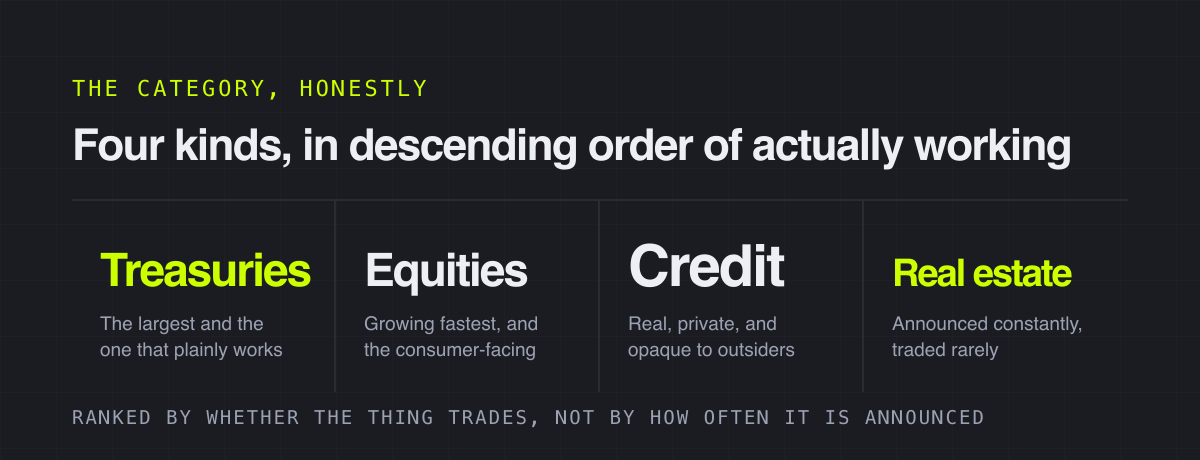
The four categories, ranked by whether they work
Tokenized Treasuries and money-market funds
Short-dated government debt, wrapped. This is the category that plainly functions: the underlying is the most liquid instrument in the world, the yield is real and comes from outside crypto, and redemption is a process the issuers run daily anyway. Most of the value in RWA sits here, and most of it is held by institutions rather than by retail.
Tokenized equities
Shares and ETFs as transferable tokens. Functionally the closest to what a trader recognises, and the category that put RWA in front of ordinary users – on this chain that is  Robinhood Stock Tokens themselves, ERC-20s tracking listed equities and trading around the clock next to memecoins.
Private credit
Loans to businesses, tokenized so the exposure can be traded. Real, sizeable, and the hardest for an outsider to evaluate: the yield looks excellent until you ask who the borrower is and what happens when they do not pay, and the answer to both lives in documents rather than on the chain.
Real estate
The category with the most announcements and the least trading. Tokenizing a building does not make it liquid, because a buyer for a fractional claim on one property is as scarce as a buyer for the property. What tokenization solves is settlement; what real estate lacks is demand, and those are not the same problem.
Why this became a narrative
Because it is the one part of crypto whose yield does not come from crypto. A Treasury token pays because the government pays, not because someone newer bought. For anyone tired of returns that depend on inflows, that is the appeal, and it is a real one.
The narrative is separate from the product, and trades on its own schedule. Tokens of companies that build RWA infrastructure move on announcements, partnerships and regulatory news, which has very little to do with whether any asset was tokenized that week.
The questions worth asking of any RWA
- Who issues it, and under which regulator? This is the counterparty, and it is the whole risk.
- What happens on redemption – who do you present the token to, and on what terms?
- Where does the yield come from? If it is not the underlying asset paying, it is an incentive with a schedule.
- Can the issuer freeze or claw back your tokens? For most compliant RWAs the answer is yes, by design.
- Is there secondary liquidity, or only issuance?
 DefiLlama RWA tracks the category's size across chains. A token you can buy and not sell has solved nothing.
The last one separates the working categories from the announced ones more reliably than anything else.
Tools mentioned
FAQ
What does RWA mean in crypto?
Real-world assets: tokens representing a claim on something that exists off the chain – Treasury bills, shares, loans, property. The token records who holds the claim; an off-chain issuer holds the actual asset and honours redemptions.
Are RWA tokens safe?
They replace market risk with counterparty risk rather than removing risk. The asset may be a government bill, but your claim on it is only as good as the issuer and the legal structure behind it, and most compliant RWAs allow the issuer to freeze or recall tokens.
What is the largest RWA category?
Tokenized short-term government debt – Treasury bills and money-market funds. It works because the underlying is the most liquid instrument there is and the yield comes from outside crypto entirely.
Is tokenized real estate a good investment?
Tokenizing a property fixes settlement, not demand. A fractional claim on one building has roughly as many buyers as the building does, which is why the category has produced far more announcements than trades. Check for secondary liquidity before anything else.
More from the blog
Social Trading vs Copy Trading: Not the Same Thing
One shows you what people are doing and leaves the decision with you. The other takes the decision away. That difference is the entire product.
Reading a Memecoin Community Before You Buy Into It
A busy Telegram is not demand. Four things separate a community from a room that was paid to look like one.
RWA Tokens: What Is in the Basket, and What It Owns
Every list of real-world-asset tokens mixes three unrelated things. Sorting them takes one question, and most lists never ask it.