What a DEX Aggregator Does, and When It Costs You
It searches every pool for the best route and splits your trade across them. That is worth real money on a large order and worth nothing on a small one.
The short answer
A DEX aggregator does not hold liquidity. It reads every pool that can trade your pair, works out which route gives the best output – often splitting one trade across several pools – and sends the transaction through them. On a large order across fragmented liquidity that routing is worth more than any fee it charges. On a small order in a token with one real pool, it adds complexity and gas for a saving that does not exist, and on brand-new tokens it may not see the pool at all.
The word suggests something that gathers liquidity. It does not. An aggregator owns no pools and holds no tokens – it is a routing layer that reads the liquidity other people supplied and decides how to walk through it.
The problem it solves
The same pair can trade in several places at once: different fee tiers on the same DEX, different DEXes, and multi-step routes that go through a third token. Each has different depth, so each gives a different output for the same input, and the differences grow with the size of the trade.
Working that out by hand is not realistic. An aggregator does it continuously, and will frequently split one order into several pieces routed differently, because the best execution for a large order is rarely one path.
Why splitting matters
Price impact grows faster than trade size. Two pools each taking half your order produce less total impact than one pool taking all of it, even when the second pool is slightly worse on paper. That non-linearity is where most of an aggregator's value comes from, and it is exactly the part a person eyeballing two quotes will get wrong.
When it is not worth it
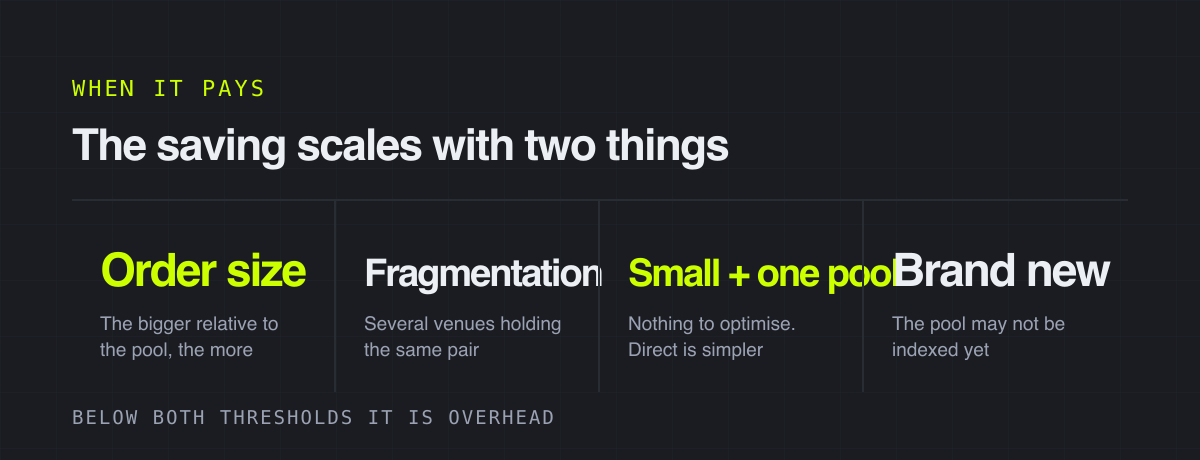
- A small trade. If your order barely moves any pool, there is nothing to optimise and the routing saves you less than the extra gas costs.
- One real pool. Most new tokens trade in exactly one place, and the best route is the only route.
- A pool minutes old. Aggregators index; indexing takes time, and the route may simply not exist yet from its point of view.
- When you care about which contract you touch. A split route interacts with more contracts than a direct swap, each of which is a surface.
- When the aggregator charges a fee on top. Some do, and on an efficient pair it can exceed what the routing saved.
What to check in a quote
- The output amount, compared against a direct swap on the main pool. That comparison is the whole decision.
- The route itself – how many hops and how many venues. More hops means more gas and more contracts.
- Whether the aggregator takes a fee, and whether it is already inside the quoted output or added after.
- The slippage setting, which on a split route applies to a more complex execution than a single swap.
- Whether the extra gas of a multi-hop route eats the improvement on the size you are actually trading.
The thing worth remembering
An aggregator improves execution; it does not create liquidity that is not there. If every pool for a token is thin, the best route through thin pools is still a thin trade, and no routing layer changes what the pools can absorb.
FAQ
What does a DEX aggregator do?
It reads every pool that can trade your pair, calculates which route produces the most output – frequently splitting the order across several pools – and executes through that route. It supplies no liquidity of its own; it only decides the path through other people's.
Is a DEX aggregator always cheaper?
No. The saving comes from order size relative to pool depth and from liquidity being spread across venues. On a small trade in a token with one real pool there is nothing to optimise, and the extra gas of a routed transaction can cost more than the routing saves.
Do aggregators work on brand-new tokens?
Often not immediately. They rely on indexing the pools that exist, and a pool created minutes ago may not appear yet. For very new tokens the direct pool is usually the only route anyway.
More from the blog
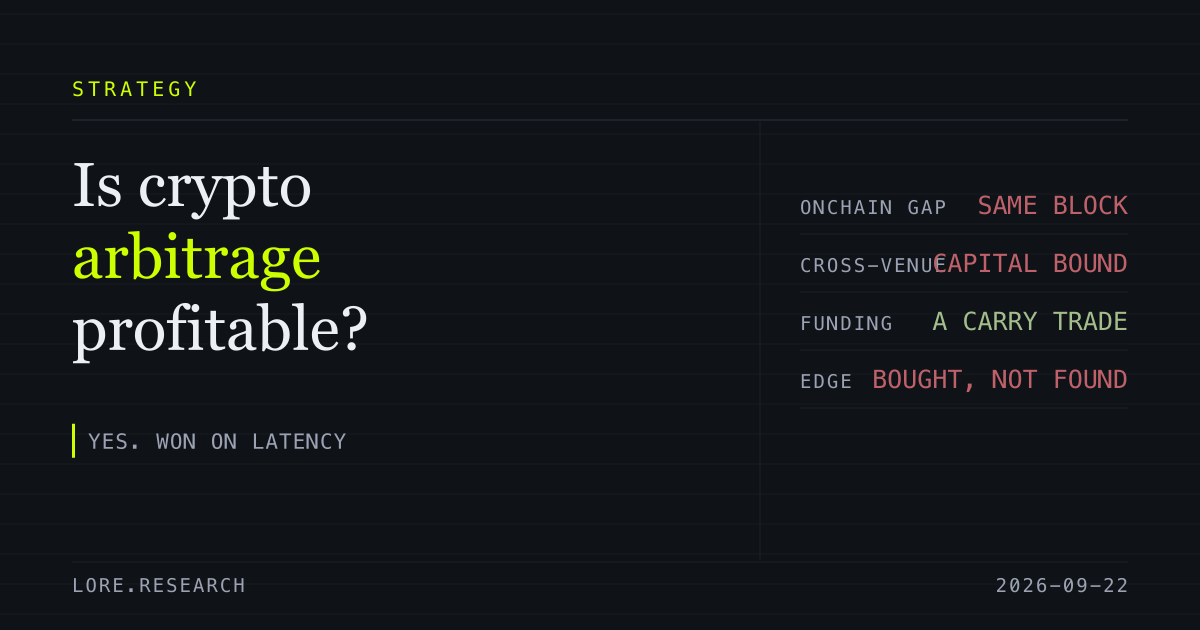
Is Crypto Arbitrage Profitable? Yes, and Not for You
The opportunity is real and it is measured in milliseconds. By the time a price difference is visible on a screen, it has been taken.
Token Approvals: The Permission You Forgot You Gave
Every swap asks for permission to move a token, and most of those permissions are unlimited and permanent. They stay live long after the trade is done.
Rabby vs MetaMask: One Shows You What You Are Signing
Both connect to the same chains and hold keys the same way. The difference is a single screen, and it is the screen where money is lost.