How to Remove Liquidity, and Why You Get Back Something Else
You put in half and half. You take out whatever the price left behind, plus fees you have to claim separately.
The short answer
Removing liquidity returns the two assets in whatever proportion the price left them, not the proportion you deposited. Uncollected fees are a separate claim, and on a concentrated position that has moved out of range you will receive a single asset – the one that lost.
Closing a liquidity position is two transactions and one surprise. The transactions are straightforward. The surprise is that what comes out is not what went in, and the difference is not a bug or a fee – it is the entire mechanism working exactly as designed.
Why the mix changed
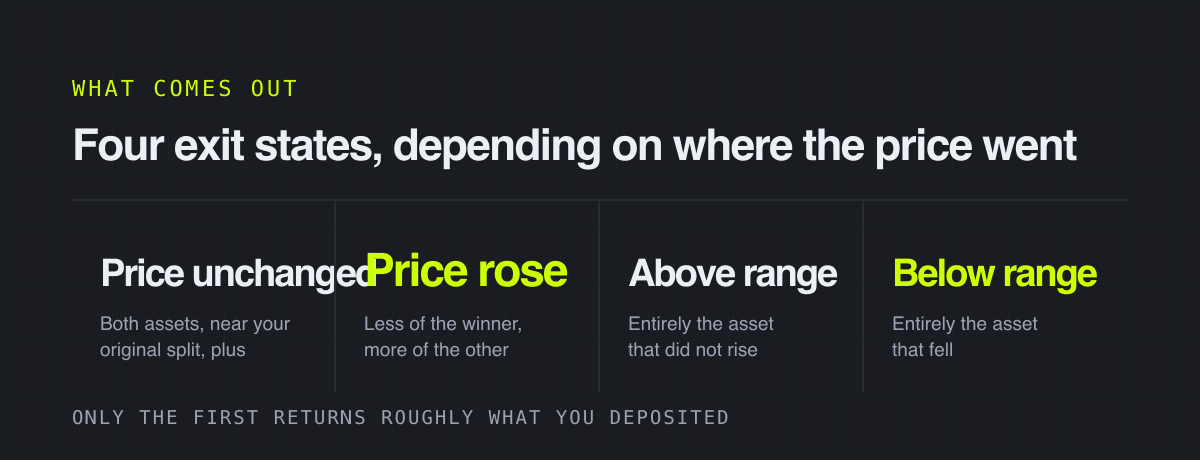
A pool is an automatic trader. When the price of one asset rises, people buy it from the pool, and the pool pays them with your capital. You end up with less of the thing that went up and more of the thing that did not – continuously, all the way up.
This is not something that happens when you withdraw. It happened while you were in the position. Withdrawing just makes it visible.
The out-of-range case
On a concentrated position, if the price has left your range, the conversion is complete. Above the range you hold only the asset that did not rise; below it, only the asset that fell. Either way you withdraw a single token, and it is the one you would rather have less of.
Fees are a separate claim
On a concentrated position, uncollected fees are not included in the withdrawn amounts automatically in every interface. Some flows claim them for you, some do not, and a position closed without claiming leaves them behind. Check the confirmation screen for two line items, not one.
The steps
- Open the position on
 Uniswap and read the current composition – it will tell you what you are about to receive.
- Decide how much to withdraw. Partial withdrawals are possible; they reduce the position rather than closing it.
- Claim the fees, either in the same flow or as a separate transaction. Confirm both appear.
- Confirm the withdrawal. The assets return to your wallet in the pool's current ratio.
- If the position is fully closed, the NFT is burned. There is nothing left to manage.
The question to ask before withdrawing
Not whether the position is up. Whether it beat holding. Those are different questions and the second is the one that tells you whether providing liquidity on that pair was a good idea. A position can be up in dollar terms and still have been worse than doing nothing.
| Comparison | What it tells you |
|---|---|
| Position value vs deposit | Whether the pair went up. Mostly about the market |
| Position value vs holding both | Whether providing liquidity was worth it |
| Fees vs divergence loss | Whether the fee tier was right for the pair |
| Time in range vs total time | Whether the range was right |
The impermanent loss calculator on this site does the second comparison, which is the only one that answers whether to do it again. Running it at exit turns a position into information rather than just a result.
Tools mentioned
FAQ
How do I remove liquidity from a pool?
Open the position, choose how much to withdraw, claim any uncollected fees, and confirm. The two assets return to your wallet in the pool's current ratio, and a fully closed concentrated position burns its NFT.
Why did I get back different amounts than I deposited?
Because the pool traded on your behalf while you were in it. As one asset rose, traders bought it from your position, leaving you with less of the winner and more of the other. Withdrawing only reveals what already happened.
What happens if I withdraw while out of range?
You receive a single asset – the one that did not rise if the price went above your range, or the one that fell if it went below. The conversion completed when the price crossed your bound.
Do I lose my fees if I remove liquidity?
Only if you close without claiming them. Some interfaces collect fees as part of the withdrawal and some do not, so check that the confirmation shows both the returned assets and the fee claim.
More from the blog
Prediction Markets: A Price That Looks Like a Probability
A contract paying one dollar if something happens trades at the market's estimate of it happening. The gap between that and a forecast is where the money is.
Staking, and Why There Is None on This Chain
Staking pays you for securing a network. An L2 that settles to Ethereum and charges gas in ETH has nothing for you to secure.
Multisig: Removing the Single Point of Failure
Two of three signatures to move anything. It solves theft and loss at once, and introduces a problem of its own.