Can You Recover Stolen Crypto? Almost Never, Honestly
The hard answer first, because the people promising a softer one are running the second scam.
The short answer
In almost all cases you cannot. An onchain transfer is final by design, nobody can reverse it, and there is no support desk with the authority to try. The narrow exceptions are funds that reached a centralised exchange, where an account can be frozen if you report fast enough and the exchange chooses to act, and cases large enough for law enforcement to take. What you can do in the first hour is limit the rest: move whatever remains to a new wallet, revoke approvals from the old one, and assume the old wallet is compromised permanently. Treat every offer to recover your funds for a fee as the second attack, because that is what it is.
This article does not have a happy version. The property that makes a public chain work – that a settled transaction cannot be undone by anyone, including the people who built it – is the same property that makes theft permanent.
Why reversal is not possible
There is no central ledger holder with the authority to move funds back. A validator cannot do it, an exchange you do not control cannot do it, and the wallet software you used has no relationship to your funds beyond holding a key. A chargeback exists because a card network sits in the middle of card payments. Nothing sits in the middle here, which was the point.
The two narrow exceptions
The funds reached a centralised exchange
Thieves frequently cash out somewhere with accounts and identity checks. If you can show that your funds landed in a specific deposit address, and you report it quickly with a police report, an exchange can freeze the account. This is the only route that recovers money with any regularity, and it depends on speed and on the exchange's cooperation, neither of which you control.
The amount is large enough for law enforcement
Specialist units exist and have recovered significant sums. They work on scale, and on cases that connect to organised operations. Report regardless, because your report may join others into something large enough to act on – but do it understanding that this is a contribution to a case rather than a path to your money.
How the second scam works
- It arrives within days, sometimes hours, because your loss is visible onchain and your complaint is visible on social media.
- It asks for an upfront fee, a gas payment, or a tax – always something you send first.
- It may show you a dashboard with your funds apparently recovered, waiting for one more payment to release.
- It may ask for your seed phrase to import the wallet, which takes whatever survived the first attack.
- Some of it wears the clothes of a law firm, a blockchain forensics company or a government agency.
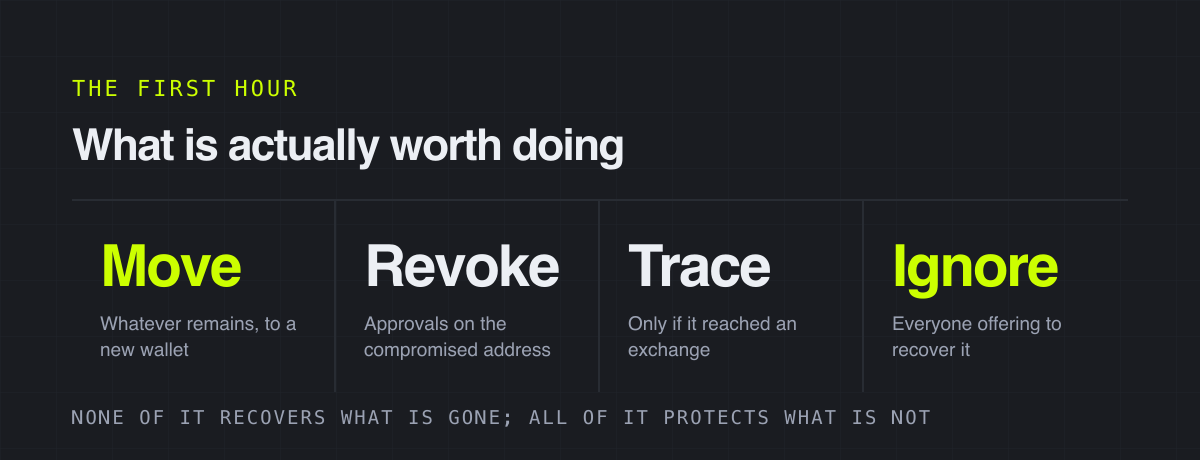
What to actually do, in order
- Move everything still in the compromised wallet to a wallet created on a clean device. Do this before anything else, and assume the drainer is still watching the address.
- Revoke every approval on the compromised address with
 Revoke.cash. It cannot recover anything, but it closes the door on the rest.
 - Never use that wallet again. If the seed was exposed, it is permanently theirs too – funding it later is a gift.
- Record the transaction hashes and the receiving addresses from
 Blockscout. This is what any report needs.
 - If the trail reaches an exchange, contact them immediately with the hashes and a police report reference.
- File the report anyway, even for a small amount, and then stop looking at it.
The part worth taking forward
Loss here is not usually a failure of knowledge – most people who get drained knew about phishing. It is a failure of structure: everything in one wallet, that wallet connecting to everything. The separation that would have limited this to an afternoon's trading balance costs nothing and takes ten minutes, and it is worth doing on the same day you read this rather than the day after you need it.
Tools mentioned
FAQ
Can stolen crypto be recovered?
Almost never. An onchain transfer is final and no one has the authority to reverse it. The realistic exception is funds that reached a centralised exchange, where an account can sometimes be frozen if you report quickly with a police report – that depends on speed and on the exchange choosing to act.
Are crypto recovery services legitimate?
Essentially none that contact you are. Your loss is visible onchain and your complaint is visible publicly, so the list of recent victims is farmed. The pattern is always an upfront fee, a release payment, or a request for your seed phrase – all of which take what survived the first attack.
What should you do immediately after a wallet is drained?
Move anything remaining to a wallet created on a clean device, revoke all approvals on the compromised address, and never use it again. Record the transaction hashes and receiving addresses, and if the trail reaches an exchange, contact them at once with those and a police report.
More from the blog
Arbitrum Orbit: The Stack Robinhood Chain Is Built On
Not a brand on a box. A specific set of choices about who orders transactions, where the data goes, and what you are trusting when you bridge in.

What Volume Means, and When the Number Is Manufactured
Volume is how much traded, not how many wanted to. Two wallets with a script can produce a week of it in an afternoon.

How to Swap Tokens, and the Four Screens That Matter
The swap itself is two clicks. Everything that decides whether it was a good one happens on the screens around it.