Liquidity Farming on Robinhood Chain: Fees, Vaults and Impermanent Loss
Three ways to provide liquidity, and the one number that decides whether any of them worked.
The short answer
Liquidity farming on Robinhood Chain means supplying an asset pair to a Uniswap v3 or v4 pool and earning trading fees, or depositing into a managed vault — Arrakis, Gamma or UNILIQUID — that rebalances the range for you. A third route is incentivised protocol farms such as Ripe, which advertise far higher nominal APRs paid in an emission token. Impermanent loss, not APR, decides your actual return: on volatile memecoin and stock-token pairs it routinely exceeds the fees earned, and concentrated ranges amplify both.
Providing liquidity is the only yield on this chain that comes from real economic activity rather than token emissions. It is also the easiest way to lose money while watching a number go up.
Route one: manual Uniswap positions
Uniswap is the base layer everything else wraps. You pick a pair, pick a price range, and deposit both sides. Inside your range you earn fees; outside it you earn nothing and hold whichever asset lost.
Concentrated liquidity is a leverage decision dressed as a convenience feature. A narrow range multiplies your fee income while you are in it and multiplies your impermanent loss when price leaves. Wide ranges behave more like the old v2 model — lower fees, gentler losses.
Route two: managed vaults
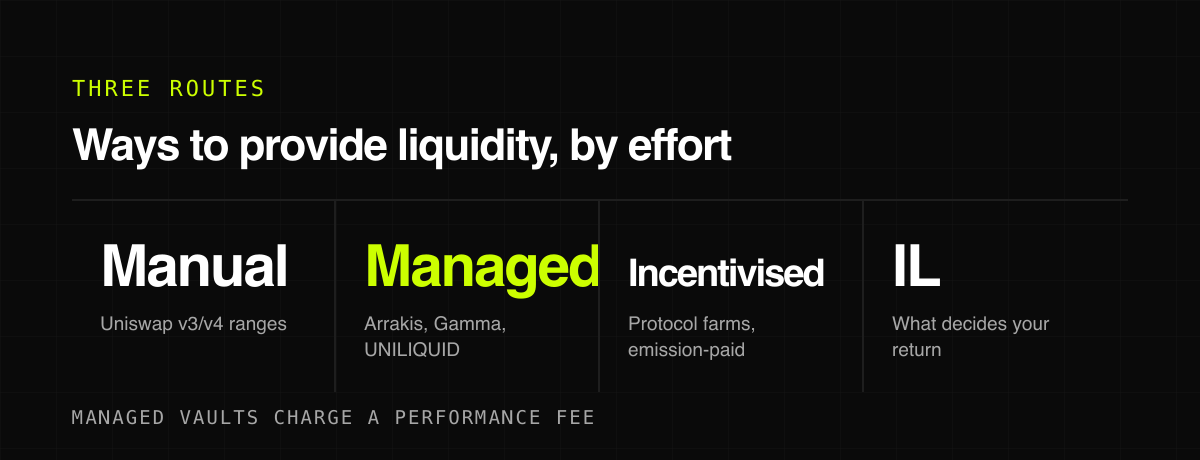
If you do not want to rebalance by hand, an automated liquidity manager does it for you and charges for the service.
- Arrakis — focused on low-risk strategies, strongest fit for stablecoin and correlated pairs.
- Gamma — a wider strategy menu with stronger external incentive programmes attached.
- UNILIQUID — Uniswap v4 liquidity tooling built specifically for Robinhood Chain pools.
- Scalar — building liquidity infrastructure for the chain, combining market discovery, concentrated liquidity and LP management.
Compare vaults on net-of-fee historical performance, not on the strategy label. Two vaults described identically can behave completely differently depending on how aggressively they rebalance.
Route three: incentivised farms
Ripe Protocol brought multi-collateral borrowing and yield farming to the chain, letting you deposit ETH, stablecoins and Robinhood stock tokens such as NVDA, AAPL and GME and borrow GREEN against the portfolio. Its farms have shown nominal APRs around 23,669% on the RIPE/NVDA pair and 8,423% on the standalone RIPE farm.
The stock-token wrinkle
Robinhood Chain has a pair type that exists almost nowhere else: a tokenized equity against a stablecoin, or against a memecoin. The equity leg behaves like the real stock, including gaps at the open when the underlying market reopens after a weekend of 24/7 on-chain trading. Your impermanent loss profile inherits that gap risk.
That is not automatically bad — it means fee income on those pools is compensating you for a real, identifiable risk rather than for randomness. But it needs to be priced deliberately.
A checklist before depositing
- Look up the pool on DefiLlama's yield page first — it shows TVL alongside APY, and TVL tells you whether the APY is survivable.
- Separate fee yield from emission yield. Only the first is repeatable.
- Model the price divergence you expect over your holding period and calculate the IL, then compare to expected fees.
- Check whether the pool's volume is real or wash-traded — a fee APR built on fake volume pays nothing.
- For managed vaults, read the fee structure. A performance fee on an emission-paid strategy can exceed the realised return.
Doing the impermanent loss maths once
Impermanent loss is not a mystery number. For a standard two-asset pool it depends only on how far the two assets diverge from the ratio at which you deposited. A 1.25x divergence costs roughly 0.6% of your position versus holding. A 2x divergence costs about 5.7%. A 4x divergence costs about 20%.
Those figures are for a full-range position. Concentrated liquidity multiplies them, because your capital is doing more work inside a narrower band and is fully converted into the losing asset once price leaves that band.
Set that against expected fees. If a pool pays 30% annualised in fees and you expect the pair to diverge 2x over the year, you are ahead. If it pays 8% and the pair is a memecoin against ETH, you are not, and no APR display will tell you that.
Which pairs are actually worth providing to
- Stablecoin pairs — minimal divergence, minimal IL, small fees. The closest thing to a genuine yield.
- Correlated pairs — ETH against a liquid staking derivative, for example. Divergence is bounded by design.
- Stock token against stablecoin — divergence is the equity's move. Predictable in character, with a scheduled gap risk at the Monday open.
- Memecoin against ETH — the highest fees and the highest chance of ending up holding all of the loser. Only defensible over short windows with active management.
What managed vaults are really charging for
A vault's fee buys you rebalancing, which matters because a concentrated position that sits out of range earns nothing while still carrying the divergence you already took. Rebalancing is not free for the vault either — every adjustment realises some loss and pays gas.
So the comparison is not 'vault versus manual', it is 'vault fee versus the cost of me rebalancing badly or not at all'. For most people who are not going to check positions daily, that comparison favours the vault. For anyone running a tight range on a volatile pair, it usually does not.
 Uniswap
 UNILIQUID
FAQ
How do I start providing liquidity on Robinhood Chain?
Bridge ETH to chain 4663, open Uniswap, pick a pair and a price range, and deposit both sides. If you do not want to manage the range, deposit into a managed vault such as Arrakis or Gamma instead.
Arrakis or Gamma?
Arrakis skews toward low-risk strategies and suits stablecoin and correlated pairs. Gamma offers a wider strategy menu with stronger external incentives. Compare net-of-fee historical performance per vault rather than the headline description.
Are the four-figure APRs real?
The numbers are arithmetically real but paid in a volatile emission token whose price typically falls as rewards are sold. Treat the headline APR as an upper bound and model the token at a heavy discount.
What is impermanent loss?
When the two assets in your pool diverge in price, you end up holding more of the loser and less of the winner than if you had simply held both. Concentrated ranges amplify it, and on volatile pairs it frequently exceeds fees earned.
More from the blog

How to Find a Wallet Worth Copying on Robinhood Chain
Leaderboards rank by total profit, which is mostly size and luck. Five checks that separate a repeatable edge from one lucky position.
Is Copytrading Profitable? The Arithmetic Nobody Runs First
Copytrading pays you the leader's return minus four deductions. Here is what each one costs, and the win rate a wallet needs before following it makes money.

Copytrading vs Trading Yourself: Which Actually Suits You
One rents someone else's research at a fixed price. The other charges you in time instead of fees. The honest comparison on cost, control and what you learn.