Single-Sided Liquidity: The Range That Is Really a Limit Order
Deposit one asset into a range the price has not reached yet, and the pool converts it for you – charging the buyer instead of you.
The short answer
Single-sided liquidity means opening a concentrated position entirely above or below the current price, so only one asset is required. As the price moves through the range, the pool sells your asset into the move and you collect fees for it – which makes it the closest thing to a limit order that exists on an automated market maker.
The usual assumption about providing liquidity is that you need both assets. That is only true if your range contains the current price. Put the range entirely above or below it and the position requires one asset, because at those prices the pool would hold only one.
What actually happens
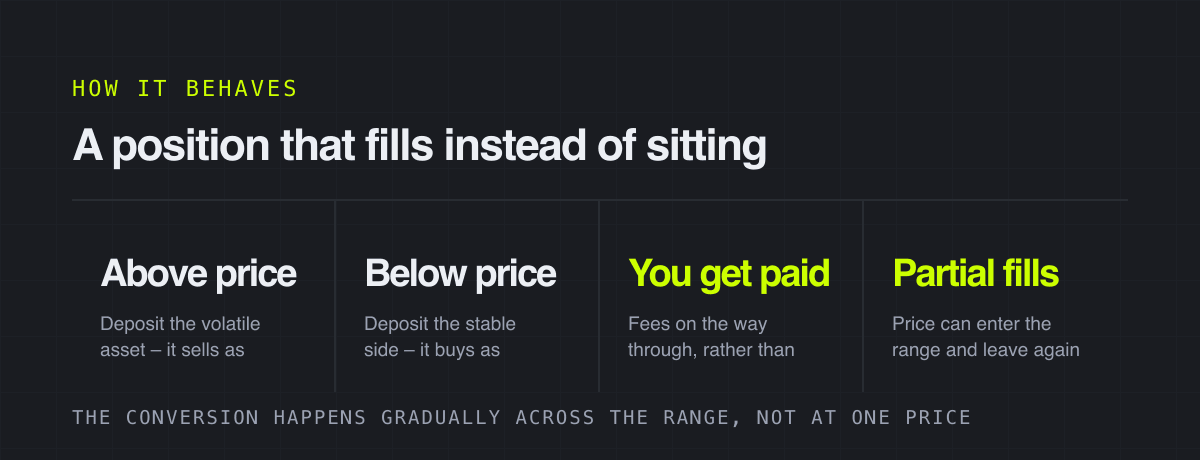
Say the price is at some level and you open a range above it, funded entirely with the volatile asset. Nothing happens while the price stays below. If the price rises into your range, traders buying will be buying from you, progressively, across the range. By the time price exits the top, your position is entirely the other asset.
You have sold, across a band of prices, and been paid fees for the privilege instead of paying a fee to take liquidity. Reverse everything for a range below the price funded with the stable side, which buys as the price falls.
Where it genuinely helps
There is no native limit order on an automated market maker, which is the single most common complaint from anyone arriving from an exchange. This is the closest available substitute, and unlike a bot watching the price it does not need a key, a server or trust in anyone.
- Scaling out of a position you already hold, across a price band you are happy to sell into.
- Accumulating below the market without leaving an order somewhere that can be seen and front-run.
- Earning a fee on capital that would otherwise be sitting waiting for a level.
- Exiting a large position gradually, in a pool where one market order would move the price against you.
What it does not do
It does not guarantee a fill. Price can enter your range, turn around and leave, and you end up holding a mixture of both assets at an average you did not choose. That is a partial fill with no way to cancel it cleanly – you can withdraw, but you withdraw whatever the position currently is.
| Limit order | Single-sided range | |
|---|---|---|
| Fill price | One price, or nothing | An average across the range |
| Fees | You pay to take | You are paid to provide |
| Partial fills | Possible | Normal and expected |
| Cancelling | Free | Withdraw whatever it has become |
| Visibility | On an order book | Onchain, but no mempool here to watch it |
Practical notes
Width is the main decision. A narrow band behaves close to a limit order and risks being skipped by a fast move; a wide band is certain to catch the price but averages your fill across a lot of ground. Pick the band you are genuinely happy to transact across, not the one with the best-looking edge.
Opening these positions is ordinary  Uniswap mechanics, and the tooling makes it less fiddly than doing it by hand –
  Liquidity Ladder builds a row of ranges rather than one, and
  Zenith LP does the same from a Telegram chat. Neither changes what the position is.
Tools mentioned
FAQ
What is single-sided liquidity?
A concentrated liquidity position opened entirely above or below the current price, which therefore requires only one of the two assets. As the price moves through the range, the pool converts your asset into the other one and you collect fees on the way.
Can you use single-sided liquidity as a limit order?
Close to it. The difference is that a limit order fills at one price and this fills gradually across a band, and that you are paid fees for providing the liquidity rather than paying to take it. Neither one guarantees a fill.
Is there impermanent loss with single-sided liquidity?
Not in the usual sense, because you started with one asset and intended to end with the other. The equivalent risk is a partial fill – the price enters the range, reverses, and leaves you holding a mixture at an average you did not choose.
How wide should the range be?
As wide as the band of prices you would genuinely be happy transacting across. Narrow behaves most like a limit order but can be skipped by a fast move; wide is more certain to fill but averages your price across more ground.
More from the blog
Tracking Whale Wallets Without Mistaking Size for Skill
A large balance is evidence of a large balance. Whether it means anything about the next trade is a separate question, and usually the answer is no.
Wallet Tracking You Will Actually Read
Everyone sets up alerts. Almost nobody survives the second week, because the setup was designed to catch everything.
Risk-Reward on a Token With No Floor
The ratio assumes you know where you get out. On a DEX with no stop loss, half the formula is missing – and it is the half that matters.