Crypto Lending: Where the Interest Actually Comes From
Someone is paying to borrow, and knowing who tells you what happens when they stop.
The short answer
Onchain lending pays depositors from the interest borrowers pay, and borrowers post collateral worth more than they take. The rate is set by utilisation – how much of the pool is lent out – so a high yield means heavy borrowing demand, and that demand is usually leverage.
Lending is the one place in this market where a yield has an obvious payer. Someone borrowed, they are paying interest, and that interest reaches you. Which makes the useful question simple to ask and rarely asked: why is anyone borrowing at this rate, and what makes them stop.
How the rate is set
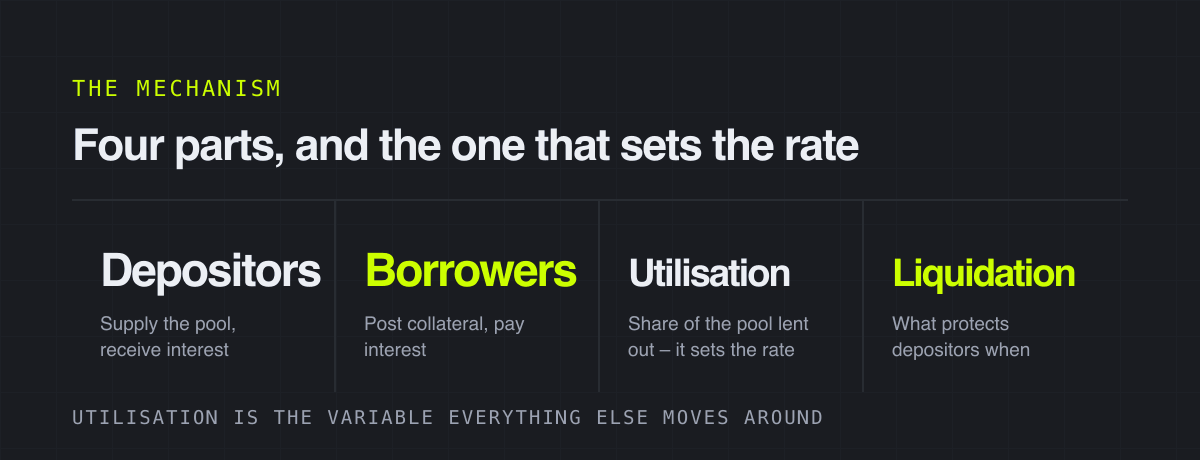
Not by a committee. The rate is a function of utilisation – the share of the pool currently lent out. Low utilisation means idle capital and a low rate; high utilisation means scarce capital and a rate that climbs, often steeply past a threshold designed to pull new deposits in.
So a high supply rate is not generosity. It is the pool telling you that borrowing demand is heavy relative to what has been supplied, and that your capital is in demand right now.
Why anyone borrows
Overwhelmingly, leverage. Post an asset, borrow a stablecoin against it, buy more of the asset. That is the dominant use and it explains the shape of the whole market: borrowing demand rises when people are bullish, which is why lending yields are highest exactly when everything else is.
The honourable minority of borrowing is people who want liquidity without selling – avoiding a taxable event, or keeping exposure while funding something else. Real, and much smaller than the leverage.
What protects the depositor
Over-collateralisation and liquidation. A borrower posts more value than they take, and if the collateral falls far enough, it is sold to repay the loan before the pool is underwater. That mechanism works almost all the time and fails in exactly one scenario: a fall fast enough that liquidation cannot complete at a sufficient price.
| Risk | What it actually is |
|---|---|
| The rate falls | Borrowers deleveraged. Normal, and usually sudden |
| You cannot withdraw | Utilisation hit 100% – your capital is lent out |
| Bad debt | Collateral fell faster than liquidation could run |
| Contract failure | The code, which is the risk no rate compensates |
| Oracle failure | A wrong price triggering or preventing liquidation |
The withdrawal problem nobody expects
Deposits are not always available on demand. If utilisation reaches the top of the range, every dollar is out on loan and withdrawals wait until someone repays or new deposits arrive. The high rate that attracted you is caused by the same condition that can stop you leaving.
On this chain
 Morpho is the lending market in the Robinhood Chain catalogue, and the questions are the same ones that apply anywhere: what collateral is accepted, where the price comes from, what the liquidation threshold is, and how much is sitting unutilised right now.
- Read current utilisation before the rate. It explains the rate and predicts whether you can withdraw.
- Find out which oracle prices the collateral. A lending market is only as sound as its price feed.
- Treat a rate far above the market as information about demand, not as an opportunity someone missed.
- Compare against
 DefiLlama Yields rather than against the protocol's own page.
Tools mentioned
FAQ
How does crypto lending work?
Depositors supply a pool, borrowers take from it against collateral worth more than they borrow, and the interest borrowers pay goes to depositors. The rate is set automatically by utilisation – the share of the pool currently lent out.
Why are crypto lending rates so high sometimes?
Because borrowing demand is heavy relative to supply. Most borrowing is leverage, so rates peak when people are most bullish – and collapse when they deleverage, which is usually the same week everything else falls.
Can I always withdraw from a lending pool?
No. If utilisation reaches the top of its range, every deposit is lent out and withdrawals wait for a repayment or a new deposit. The condition causing the high rate is the condition that can trap you.
What is the main risk in crypto lending?
Bad debt from collateral falling faster than liquidations can execute, and failures in the contract or the price oracle. The borrower defaulting is not really the risk – over-collateralisation handles that in ordinary conditions.
More from the blog
Prediction Markets: A Price That Looks Like a Probability
A contract paying one dollar if something happens trades at the market's estimate of it happening. The gap between that and a forecast is where the money is.
Staking, and Why There Is None on This Chain
Staking pays you for securing a network. An L2 that settles to Ethereum and charges gas in ETH has nothing for you to secure.
Multisig: Removing the Single Point of Failure
Two of three signatures to move anything. It solves theft and loss at once, and introduces a problem of its own.