How to Copy Trade Onchain: The Steps Nobody Writes Down
Choosing who to follow is the part everyone covers. This is the wiring – the settings that decide whether copying a good wallet makes you money.
The short answer
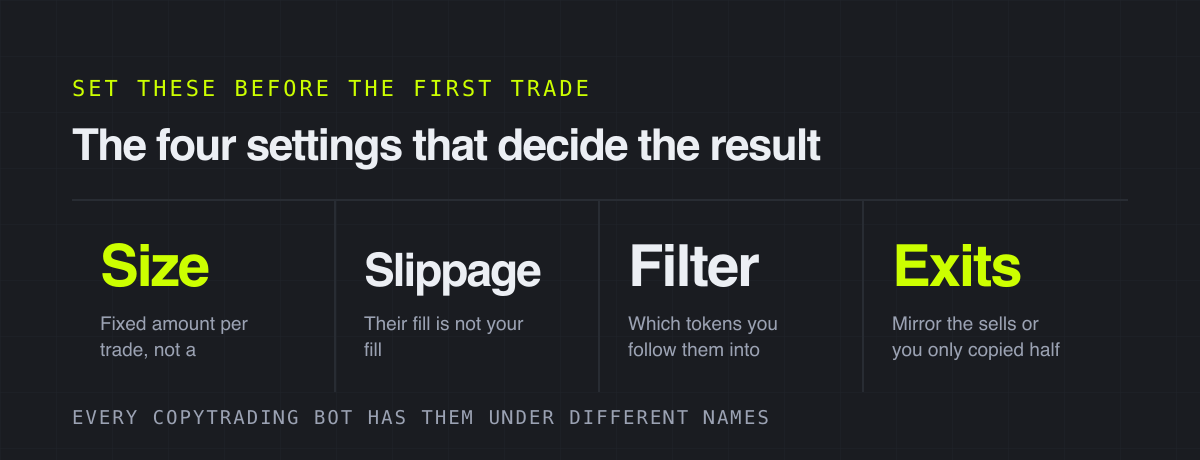
To copy trade onchain you pick a wallet, connect a copytrading bot to it, and set four things: how much of your balance each copied buy uses, the slippage you will accept, which tokens you will follow the wallet into, and whether the wallet's sells are mirrored too. The fourth is the one people leave off, and it is the one that decides the outcome: copying entries without exits turns a trader's round trip into your bag. Start at a size you would be willing to lose entirely, because the first week is a test of the configuration, not of the wallet.
Most writing on copytrading stops at choosing a wallet. That is the interesting half and the smaller half. A well-chosen wallet wired up carelessly loses money, and the ways it loses are boring and repeatable, which means they are avoidable.
Step 1: pick the wallet, then verify it yourself
Leaderboards rank by realized profit and win rate. Both are backward-looking and both can be produced by luck over a handful of trades. Before you follow anyone, read the trade count, the average position size and the hold time, then open two or three of their trades on the explorer and check that the story matches.
Hold time matters more than it looks. A wallet that scalps in ninety seconds is running a strategy you cannot copy with a bot that reacts in five, no matter how good the wallet is.
Step 2: pick the vehicle
There are three shapes. A terminal with copytrading built in keeps the feed and the execution on one screen. A Telegram bot puts the trades where your alerts already are, at the cost of custody in most cases. An alert service copies nothing and only tells you what happened, leaving the decision to you.
Step 3: the four settings
Position size, as a fixed amount
Bots offer two modes: a fixed amount per copied trade, or a percentage matching the leader's. The percentage mode reads as the faithful one and is the trap. Their position sizing reflects their balance and their conviction; a wallet ten times your size taking a two percent swing is asking you for twenty percent of yours.
Slippage, which is the price of arriving late
You are, by construction, behind. The leader's transaction has to land, be observed, and be answered with yours. On a chain producing a block roughly every hundred milliseconds that gap is small, but on a token that moves on every fill it is not nothing. Setting slippage high enough to always fill means agreeing in advance to whatever price your delay produces.
The token filter
A good trader has more than one strategy. The wallet you admire for its launch entries also parks capital in blue chips, rotates stablecoins and occasionally buys something for reasons you would not endorse. Filters – minimum liquidity, minimum age, a category – let you follow the part of their behaviour you actually wanted.
Exit mirroring, the one that decides everything
If the bot copies buys and not sells, you have not copied a trader. You have taken a stream of entry signals from someone whose exit discipline was the reason they made money. Their round trip becomes your position, and you are now holding it with no plan, because the plan belonged to them.
Step 4: what still goes wrong
- The leader's fill and yours differ enough that a trade profitable for them is flat for you. This is normal and it is the cost of the approach, not a fault.
- They add to a position and your bot reads it as a new entry, doubling you in.
- They exit into liquidity that your exit, moments later, no longer finds.
- They stop trading. A wallet going quiet looks identical to a wallet waiting, and the bot cannot tell you which it is.
- They know they are watched. A public address with followers is an address that can be traded against on purpose.
Step 5: size the first week as a test
The first week measures your configuration, not the wallet. Run an amount you would shrug off, then read the result as a comparison: how did your fills compare to theirs, how many trades did the filter block that you would have wanted, how many sells arrived. Adjust once, then leave it alone long enough for the sample to mean something.
What the fee stack actually is
| Layer | What it takes |
|---|---|
| Pool fee | The DEX's own fee on the swap, same as any trade |
| Bot fee | A percentage per copied trade, charged both ways |
| Slippage | Not a fee, but a real and recurring cost of arriving second |
| Gas | Small on an L2, but paid on every mirrored buy and every mirrored sell |
Four layers, two of which apply on the way out as well. A strategy that clears them has to win by more than it looks.
FAQ
How much money do you need to copy trade onchain?
Enough that gas and the bot's per-trade fee are not a large share of each position, and little enough that losing all of it changes nothing for you. In practice that is a small fixed amount per trade rather than a total: the per-trade size is what determines whether the fee stack eats the edge.
Can you copy trade without giving a bot your private key?
Yes, with the vehicles that sign from your own wallet or that only send alerts. Telegram bots that trade from a wallet they generated for you hold the keys, which is the trade you are making for their speed and convenience.
Does copy trading work if the wallet is public?
It works less well the more followers an address has. A wallet that knows it is watched can enter positions it intends to sell into its own followers, and a crowd arriving behind one buy moves the price the crowd is trying to get.
More from the blog
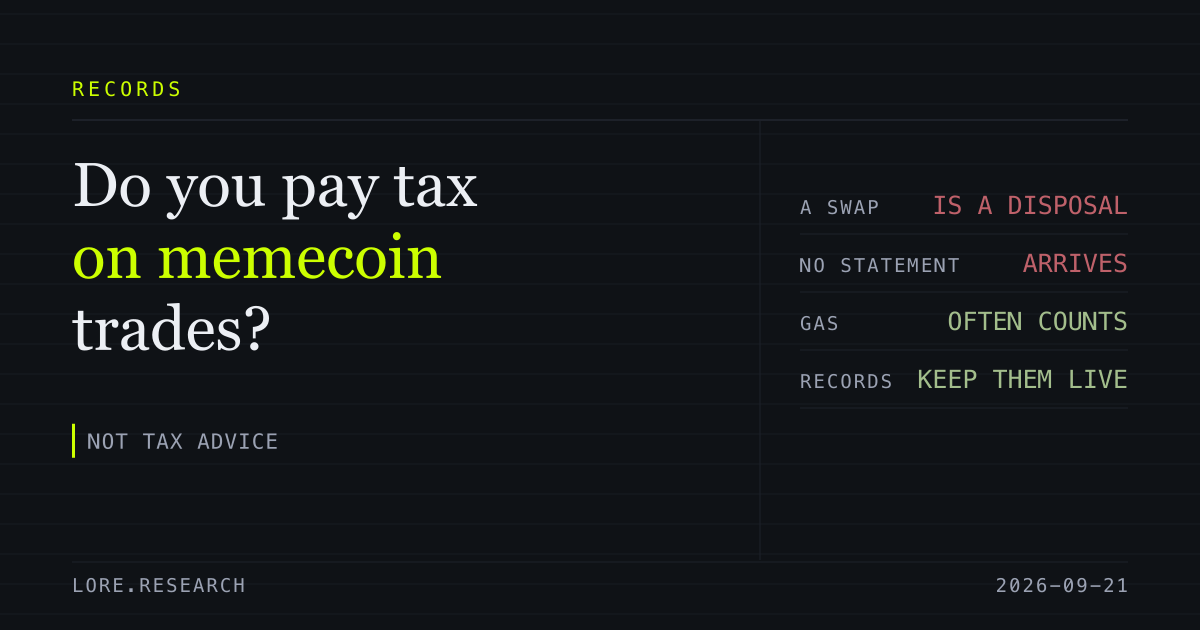
Do You Pay Tax on Memecoin Trades? What Creates an Event
Not advice, and not jurisdiction-specific. A description of which onchain actions tax authorities generally treat as events, and what records you will need if yours does.
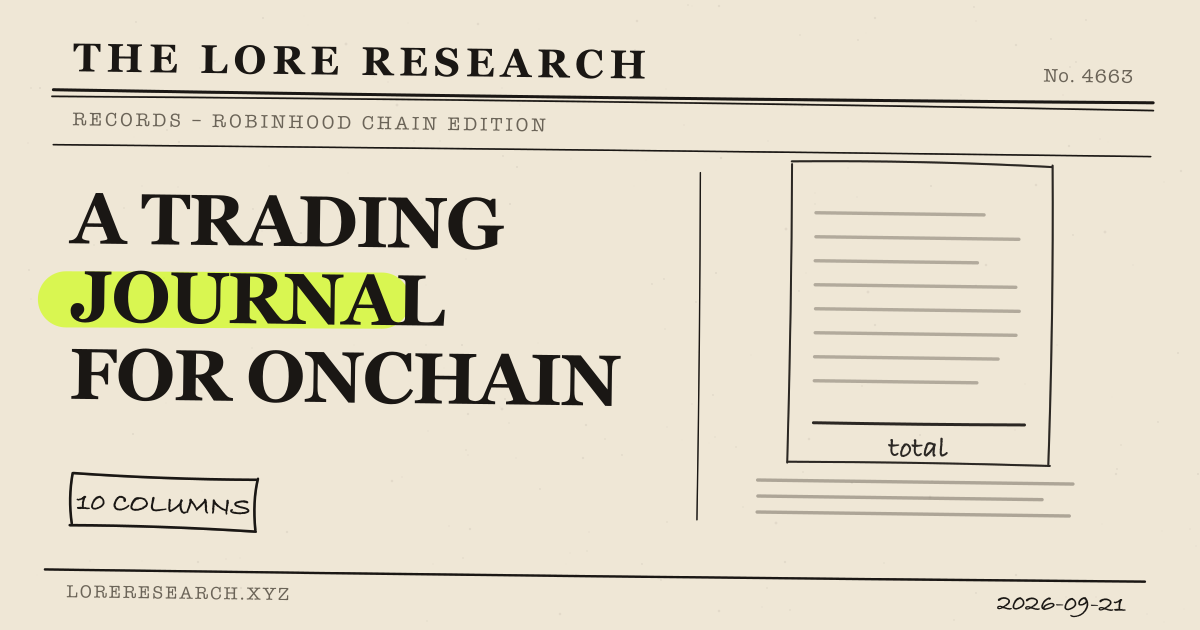
A Trading Journal for Onchain Trades: What to Record
The chain already logs every transaction you made. What it cannot log is why you made it, and that is the column the journal exists for.
Paper Trading Memecoins When No Paper Mode Exists
There is no demo account on a DEX. Here is how to practise anyway – and the one thing simulation can never teach you.