Sniper Bots on a Launchpad: What They Do and Who Wins
A bot that buys in the first block is not a strategy. It is an arms race with an entry fee, against people who have already paid more.
The short answer
A sniper bot watches for new deployments and buys within the first blocks, before the price has moved. It works when you are genuinely faster than everyone else, which requires infrastructure most users do not have – and on a launchpad the earliest buyers are frequently the deployer's own wallets.
Sniping is buying a token in its first moments, before the price reflects that anyone wants it. The logic is sound and the execution is a competition, and most people evaluating a sniper bot are evaluating the wrong component.
What the bot does
Watches for new deployments matching filters you set, and submits a buy as fast as it can once one appears. That is the whole function. Filters vary – minimum liquidity, creator history, keyword matches – and in the mainstream bots,  Maestro and
 Banana Gun among them, the filters are usually the only part a user actually configures.
Why speed is the wrong thing to buy
Because everyone else has bought it too. Sniping is zero-sum against other snipers: the profit comes from being earlier than the next buyer, so an edge exists only relative to the competition. Buying a faster bot moves you up a queue whose other members are also buying faster bots.
The buyers who were already inside
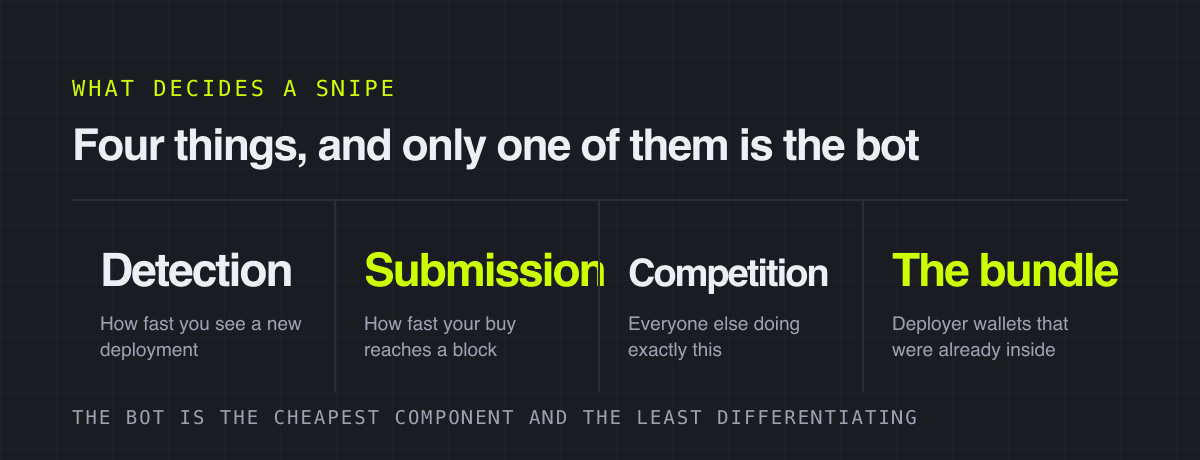
This is the part that decides most snipes and has nothing to do with speed. A deployer who wants the opening float can fund wallets in advance and buy in the same block as the deployment – not by being fast, but by being the one who chose when the deployment happened.
No bot beats knowing the timestamp. Which means that on a meaningful share of launches, the first block is already spoken for and the race you are entering starts in second place.
| Participant | Advantage | Beatable by speed? |
|---|---|---|
| The deployer's own wallets | Knew the launch time | No |
| Professional snipers | Infrastructure and latency | Only by spending more |
| A retail bot user | Filters, and a subscription | That is the race |
| Someone buying ten minutes later | None – and often better prices | Different game |
What the chain changes
Robinhood Chain has no public mempool and produces blocks roughly every hundred milliseconds, which removes the mempool-watching route entirely and compresses the window everything happens in. That changes the shape of the competition rather than ending it – detection and submission still decide the outcome, just through different plumbing.
The alternative nobody sells
Waiting. The case for buying ten minutes after a launch rather than in the first block is that the information is better – the bundle is visible, the holder chart exists, and the contract can be checked – at the cost of a worse price.
- Price the subscription against realistic outcomes, not against the launch you read about.
- Check what share of supply went in the deploy block before concluding the race was fair –
 Bubblemaps clusters the wallets that shared a funder.
- If you snipe, treat the exit as the hard part – entering early with no exit plan is the most common way this loses money.
- Compare against simply buying later with full information. It is a real strategy and it has no subscription.
Tools mentioned
FAQ
What does a sniper bot do?
Watches for new token deployments matching your filters and submits a buy as quickly as possible, aiming to enter before the price reflects demand. The filters are usually the only part a user configures.
Do sniper bots actually work?
They work in the narrow sense of executing fast. Whether they profit depends on being faster than other snipers, which is an arms race where everyone is buying the same advantage – and on many launches the first block already belongs to the deployer's own wallets.
Can you snipe on a chain with no public mempool?
The mempool-watching route disappears, so detection has to come from elsewhere and the window is compressed by fast blocks. That changes the mechanics of the competition rather than removing it.
Is it better to snipe or wait?
Waiting buys information at the cost of price: ten minutes later the bundle is visible, the holder chart exists and the contract can be checked. That is a real strategy with no subscription, and it is rarely presented as the alternative it is.
More from the blog
Prediction Markets: A Price That Looks Like a Probability
A contract paying one dollar if something happens trades at the market's estimate of it happening. The gap between that and a forecast is where the money is.
Staking, and Why There Is None on This Chain
Staking pays you for securing a network. An L2 that settles to Ethereum and charges gas in ETH has nothing for you to secure.
Multisig: Removing the Single Point of Failure
Two of three signatures to move anything. It solves theft and loss at once, and introduces a problem of its own.