Bundled Supply: When a Launch Was Bought in One Block
Two hundred holders in the first minute is not two hundred people. Here is how to tell which one you are looking at.
The short answer
Bundling is when a launch's supply is bought by many wallets in the same block as deployment, usually funded from one source. On a holder chart it looks like instant organic demand; when it sells, it behaves like a single wallet. The difference is visible in the first block's transactions and in where those wallets were funded from.
On a new launch the holder count is the first number anyone looks at, and it is the easiest one to manufacture. Bundling is how it is done: a deployer funds a set of wallets before launch and buys through all of them in the same block the token goes live. Sixty seconds later the chart shows two hundred holders. The reality is one person holding two hundred addresses.
What bundled actually means
A bundle is a group of transactions submitted so that they land in the same block, in an order the sender chose. On chains with a public mempool that is arranged through a block builder. Robinhood Chain has no public mempool, which changes the route but not the outcome – a deployer can still send the buys back to back in the same block as the deployment, and a sequencer producing blocks every hundred milliseconds gives nobody else time to arrive first.
The technical route is not the point. The point is that supply which arrived in the opening block, from wallets funded by the same source, is not demand. It is inventory that has been distributed across addresses.
Why it survives a holder chart
Every check people run on a new token is a check on concentration. Top ten holders, percentage held by the largest wallet, number of unique addresses – bundling is designed to pass all three. Split a third of supply across two hundred wallets and no single one looks alarming, the top ten is unremarkable, and the holder count reads healthy.
How to see it in five minutes
- Open the contract on
 Blockscout Explorer and sort transactions oldest first. The deployment is transaction one; read what lands in that block and the next one.
 - Count the buys in those two blocks and add up what share of supply they took. That total is the bundle, whatever the wallets are called.
- Run the token through
 Bubblemaps. It clusters addresses that share a funding source, which is the part a holder chart will never show you.
 - Check the launchpad's own mechanics.
 PONS and
  hood.fun publish what is sold on the curve and what the deployer keeps, so an unexplained block-one position has to come from somewhere else.
 - Watch whether the cluster has moved since. A bundle that is still sitting is a position; a bundle already distributing is your counterparty.
What the share means
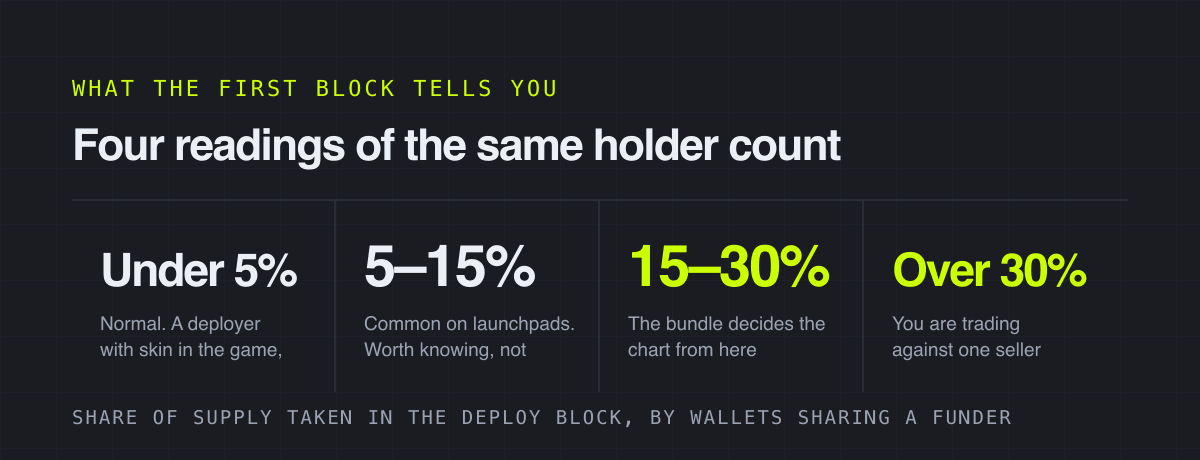
| Bundle share of supply | What it usually is | What it does to your exit |
|---|---|---|
| Under 5% | A deployer buying their own launch, or genuinely fast wallets | Little – the float is real |
| 5–15% | Standard practice on most launchpads | A ceiling you should know about |
| 15–30% | A coordinated launch with the chart pre-arranged | The cluster decides when the top is |
| Over 30% | One seller distributed across a crowd of addresses | You are exit liquidity by construction |
Bundling is not automatically a scam
A deployer buying their own token at launch is not fraud, and on several launchpads it is disclosed. Teams bundle to stop snipers taking the entire opening float, which is a real problem with a real cost. The question worth asking is not whether a bundle exists but whether it was disclosed, how large it is, and whether it has started moving.
The dishonest version is the one presented as organic demand – a holder count in the marketing, a chart that went vertical in the first minute, and no mention that one wallet paid for all of it.
What to do with the number
- Treat bundled supply as float that can arrive at any price, and size as though it will.
- Set your exit against the cluster's cost basis, not against a round number – they are in profit long before you are.
- Re-check after a move. A bundle that stayed still through a 3x is a different signal from one that sold into it.
- If the share is above 30% and undisclosed, the honest read is that the chart is someone's plan rather than a market.
None of this tells you the token will fail. Plenty of bundled launches run for weeks. It tells you who is on the other side of your trade, which is the one thing the holder count was hiding.
Tools mentioned
FAQ
What does bundled mean for a memecoin?
That a group of wallets bought the token in the same block it was deployed, funded from the same source. The holder count goes up immediately, but the supply is controlled by one party rather than spread across many buyers.
Is bundling illegal?
It is not illegal and on many launchpads it is expected – teams bundle to stop snipers taking the whole opening float. What matters is the size of the bundle and whether it was disclosed. Presenting a bundle as organic demand is the dishonest version.
How do I check if a token was bundled?
Open the contract on Blockscout, sort transactions oldest first and count the buys in the deployment block and the one after. Then run the token through Bubblemaps, which clusters wallets that share a funding source.
What bundle percentage is too high?
Above roughly 30% of supply the cluster decides the chart, because they can sell more than the market can absorb at any price they choose. Between 5% and 15% is common enough to be unremarkable.
More from the blog
Tokenized Bonds Beyond Treasuries: Credit, Coupons and Who May Hold Them
A tokenized treasury is a short government loan with no credit question. Everything else in the bond market has one, and it changes the product.
Tokenized Private Credit: The Yield Is Someone Else's Loan
The highest yields in RWA come from the part with no public market, no daily price and no easy exit. That is not a coincidence.
Tokenized Commodities: What Is Behind the Barrel
Gold sits in a vault. Oil does not sit anywhere convenient, which is why almost every oil token is a fund and not a barrel.