Market Cap vs FDV: Why the Two Numbers Disagree
One counts what exists, the other counts what will exist. When they are far apart, the gap is a schedule of future selling with your name on the other side.

The short answer
Market cap is price times circulating supply – the tokens that exist and can trade today. Fully diluted valuation is price times total supply, including tokens not yet unlocked or minted. A project with 10% of its supply circulating shows a market cap ten times smaller than its FDV, and the gap is not an accounting curiosity: it is tokens that will arrive on the market later, usually held by people who paid less than you. On memecoins the two are often identical because supply is fixed at launch, which makes the ratio a fast way to tell what kind of token you are looking at.
Two numbers sit next to each other on every token page and they frequently differ by a factor of ten. Neither is wrong; they answer different questions, and knowing which question you are asking is most of the skill.
The definitions, briefly
| Formula | Answers | |
|---|---|---|
| Market cap | Price × circulating supply | What is this worth at today's price, counting only what exists |
| FDV | Price × total supply | What would it be worth at today's price if everything existed now |
Circulating means tokens that are actually out and tradable. Total includes what is locked in vesting contracts, held by the team, reserved for a treasury, or simply not minted yet.
Why the gap matters
Because locked tokens do not stay locked. A schedule exists, it is usually public, and every unlock puts supply into the market at whatever price prevails that day. If eighty percent of the supply is yet to arrive, you are buying into a token whose float is going to multiply, and the people receiving those tokens generally have a much lower cost base than you.
Where FDV misleads in the other direction
FDV assumes every token arrives at today's price, which is rarely how it works – large unlocks tend to move the price they arrive into. Treating FDV as a prediction of value overstates it. It is better read as a measure of dilution ahead, not as a valuation.
It also breaks entirely on tokens with no fixed total supply. If more can be minted, total supply is a decision rather than a number, and any FDV computed from it is a snapshot of somebody's current intention.
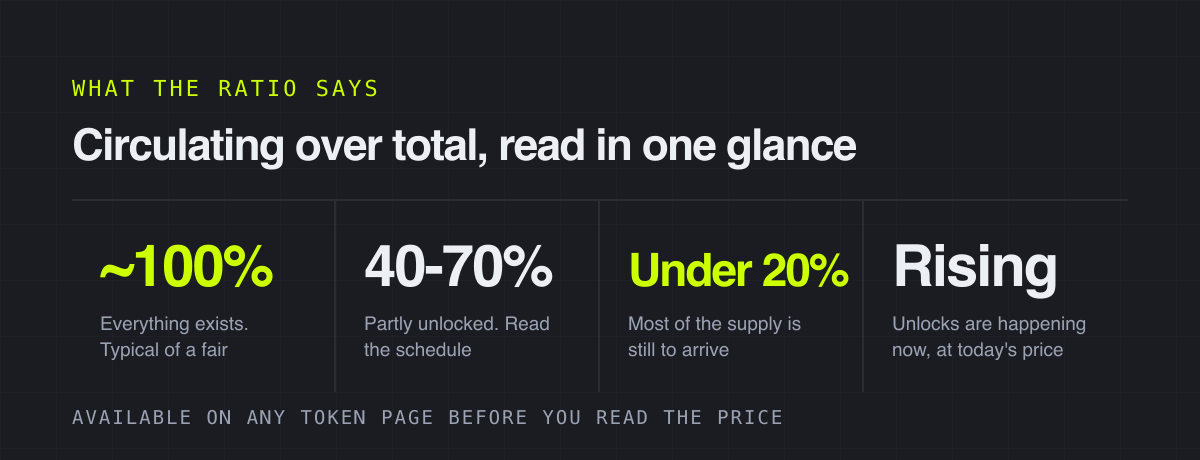
On memecoins the ratio is usually 1
A token launched with its entire supply minted at once and thrown into a pool has no vesting, no treasury and no unlock schedule. Market cap and FDV are the same number, and the divergence question disappears.
Which makes the ratio a quick classifier. Identical numbers means the supply is all here and your risk is concentration – who holds it – rather than dilution. A large gap means the opposite, and the two demand completely different checks.
What to do with both numbers
- Read circulating over total first. One number, and it tells you which kind of token this is.
- If the ratio is near 1, stop asking about dilution and go look at holder concentration instead.
- If the ratio is low, find the unlock schedule before anything else, and note the next large date.
- Compare FDV rather than market cap when comparing two projects at different points in their schedules.
- Treat any market cap computed on a thin pool as fiction regardless of the ratio – a price with no liquidity behind it multiplies into a meaningless number.
FAQ
What does FDV mean in crypto?
Fully diluted valuation: the token's price multiplied by its total supply, including tokens that are locked, vesting or not yet minted. It answers what the project would be worth at today's price if every token already existed.
Is a low market cap to FDV ratio good or bad?
It is a warning to read the unlock schedule, not a verdict. A low ratio means most of the supply has yet to reach the market, and it will arrive held by people whose cost base is usually far below yours.
Why are market cap and FDV the same for memecoins?
Because the entire supply is normally minted at launch and placed straight into a pool, with no vesting, treasury allocation or future minting. There is nothing left to dilute, so the two figures coincide – and the risk moves from dilution to who holds the supply that exists.
More from the blog
Is Crypto Arbitrage Profitable? Yes, and Not for You
The opportunity is real and it is measured in milliseconds. By the time a price difference is visible on a screen, it has been taken.
What a DEX Aggregator Does, and When It Costs You
It searches every pool for the best route and splits your trade across them. That is worth real money on a large order and worth nothing on a small one.

Token Approvals: The Permission You Forgot You Gave
Every swap asks for permission to move a token, and most of those permissions are unlimited and permanent. They stay live long after the trade is done.