Is Crypto Arbitrage Profitable? Yes, and Not for You
The opportunity is real and it is measured in milliseconds. By the time a price difference is visible on a screen, it has been taken.
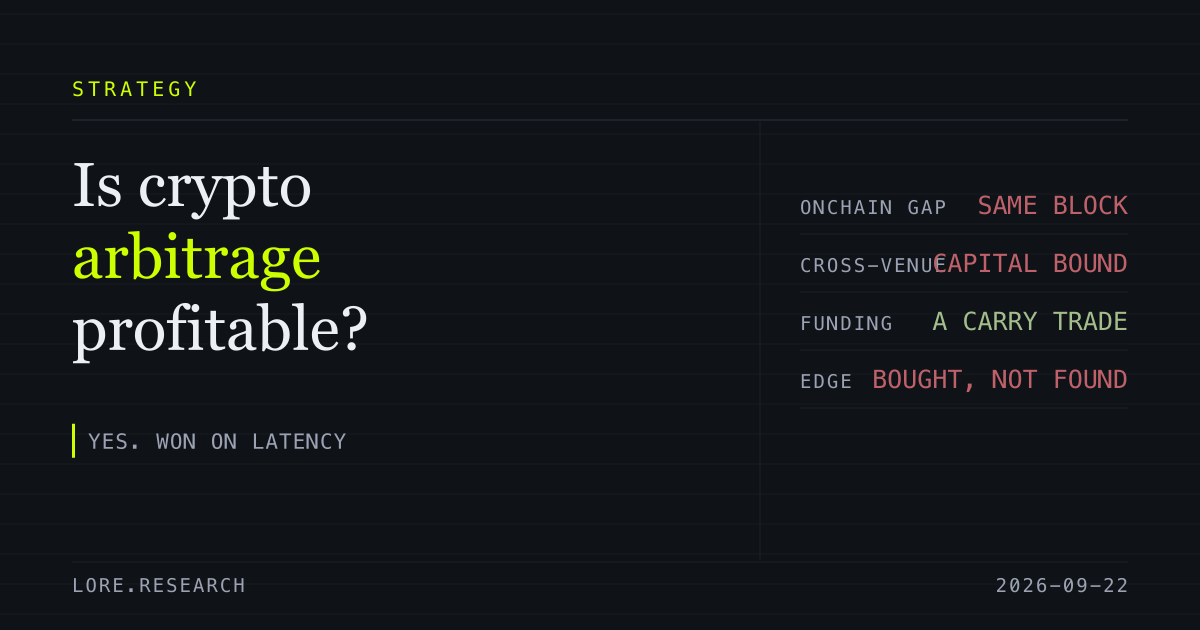
The short answer
Arbitrage is consistently profitable and it is won by infrastructure, not by analysis. Onchain, a price difference between two pools is closed in the same block by bots that pay for position in the ordering, so a gap visible on a chart has already been taken. The versions still available to an individual are slower and have real costs: cross-exchange arbitrage needs capital pre-positioned on both venues and is limited by withdrawal times, and funding-rate arbitrage is a carry trade with liquidation risk, not a riskless one. The honest summary is that the edge is a latency edge and latency is bought.
The question gets asked because the idea is genuinely sound: the same asset at two prices is free money, and crypto has thousands of venues that do not talk to each other. The idea is correct. The conclusion people draw from it usually is not.
Onchain arbitrage: real, and already gone
When one pool prices a token differently from another, a single transaction can buy in one and sell in the other. This is one of the largest categories of extractable value on any chain, and it is competed for by software that exists solely to do it.
The competition is resolved in the ordering of transactions within a block. By the time a difference is large enough to see on a chart, it has been closed – not minutes ago, in the same block. There is no version of this a person executes by hand.
Cross-exchange arbitrage: available, and capital-bound
Prices do differ between venues for longer than a block, because moving assets between them is slow. That is exactly why the gap persists, and it is also why capturing it is harder than it looks: to trade the difference instantly you must already hold both assets on both venues.
Which means the strategy is not 'spot a difference and act'. It is 'pre-position capital on several venues, keep it there idle, and act on differences when they appear'. The returns have to be measured against that idle capital, and against withdrawal delays, transfer fees, and the risk of holding balances on venues you do not control.
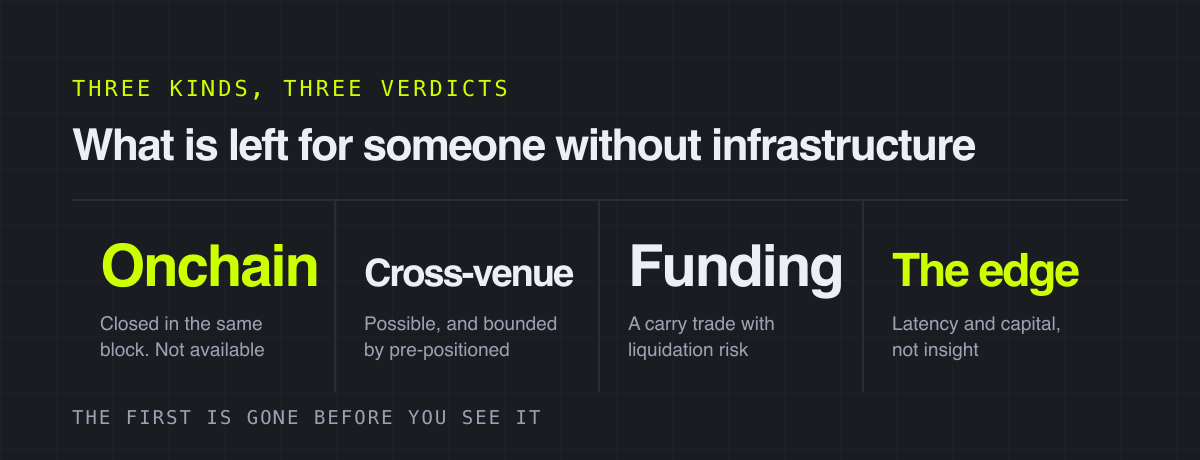
Funding-rate arbitrage: a carry trade wearing a costume
Hold spot, short the perpetual against it, collect funding while carrying no directional exposure. This is the most commonly recommended version and it does work – but calling it arbitrage oversells it. The rate can turn against you while you hold. The short leg needs margin and can be liquidated by a wick your spot leg does not protect you from. And the quoted returns come from periods of high funding, which are periods when the trade is crowded.
What the costs actually are
| Cost | Why it bites |
|---|---|
| Latency | Onchain, the entire outcome. Position in the block is bought |
| Idle capital | Cross-venue, returns are on total deployed, not on the trade |
| Transfer time | The reason the gap exists is the reason you cannot close it quickly |
| Fees, both sides | Every arbitrage is two trades, and small spreads do not survive them |
| Counterparty | Balances sitting on venues you do not control, indefinitely |
| Liquidation | On any version with a leveraged leg, regardless of being hedged |
So is it profitable
Yes, reliably, for participants whose edge is infrastructure: co-located execution, capital across venues, and automation that never sleeps. The profitability is real and it is theirs. For an individual with a browser and a normal balance, the honest answer is that the opportunity visible to you has been priced by someone faster, and the versions that remain are carry trades with risks that deserve to be named rather than arbitrage in the sense the word promises.
FAQ
Is crypto arbitrage still profitable in 2026?
Yes, for participants competing on infrastructure. Onchain price differences are closed within the same block by automated systems, so the profitability is real but it accrues to whoever is fastest and has capital in position, not to someone reacting to a visible gap.
Can you do crypto arbitrage manually?
Not the onchain kind – it is decided in the ordering of transactions inside a block. Cross-exchange arbitrage is possible by hand but requires capital already sitting on both venues, because the transfer time that creates the opportunity also prevents you from capturing it reactively.
Is funding rate arbitrage risk free?
No. It removes directional exposure, not risk. The funding rate can flip while you hold, the short leg carries liquidation risk on a wick even when the spot leg is unaffected, and holding balances across two venues adds counterparty exposure to both.
More from the blog
What a DEX Aggregator Does, and When It Costs You
It searches every pool for the best route and splits your trade across them. That is worth real money on a large order and worth nothing on a small one.

Token Approvals: The Permission You Forgot You Gave
Every swap asks for permission to move a token, and most of those permissions are unlimited and permanent. They stay live long after the trade is done.

Rabby vs MetaMask: One Shows You What You Are Signing
Both connect to the same chains and hold keys the same way. The difference is a single screen, and it is the screen where money is lost.