Crypto Phishing: The Signature That Empties a Wallet
Nobody guesses a seed phrase. They get you to approve something, on a page that looks exactly like the one you meant to open.
The short answer
Onchain phishing rarely tries to steal a seed phrase. It gets you to sign something: an unlimited token approval, a Permit signature that authorises spending without an onchain transaction, or a transfer dressed up as a claim. The delivery is a convincing copy of a site you use, reached through a paid search result, a reply under a real announcement or a direct message about an airdrop. The defence is not vigilance, which fails on the day you are tired – it is a wallet that simulates what you are about to sign, a trading wallet holding nothing you would miss, and treating every unexpected message as the attack it usually is.
The mental model most people carry is of someone stealing a password. That is not how funds leave a wallet onchain. They leave because the owner authorised it, on a page that looked right, in a moment that felt normal.
What you are actually asked to sign
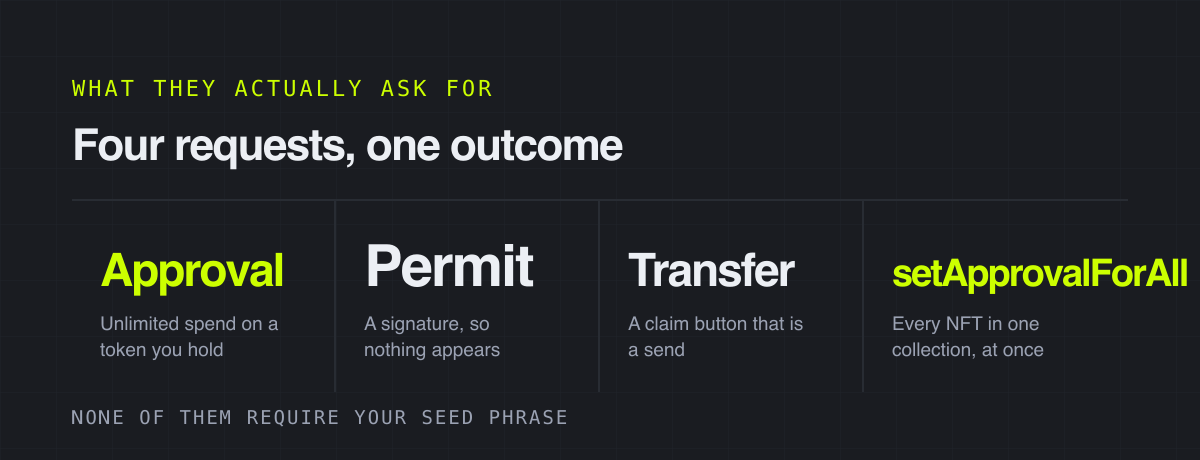
An unlimited approval
The same mechanism every legitimate swap uses, pointed at a contract that will spend your balance later. It looks identical to a routine approval because it is one.
A Permit signature
This one is worse, because it is not a transaction. Permit lets you authorise spending with a signature alone – no gas, nothing onchain, nothing in your history to notice afterwards. A wallet showing you a block of hex has told you nothing, and the approval-revoking tools will not list it, because there is nothing onchain to list.
A transfer wearing a claim button
The page says Claim. The transaction sends. On a confirmation screen that does not simulate, the difference is a function name most people do not read.
How it reaches you
- A paid search result above the real site, for the exact name you typed.
- A reply under a genuine announcement, from an account with a copied name and photo, posted within a minute of the original.
- A direct message about an airdrop, a support ticket you did not open, or a collaboration offer with a link.
- A token that appears in your wallet on its own, whose page you have to visit to sell – that visit is the attack.
- A bookmark you saved once, to a domain that later changed hands.
What actually works
- A wallet that simulates before you sign and shows balance changes in plain language –
 Rabby does this, so an approval you did not intend is visible as an approval rather than as hex.
 - A trading wallet that holds only what you are trading. An unlimited approval on an almost empty wallet is an unlimited claim on almost nothing.
- Holdings in a separate wallet that never connects to anything new, and ideally never connects at all.
- Approvals cleared periodically with
 Revoke.cash, which closes the onchain half of the exposure.
 - Reaching sites through your own bookmarks rather than through search, which removes the paid-result vector entirely.
The one rule that covers the rest
Nothing legitimate arrives unexpectedly and needs your signature within the hour. Airdrops that are real stay claimable. Support does not message first. A deadline in an unsolicited message is not a deadline, it is the method – urgency exists in these messages specifically to stop you doing any of the five things above.
Tools mentioned
FAQ
How do crypto phishing attacks actually work?
They get you to sign something rather than to reveal a seed phrase – usually an unlimited token approval, a Permit signature, or a transfer disguised as a claim. The site is a convincing copy of one you already use, reached through a paid search result, a reply under a real announcement, or a direct message.
Can revoking approvals undo a phishing attack?
It prevents further spending through an onchain approval, but it does not reverse a transfer that already happened, and it does not touch Permit signatures – those authorise spending without anything onchain, so no revoking tool can list them.
What is the best protection against wallet phishing?
Structure rather than vigilance. Trade from a wallet holding only what you are trading, keep holdings in a wallet that never connects to anything, use a wallet that simulates transactions before signing, and reach sites through your own bookmarks instead of search results.
More from the blog
Arbitrum Orbit: The Stack Robinhood Chain Is Built On
Not a brand on a box. A specific set of choices about who orders transactions, where the data goes, and what you are trusting when you bridge in.
What Volume Means, and When the Number Is Manufactured
Volume is how much traded, not how many wanted to. Two wallets with a script can produce a week of it in an afternoon.
How to Swap Tokens, and the Four Screens That Matter
The swap itself is two clicks. Everything that decides whether it was a good one happens on the screens around it.